Salesi Moa, a recruit previously committed to Utah who entered the transfer portal on Monday, Jan. 12, has committed to the Wolverines, he announced at the Polynesian Bowl in Honolulu on Friday, Jan. 16.
Advertisement
Advertisement
Advertisement
The 6-foot-1, 190-pound athlete from Ogden, Utah, was one of the premiere recruits in the class of 2026. The four-star recruit is the No. 1 player in Utah, No. 3 athlete in the nation and No. 45 player overall, according to 247 Sports’ composite rankings.
Moa is the fifth former Utah player or recruit to come to Michigan since the program hired Kyle Whittingham on Dec. 26.
Salesi Moa, Class of 2026 athlete who plays at Freemont High School and is from Ogden, Utah.
Moa was aggressively recruited by the previous Wolverines staff. He had U-M in his final handful of schools and visited Ann Arbor during U-M’s 27-9 loss to Ohio State on the final weekend of November. He then committed to Tennessee, then flipped to Whittingham in his home state.
Advertisement
Advertisement
Advertisement
That was before Whittingham stepped down as the Utes‘ head coach. Since than, he has been hired in Ann Arbor, and brought with him EDGE coach Lewis Powell – Moa’s uncle.
There could be more family connections to come: Moa’s brother, Aisea, a linebacker who previously played for Michigan State, has also been targeted by the Wolverines this cycle.
Whittingham also brought former Utah wide receivers coach Micah Simon with him. Listed as an athlete, Salesi Moa projects to play wide receiver – the position he was going to play for Simon in Provo. U-M’s previous staff originally recruited him as a defensive back.
Moa starred at both Weber and Fremont high schools, amassing 226 career catches for 3,757 yards and 44 touchdowns. That included a 2025 senior campaign in which he had 63 catches for 1,272 yards (20.2 yards per catch) and 16 touchdowns. He also played defense as a senior and recorded 57 tackles and three interceptions.
Advertisement
Advertisement
Advertisement
“Productive two-way athlete with slick athleticism that could play on either side of the ball in college, but might make the most sense at wide receiver,” wrote 247 Sports’ Andrew Ivins. “Finds ways to slip behind defenders and race into the deeper third as he’s a technically advanced route runner that can mix gears and create separation.
“Might not profile as a true WR1, but can emerge as a trusted option at the Power Four level with his skill set.”
Kyle Whittingham speaks at a news conference introducing him as the new Michigan Wolverines head football coach at the Hyatt Regency Orlando on Dec. 28, 2025 in Orlando, Florida.
Michigan has loaded up on wide receivers this cycle, first landing former Texas wideout Jaime Ffrench Jr. and more recently receiving a commitment from former Utah tight end JJ Buchanan, who will also join Simon’s unit.
Advertisement
Advertisement
Advertisement
The Wolverines have made a concerted effort to surround quarterback Bryce Underwood with talent – they brought back five of their top offensive line recruits plus running back Jordan Marshall, then added five-star incoming freshman Savion Hiter into the backfield with him.
Tony Garcia is the Wolverines beat writer for the Detroit Free Press. Email him at apgarcia@freepress.com and follow him on X at @RealTonyGarcia.
The expansion more than doubles the size of Deer Valley Resort, adding close to 2,700 acres with about 100 new runs and 10 new chairlifts, including a 10-person gondola.
PARK CITY, Utah — Just off Route 189, about 15 minutes from Park City to the north and Heber City to the south, lies a new access point to Deer Valley Resort. This portal leads skiers to a huge swath of terrain open for the first time this year as part of the ski resort — well, not entirely open yet, but it will be as soon as Mother Nature cooperates.
This massive expansion more than doubles the size of Deer Valley Resort, adding close to 2,700 acres (bringing the overall terrain to 4,300 acres) with about 100 new runs and 10 new chairlifts, including a 10-person gondola that whisks people from the new Deer Valley East Village to the top of Park Peak. Deer Valley claims it’s the largest-ever ski resort expansion in North America.
Locals, property owners with slopeside homes, and those in the know have accessed Deer Valley from this quieter side for years — hopping on the nearby Jordanelle Express Gondola up to Little Baldy Peak and beyond — to avoid the Park City morning bustle (I’ve used this access point myself while staying in the town of Midway or Heber City). Now, visitors can make the East Village their home base for exploring a whole new side of the resort while still being able to connect to Deer Valley’s existing terrain.
You can reach the East Village from Salt Lake City International Airport in about 45 minutes — and, as locals like to say, without hitting one stop light. Bring your Ikon Pass, if you have one, and ski at Deer Valley for seven days, but make reservations in advance (the Ikon Pass works at nine New England resorts, including Stratton, Sugarbush, Killington, Sunday River, Sugarloaf, and Loon).
Alterra Mountain Company purchased the new terrain for Deer Valley in 2023 and set to work installing new lifts, planning the base village area, and creating and naming the new trails. Since Park City got its start as a silver and lead mining town, most of the new runs were named after mining claims or mining terms. Trails in the Pinyon kids’ area are named after historic mining claims with playful names such as Clipper Junebug, and Straddlebug, while the Deep Enuf run off Park Peak is named in honor of the general manager of the Mayflower Mine, who signed his emails “Deep enuf and well timbered,” meaning the tunnels were dug deep enough for mining and well supported, or “well timbered.” The Green Monster name dates back well before Fenway’s scoreboard wall was painted green in 1947. Deer Valley’s Green Monster trail reportedly gets its name from an early 1900s Wasatch County mine that had a streak of green malachite (a copper ore) on its cliff face.
From the Homeward Bound run on Bald Mountain, visitors can look toward Deer Valley Resort’s new terrain (pictured here), which includes views of Park Peak and two new chairlifts — the new Revelator Express and Pinyon Express, which connects the new and original areas of the resort.Handout
From the East Village, beginner skiers can lap the new Hoodoo Express at the base area to gain confidence and basic skills (ski school will run all its beginner lessons in this area); hop the Pioche Express up to Pioche Point and enjoy longer, meandering green runs (with a couple of short intermediate blue trails as optional alternatives); or load onto the gondola (which has individual heated seats) and ride 3,000 feet up to Park Peak where they can access multiple green runs off the summit, including the 4.85-mile-long Green Monster — now the longest ski run in Utah — which takes skiers back to the base area.
What’s special about Park Peak: Beginners can ride up to 9,350 feet — the second-tallest summit in the resort, behind the intermediate- and expert-only Empire Peak, at 9,570 feet — for sweeping views across the Wasatch Mountains. Also, all levels can ski 360 degrees off Park Peak’s summit — it’s open and skiable in every direction.
Intermediate skiers have plenty of options from the gondola’s midway point at Big Dutch Peak, from Park Peak’s summit, and off the new Keetley Express, while expert skiers can enjoy the challenging black diamond chutes off Redemption Ridge east of Park Peak’s summit. The new 6-person heated bubble chairlift, Pinyon Express, connects the new terrain (from just below Park Peak summit) to the existing ski area (just above Ontario Bowl on Flagstaff Mountain).
The geothermal-fed pool inside a natural dome in the town of Midway, about 25 minutes from Park City, Utah, draws visitors who come here to float in the mineral-rich waters. The 66-foot-deep pool also draws SCUBA divers who come to practice diving and get their certification in the warm (95-degree) waters.Kari Bodnarchuk
Currently, the East Village has a temporary structure serving as a base lodge where — as soon as everything is up and running — you can get hot lunches (elk chili, the resort’s renowned turkey chili, burgers, and more), rent ski gear, and sign up for lessons. The village’s only open hotel, the 381-room Grand Hyatt Deer Valley, has a restaurant, a speakeasy, a game room with old-school arcade games (think Ms. Pac-Man), a spa, outdoor hot tubs next to a heated pool, and outdoor fire pits for roasting s’mores. Its view of the ski area will disappear once the new Four Seasons Private Residences are complete, but honestly, it’s the Grand Hyatt’s expansive, million-dollar view of the Jordanelle Reservoir and Uinta Mountain Range to the east that you won’t forget.
Eventually, the village will have two five-star hotels, private homes, and condos that will be part of Deer Valley’s rental pool, an outdoor ice-skating rink, and a full-fledged base lodge. All of that is still in the works, so it’s currently a construction zone with one hotel, a temporary base lodge, and plenty of day parking with space for 1,200 cars.
My daughter and I traveled to Park City right before the holidays for a mother-daughter ski getaway and a visit with local relatives. Even though the new terrain wasn’t open yet (not enough snow), we still found decent snow on Bald Mountain for a couple of hours of skiing each morning (thanks to the resort’s snowmaking efforts) and plenty to do in the afternoons off the slopes.
One of the area highlights included a visit to what locals call the Homestead Crater, a geothermal mineral pool inside a beehive-shaped dome at The Homestead property in Midway, a town about 25 minutes from Park City. (Midway is often referred to as Little Switzerland because of the dramatic mountain views and its Swiss architecture and heritage.) The natural limestone dome measures 400 feet in diameter and 55 feet tall, and it has a natural hole in the top. Follow the steps up the outside of the dome and peer down into it, or walk through a short tunnel inside the dome and go for a swim in the mineral-rich waters. The 66-foot-deep pool and toasty (95-degree) waters draw SCUBA divers who come here to get their SCUBA certification.
Utah Olympic Park near Kimball Junction (15 to 20 minutes from both the East Village and Park City) is worth a several-hour stop to visit the small ski and Olympic museums, tour the ski jump and bobsled tracks, go for a real bobsled run (it’s dramatic, but over within 50 seconds), and learn about Park City’s Olympic past and future — it hosted the 2002 Winter Olympics and will again host the Winter Olympics in 2034. The free museums display historic ski and snowboard gear, showcase Olympic heroes, and have a mountain sport simulator that lets you experience virtual bobsled and ski runs.
Visitors make s’mores at an outdoor firepit at the Grand Hyatt Deer Valley, the first completed hotel in the new Deer Valley East Village, about 15 to 20 minutes from Park City. The hotel has stunning views of the Uinta Mountains, a game room with vintage arcade games, and a speakeasy.Kari Bodnarchuk
Go on a one-hour shuttle tour of Olympic Park, and you can stand at the top of the ski jumps and bobsled track and learn about the locals and Olympic hopefuls who train here. Then climb into a bobsled with a professional pilot who will steer you and two other riders — wearing helmets — through five turns on the track — one of only three operational bobsled tracks in North America (in addition to Lake Placid and Whistler).
Finally, you can’t visit the area without a stop at the Park City Museum on Main Street, where you can learn about the city’s early settlement and mining history (a cool diorama with a light display shows you where the different mines existed underground, with more than 1,000 miles of tunnels). Sit in an old rai car and learn about the electric mine train that carried skiers and their gear three miles into the mountain through an old mining tunnel and then hoisted them 1,800 feet to the surface on “the world’s first underground ski lift” — a clever but short-lived operation due to the cold, wet conditions.
Hopefully, the new trails will be open by the time you read this — or soon thereafter — but you’ll still find plenty of good skiing on Deer Valley’s “OG” slopes and unique activities around this historic region.
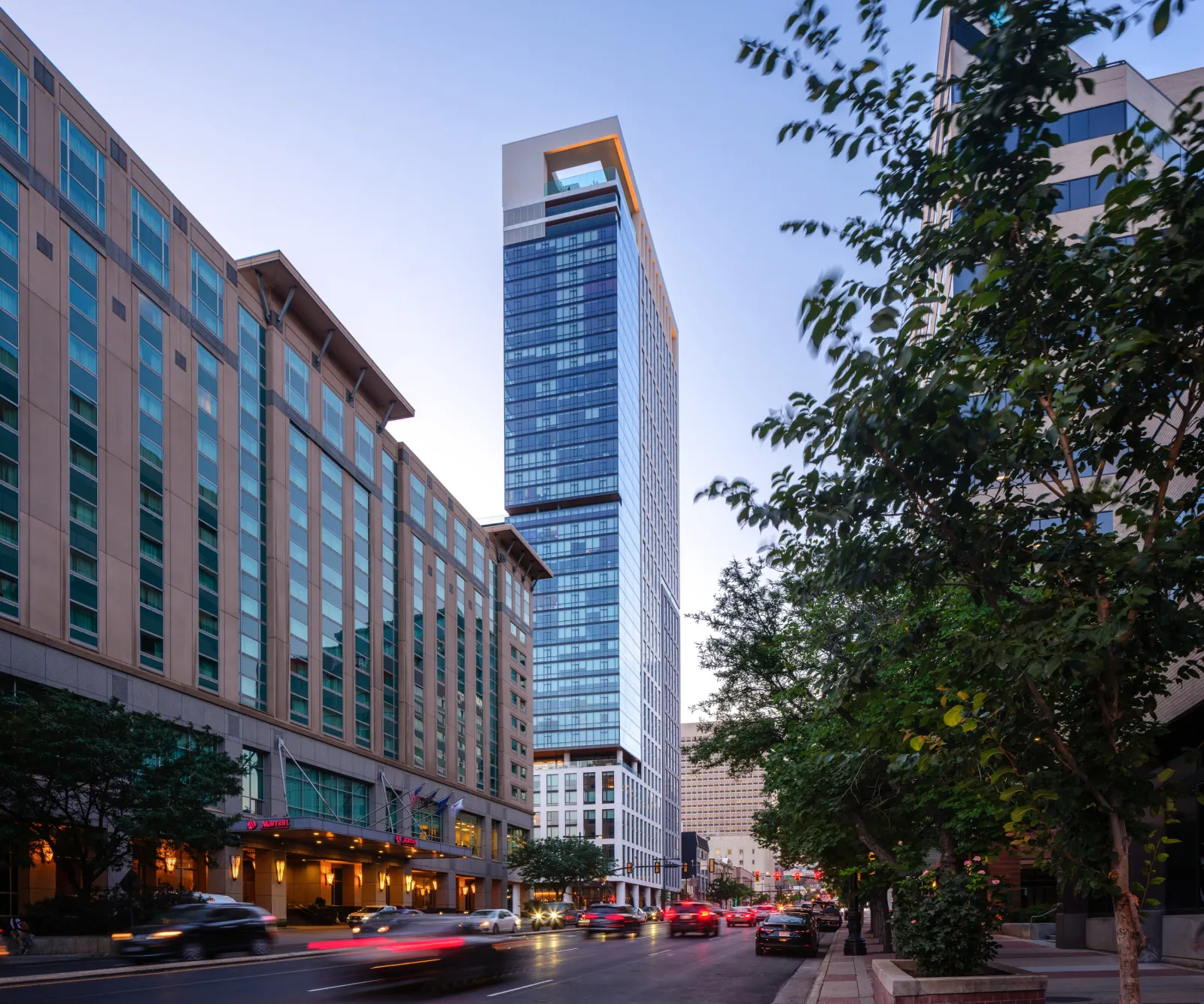
The façade lighting at the top of the imposing tower in Salt Lake City changes color depending on the air quality.
Salt Lake City’s skyline has a striking new focal point—the Astra Tower, a 451‑foot residential skyscraper, the illuminated crown of which serves not just as an architectural flourish but as a real‑time air quality monitor for the entire city.
Designed by global architecture firm HKS, the tower overtakes the 422‑foot Wells Fargo Center—also by HKS—as the tallest building in Utah.
Offering 372 residential units and over 40,000 square feet of amenities, including a rooftop pool, the building also boasts a color‑changing LED lighting display at its crown, which is rooted in the valley’s unique environmental conditions.
Architect Emir Tursic, a partner and office director for HKS Salt Lake City, told Newsweek: “Ironically, the same mountain range that makes the Salt Lake Valley so striking also contributes to one of its greatest environmental challenges. Winter inversions trap pollution and off-gassing in the valley, making air quality the region’s most significant environmental threat.”
A LED Crown That Communicates With the City
According to Tursic, the air quality‑responsive crown was born from a challenge issued by developer KIC (Kensington Investment Company). “KIC challenged HKS to address this issue not only within the building itself, but beyond the project boundary—using design as a platform for awareness and engagement,” the architect said.
He explained that Astra’s illuminated façade draws on the long tradition of Salt Lake City buildings that broadcast weather conditions through exterior lighting. Now, instead of weather, Astra signals air quality. Leveraging its prominence on the skyline as a civic signal, “Astra’s façade lighting changes color in accordance with the air quality index, making environmental conditions visible and fostering broader public awareness,” Tursic said.
Sensors at the top of the tower, where there is an open terrace illuminated by LED lights, measure the air and shift the lighting tone from white to purple, based on data from the Environmental Protection Agency and National Oceanic and Atmospheric Administration, to show the level of outdoor pollution.
Sustainability Systems Embedded Throughout the Tower
Beyond its LED crown, Astra incorporates a wide suite of engineering and sustainability strategies.
Tursic notes that the building “pairs its headline LED air-quality crown with a broader set of sustainability and resilience moves that support wellness-oriented, high-density living.”
The tower’s underlying structure reflects this philosophy. Made with an “efficient vertical organization and performance-based design,” Tursic said the building’s layout and major systems were approached with carbon, energy, and resource reduction in mind from the very beginning.
That structural framework was also engineered for long‑term resilience. According to Tursic, “the structural system was engineered to industry-leading performance standards, beyond prescriptive code, and designed to withstand significant seismic events, supporting long-term durability and climate resilience.”
A Building That Cleans the Air
One of Astra’s most notable innovations is its city‑scale air filtration concept. “A central air intake with filtration supplies ducted, filtered air to all units, and the building is designed to filter polluted outdoor air and improve it before releasing it back into the atmosphere—effectively acting as an air purifier for the city,” Tursic said.
Inside, residents also benefit from “smart air-quality awareness beyond the crown,” he explained. “Air-quality sensors are connected to elevator and lobby screens, so residents get real-time information inside the building, in addition to the exterior lighting signals.”
Engineering for Energy Efficiency
The skyscraper’s environmental strategy extends into its mechanical systems. It features a “high-performance ventilation and heat recovery” approach, including “demand control ventilation, an air-side heat recovery system, and a water-side heat recovery system to reduce energy use while maintaining indoor comfort and air quality,” Tursic said.
He notes that the Astra Tower was envisioned as more than a vertical neighborhood. “As a vertical community centered on wellness and healthy living, Astra strives to be a responsible steward of the environment at multiple scales,” the architect said.
Do you have a travel-related video or story to share? Let us know via life@newsweek.com, and your story could be featured on Newsweek.
Updated statistics show that it’s more than economic strength, charitable giving and religiosity that stand out.
For the fourth consecutive year, Utah was ranked first in the 2025 U.S. News & World Report’s Best States rankings. Based on 71 metrics across eight categories, this composite ranking has become one of the most widely cited, common reference points in comparing state performance in key domains.
But no single ranking captures everything a state does well — or poorly — so Deseret News also reviewed other data sets that track family life, health, community and economic conditions. We used federal data when available, along with other third-party indexes to fill in more of the picture.
Since we first reviewed this in 2024, several new data sets have been released, allowing an updated look at how the Beehive State compares with the rest of the nation. Here, then, is a fresh look at 15 patterns that continue to show up in national data sets illustrating Utah’s comparative strengths as a state.
1. Higher marriage rates and less divorce
Marriage rates are dropping everywhere, including Utah. But Utahns continue to show above-average marriage levels across several common measures. For instance:
Advertisement
Advertisement
Advertisement
Advertisement
55% of Utah women in the most recent census report have been married at some point in their life (vs. 46.5% nationally).
There were 11.2 Utah marriages per 1,000 people in 2023 CDC data (vs. a 6.2 national average).
There were also 52 marriages per 1,000 unmarried women in a 2024 Bowling Green analysis (vs. 31 marriages as a national average — ranging from the next highest state of 44 in Idaho, to 20 in the lowest state of Delaware).
Utah also falls in the lower-divorce tier in some state comparisons, such as the latest Wallethub report where Utah ranks lowest in its combined “separation and divorce rate.”
Yet the exact ranking depends heavily on how divorce is measured. For instance, divorce rates per 1,000 residents can look higher in states with a larger share of married adults, because more people are at risk of divorcing each year. In 2023, a Kem C. Gardner Policy Institute analysis of census survey data reported 13.3 out of every 1,000 married Utah women divorced, compared with 14.4 nationally.
2. Prioritizing children
According to the CDC’s most recent National Vital Statistics Reports in 2023, Utah continues to have the highest “general fertility rate” at 64-65 births per 1,000 women, compared with a national average of 56 births per 1,000 women.
Advertisement
Advertisement
Advertisement
Advertisement
By this measure, Utahns are about 15-20% above the national average, with Utah’s birthrate more than 5-8 points above the next states of North and South Dakota and Nebraska.
Utah led the nation in population growth from 2010 to 2020 (18.4% in the latest census) — followed by Idaho, Texas and North Dakota. This continues its pace as one of the fastest-growing states since 2000.
More in U.S.
When measuring lifetime childbearing (the “total fertility rate”), Utah no longer ranks first. After leading the nation until 2016, Utah has fallen out of the top tier, ranking fourth in 2022 and 10th in 2023 behind states such as South Dakota, Nebraska and North Dakota.
These young children in Utah are also more likely to be supervised by two committed parents. Last year, University of Virginia professor Brad Wilcox wrote in the Deseret News that “no state in America has more families headed by married parents than the Beehive State” — citing 2021 data that “82% of its children were living in married-couple families” compared with 75% of children nationally.
3. Strong social capital and community cohesion
The Social Capital Index is a 2018 measure of how closely tied people are to their communities. Noting that “nearly 60% of Americans reside in the bottom two-fifths of states for social capital,” the congressional authors of this index identified Utah as having the highest social capital score, followed by Minnesota and Wisconsin.
Utah’s community fabric has also been recognized as open to newcomers, especially compared with other red states — welcoming an estimated 304,918 immigrants (almost 9% of the population), most hailing from Mexico, Peru, Venezuela, India and China, in that order.
Fatima Musa picks out a backpack for fourth grade during Refugee Back to School Night at Granite Park Junior High in South Salt Lake on Monday, Aug. 7, 2023. | Kristin Murphy, Deseret News
The state has a reputation for civic cooperation, reflected in the 2010 Utah Compact on immigration (reaffirmed in 2019) and the 2015 “Utah compromise” on religious liberty and gay rights. Utah Gov. Spencer Cox’s focus as chairman of the National Governors Association in 2023 was “disagree better.”
Advertisement
Advertisement
Advertisement
Advertisement
Utah’s major universities also appear unusually politically mixed by one measure — faculty political-donation patterns — which can shape how often students encounter viewpoints across the spectrum. Utah State and the University of Utah show unique balance, with Brigham Young University the most politically balanced in the analysis.
Utah ranked first in one 2025 “kindness index” that blends volunteering, charitable giving, trust and crime. The authors report: “Utah leads the nation in kindness, powered by the country’s strongest combination of volunteering, charitable giving, and neighbor trust,” noting that “6 in 10 Utah residents report helping neighbors monthly.”
“We can’t guarantee someone will return your lost wallet, but in Utah, the odds are better than anywhere else.”
4. Higher levels of faith and religious involvement
According to congregation data compiled by the 2020 U.S. Religion Census, Utah has the largest share of religious adherents across the United States. The report found 76% of Utah residents adhering to a religious affiliation, with the next highest states being Alabama at 64% and Louisiana at 63%.
Advertisement
Advertisement
Advertisement
Advertisement
(These behavioral findings in reported participation contrast with other surveys asking people to self-report how highly religious they are; in that case, Utah ranks 12th in people identifying as religious, after many of the Southern, Bible-belt states.)
Across all faiths, Utah also has the eighth-highest concentration of congregations per 100,000 people of any state (184), a number that increased from 2010 to 2020. There are currently at least 19 religions with 10 or more congregations in the state, with notable growth rates for Traditional Temples Hindus, Muslims and the National Baptist Convention.
According to the census, The Church of Jesus Christ of Latter-day Saints has the highest number of adherents in the state at 2,126,216 in 2020 — with a growth rate of 8.4% between 2010 and 2020.
The Jarvis family from Stansbury Park takes a selfie outside the Conference Center prior to the 194th Annual General Conference of The Church of Jesus Christ of Latter-day Saints in Salt Lake City on Saturday, April 6, 2024. | Scott G Winterton, Deseret News
5. High charitable giving and voluntarism
Connected with community and religious trends, Utah has been No. 1 in both charitable giving and voluntarism most years, as reflected in many past reports like this from Gallup in 2014: “Utahans Most Likely to Donate Money and Time.”
Advertisement
Advertisement
Advertisement
Advertisement
The latest WalletHub report on “Most Charitable States” analyzed 19 key metrics ranging from overall volunteer rate, donated hours per capita, the share of population donating time or money, and percentage of income donated — as well as public charities and food banks per capita, percentage of sheltered homeless, and the share of population collecting food and clothing, fundraising or selling items to raise money.
Based on this in-depth report, Utah was labeled as the second most charitable state in 2025 after Wyoming — with the highest volunteer rate of 47% (2.5 times the lowest state) and the most volunteer hours per capita at 46 hours (4.7 times the lowest state).
Utah families are second highest in donating their adjusted gross income (3.5% of their earnings, on average), with the state also reflecting the third-highest percentage of taxpayers who donate money to charity.
6. Educational excellence and affordability
According to the latest U.S. News & World Report analysis of state educational metrics, Utah ranks fourth in education, after New Jersey, Florida and Colorado (the state ranked second in 2024).
Advertisement
Advertisement
Advertisement
Advertisement
This ranking derives from Utah’s fifth-best K-12 student performance, including the nation’s fourth-best math scores, eighth-best reading scores and 13th-best high school graduation rates. Utah also performs among the top 15 states nationally for youth engagement in education, training or employment.
In a 2025 WalletHub report on “Best and Worst States for Teachers,” Utah ranked second-best nationally. This was based on a review of 24 key metrics, including teachers’ income growth potential, pupil-teacher ratios and public-school spending per student.
Utah students are also 10th best nationally in college readiness, with the state ranking seventh overall in higher education. A 2025 report highlights Utah as being in “the top third of states when it comes to educational attainment” — with only Colorado outperforming Utah in the percentage of population with a bachelor’s degree or higher.
Ben Blau, head of the Department of Economics and Finance at Utah State University’s Jon M. Huntsman School of Business, told U.S. News & World Report in 2024 that Utah taxpayers are “extremely generous” in funding public higher education in the state.
7. Positive lifestyles and physical health
Utah consistently scores high on measures of physical activity:
A 2021 analysis of health data from the Centers for Disease Control and Prevention concluded Utah was the seventh “fittest state in the nation,” with over 80% of the Utah population participating in some form of physical activity per month (the highest scoring state for this statistic).
More recently, Utah has been ranked as the second most physically active state by America’s Health Rankings of CDC data, which currently lists the state as third best after Colorado and Vermont — with 16.8% percent of adults reporting “no physical activity or exercise other than their regular job in the past 30 days.”
A December 2023 review of gym data by a fitness organization concluded Utah had more residents who exercise outside their regular jobs than anywhere else (83%) — grading the state as the fourth most physically active state once other variables were taken into account.
Hikers watch the sunset from Mount Olympus in Holladay on Thursday, June 13, 2024. | Jeffrey D. Allred, Deseret News
Wallethub likewise lists Utah as having the “highest sports participation rate” generally. More specifically, a new report calls Utah “the fastest-growing hotbed for pickleball nationwide,” ranking the state No. 2 in the U.S. for pickleball obsession, based on 737,000 Google searches about the sport in the state in 2025 and 4.5 pickleball venues per 100K people.
Advertisement
Advertisement
Advertisement
Advertisement
In line with a relatively high level of physical activity, Utah was rated fourth in a 2022 Forbes analysis of state populations with the “healthiest hearts.” The state ranks 11th lowest for obesity and is among the group of states with the lowest incidence of cancer.
Other recent analyses rank Utah sixth nationally in “health outcomes and healthy behaviors” and ninth among states that “take the best care of their health.”
According to the latest U.S. census, Utah also tied North Dakota for states ranking first in having the highest percentage of residents covered by employer-sponsored insurance at 78.4%. More broadly, U.S. News & World Report ranks health care in Utah 14th in the nation, due to the nation’s 10th-best health care quality and 13th-best public health.
Another 2025 analysis by the Commonwealth Fund identified Utah as third after the District of Columbia and Massachusetts for “health care quality,” which it defined as “receiving the right care at the right time.”
Advertisement
Advertisement
Advertisement
Advertisement
Utah is currently listed as ninth in terms of the longest life expectancy among states. One deeper 2023 analysis of federal longevity data combined lifestyle indicators such as exercise, diet, weight, sleep, stress, isolation, natural spaces and time outdoors — ranking Utah as fifth on the list of the “Top 10 best states in the U.S. for a long, healthy life.”
8. Lower alcohol and drug abuse
WalletHub released a 2026 analysis of which states have the biggest drug problems — assessing 20 different measures across three overall categories: 1) drug use and addiction, 2) law enforcement and 3) drug health issues and rehab. Crunching all the numbers, including state-by-state overdose trends, Utah was the second-lowest state in terms of overall drug use and percentage of teenage drug users.
According to a 2022 Forbes analysis, Utah also had the lowest percentage of people who smoke daily and the highest percentage of people who had never smoked.
The state also demonstrates the lowest percentage of adults who are binge-drinkers and the lowest alcohol consumption per capita by large margins, with the state’s estimated 17.7 gallons per resident per year about half the national average of 34 gallons — and 8 gallons below the next state, Maryland. (Idaho came in third, at 26.5 gallons per person.)
Advertisement
Advertisement
Advertisement
Advertisement
Utah is the state with the lowest percentage of fatal accidents caused by drunk driving (22%), according to 2022 National Highway Traffic Safety Administration data.
9. High public safety and lower crime
Utah is the fifth-safest state for driving overall, according to a 2024 Forbes analysis across key metrics from the NHTSA, including the number of fatal car accidents and people killed in car accidents per capita, as well as percent of fatalities from speeding and impaired driving.
Utah’s crime rate is consistently well below national levels. For instance, compared to the U.S. average, the violent crime rate in 2024 in Utah was approximately 36% lower, and its rate of property crime was 20% lower.
The 2025 U.S. News & World Report ranks the state as seventh overall in “crime and corrections,” based on the state being No. 7 in corrections outcomes, with an incarceration rate of 176 per 100,000 residents, compared with a national average of 311 — and a juvenile incarceration rate of 23 per 100,000 compared with 39 nationally.
Advertisement
Advertisement
Advertisement
Advertisement
A WalletHub 2025 report on the “Safest States in America” examined 52 key metrics, including assaults, bullying, theft and rape per capita and number of mass shootings. Utah was ranked as the fifth-safest state in the nation, after a set of smaller New England states, Vermont, Massachusetts, New Hampshire and Maine.
Compared with analyses that limit themselves to FBI data to assess state-by-state comparisons of sexual violence, more comprehensive analyses reveal more nuance. For instance, higher or lower rates of reporting child abuse or sexual assault may reflect more or less willingness of a community to hold perpetrators accountable and take abuse seriously enough to report it to authorities.
Other methodological differences also play a significant role in measuring abuse. For instance, in both 2012 and 2016-2017, the National Intimate Partner and Sexual Violence Survey found that Utah had some of the lowest sexual violence rates across states. Yet the latest 2023-2024 report from the National Intimate Partner and Sexual Violence Survey positions the state into a higher tier of sexual violence.
Due to substantial methodological changes in sampling and measurement approaches, the CDC cautions against comparing these figures directly with prior NIPSV surveys.
10. Overall happiness and life satisfaction
Compared to investigations more narrowly focused on a small set of variables related to well-being, at least three different analyses across 50 states have examined an extensive list of happiness-related variables. In 2009, Gallup assessed emotional health, how much someone is thriving, healthy behaviors, physical health and work environments across the nation, ranking Utah No. 1 in overall well-being.
The Sharecare Community Well-Being Index similarly compiles into a single health score more than 600 data points spread across five categories of personal well-being (physical, social, community, purpose and financial) and five types of social health (health care access, food access, resource access, housing and transportation, and economic security). Utah has consistently ranked in the first quintile of well-being, including fifth in 2018, 10th in 2022 and ninth in 2025.
And a 2025 WalletHub report on the “Happiest States in America” examined 30 relevant metrics across three key dimensions: 1) emotional and physical well-being, 2) work environment and 3) community and environment.
Utah ranked as the No. 1 happiest state in 2023 based on this more comprehensive examination, followed by Hawaii and Maryland. In 2026, the state was ranked sixth.
After examining a wide range of factors that impact mental health, Soliant Health has listed Utah as No. 9 and No. 10 on its 2023 and 2024 reports on “Best States for Mental Health.” In addition to the frequency of “bad mental health days” reported by the population, and access to mental health providers and suicide rates, the report assessed unemployment and violent crime rates, how many teens and young adults are disconnected (neither working nor in school), access to exercise opportunities and air pollution.
According to one travel magazine’s list of “Most Beautiful States in the U.S.,” Utah was ranked fourth in the list of 50 states — topped only by Hawaii, California and Alaska.
“To rank this high with exactly zero miles of coastline, you’ve gotta have some superlative sights,” the authors remark, “and Utah brings it like no other landlocked state in the nation.”
Thanks to high elevation and good visibility (low light pollution), Utah also ranks fourth in the top states for spotting an asteroid in the U.S. (after California, Colorado and Oregon).
11. Lower poverty and higher upward mobility
According to multiple analyses, Utah has the lowest childhood poverty rate in the nation, the second lowest for women, and the second or third lowest poverty rate for families overall (depending on the study). The state’s homeless level, which has increased in recent years to 13 per 10,000, is still significantly below the national rate of 23 per 10,000.
The state is also the No. 1-ranked state for social mobility, according to a 2023 analysis led by Justin T. Callais at the University of Louisiana at Lafayette. This data aligns with an earlier 2018 finding from Harvard economist Raj Chetty and colleagues that Utah has one of the highest rates of upward economic mobility of any state in America (defined as the odds that a child will earn more than his or her parents did at the same age).
In their 2014 study, Chetty and colleagues identified Salt Lake City and San Jose, California, as having the highest rates of “absolute mobility” in the nation. Specifically, the likelihood of moving from the poorest income threshold to the richest was 10.8% in Salt Lake City, compared with 4% elsewhere in the country.
Places like Salt Lake City and San Jose, they concluded, “have rates of mobility comparable to countries with the highest rates of relative mobility, such as Denmark.” In a 2017 Bloomberg article titled, “How Utah Keeps the American Dream Alive,” columnist Megan McArdle quipped that Utah is “a bit like Sweden might be if it were run by the U.S. Chamber of Commerce.”
A separate 2015 analysis by the American Enterprise Institute likewise identified Utah as the No. 1 state in terms of economic mobility for poor children. As Natalie Gochnour summarized, “children born in low-income families in the Salt Lake metro area are more likely to achieve the American dream than anywhere else in the country.”
While Utah’s social mobility has continued increasing since 2013, a 2025 report from the Utah Foundation shows the gap with the rest of the country has decreased with Utah now ranking as 12th in social mobility.
A 2023 Census Bureau analysis examined income inequality across the nation by combining various financial measures into a single statistic — concluding that Utah had the lowest inequality score of any state in the nation.
Among the 51 metropolitan areas with more than one million in population, Salt Lake City scored the lowest in income inequality — with West Jordan City the lowest in income inequality among the 267 cities over 100,000 in population, as Gochnour likewise points out.
Digging deeper on the same data, Deseret News contributor Stephen Cranney notes that “the lower the percentage of (Latter-day Saint) church members in the county, the higher likelihood of economic inequality — a finding that is highly statistically significant.”
Like other fast-growing states, housing affordability is a concern (36th compared to other states), along with affordability overall (31st). This has been increasingly emphasized as arguably Utah’s most significant structural challenge, especially for younger families.
More positively, according to a 2025 report, Utah ranks 13th nationally for homeownership and is one of the top-performing mountain states, ranking just behind Idaho and tying with Wyoming for second place.
Provo, home to Brigham Young University, leads the nation in cities where young adults make up the largest percentage of homeowners — with people under 25 making up roughly 39% of homeowners in the city and young adults owning more homes than older cohorts.
And Utah ranked first in 2023 and fourth in 2025 in new home construction nationally. At an average of 42 people per square mile, the state ranks 30th nationally in population density, suggesting comparatively more physical capacity for growth, though water constraints continue to be real.
12. Economic strength and growth
A 2025 independent analysis of 15 policy variables by the American Legislative Exchange Council’s Center for State Fiscal Reform concluded Utah has the nation’s best economic outlook among U.S. states and the third best current economic performance.
According to the last two 2024 and 2025 U.S. News & World Report analyses of state economic variables, Utah likewise has ranked third overall among states for its economy, after Florida and Idaho. This is based on the state’s third-best employment, fourth-best GDP growth, fifth-best growth of young population and the sixth-best overall economic growth.
A separate 2025 analysis by WalletHub compares states on 28 key indicators of economic performance and strength, including GDP growth, unemployment rate, startup activity and the share of jobs in high-tech industries. Across these factors, they rank Utah as the state with the second-best overall economy.
The analysts note that “at over $88,500, the median annual household income in the state is the second-highest in the country after adjusting for the cost of living.” (The state elsewhere ranks as the eighth highest for median household income). In addition, “the average income in the state also grew by 6.1% between 2023 and 2024” (similar to growth the previous year).
“The labor market in Utah is also very healthy,” WalletHub also notes. “Utah has one of the lowest unemployment rates in the country, at 3.2%, along with the eighth-most growth in the civilian labor force between 2023 and 2024.”
U.S. Bureau of Labor Statistics confirm a rate of nearly 68% labor force participation in Utah — also the highest in the country. In terms of overall job satisfaction, Provo, Salt Lake City and Ogden all rate highly (No. 1, No. 9 and No. 11, respectively) in Glassdoor’s 2023 analysis of “cities with the most satisfied workers.”
WalletHub lists Utah as having the “lowest work hours,” perhaps reflecting the state’s priority on family and faith.
WalletHub also underscores the state’s “great potential for the future of business,” based on the third-highest growth rate in the number of businesses and the sixth-highest share of jobs in high-tech industries. The state has been called the first (2024) and third-best (2025) state to start a business, with three of the top five “best cities to start a business” all in Utah: St. George, Cedar City and Washington.
13. Fiscal responsibility, government stability and public trust
U.S. News & World Report concluded that Utah’s financial stability was first in the nation in 2025, after being sixth in 2024. That was based on a fourth-rated long-term fiscal stability, due to a nation-best Government Credit Rating and a seventh-best Pension Fund Liability.
The state also has been ranked the sixth best in short-term fiscal stability, based on the nation-leading ranking in budget balancing. Utah also has an AAA Government Credit Rating — which is the highest value possible, denoting the “lowest expectation of default risk” and “assigned only in cases of exceptionally strong capacity for payment of financial commitments,” which is “highly unlikely to be adversely affected by foreseeable events.”
Alongside these measures of trustworthy governance, data from 2013 to 2021 also shows Utah residents with as many 20 to 30 percentage points above the national average in terms of trust in law enforcement.
WalletHub appraised Utah in 2025 as the most independent state in the nation based on Utah consumer finances, the government, the job market, international trade and personal vices. That includes the fact that Utah has the second highest number of households with rainy-day and emergency funds.
Utah has also been rated as the third least federally dependent state (after New Jersey and Washington), and the second lowest state in terms of households receiving public assistance and SNAP/food stamps (after Wyoming).
A separate WalletHub analysis across 17 metrics rated Utah as second highest in “financial knowledge and education,” and the seventh highest in “financial literacy” overall.
That’s partly due to the state’s No. 1 ranking in internet access nationally. Access to high-speed internet has specifically expanded: Nearly 60% of Utahns now have access to gigabit service, and BroadbandNow ranks the state 16th among states in 2025 for internet.
The state also ranks second in transportation overall, again based on data in commute and road quality, along with public transit. Commute times in Utah average 21.6 minutes, about 5 minutes less than the national average.
Motorists drive in the spaghetti bowl in Salt Lake City on Thursday, June 13, 2024. | Jeffrey D. Allred, Deseret News
While sustained growth continues to strain infrastructure and public services, U.S. News and World Report notes that these growing pains may propel Utah to grow stronger in its infrastructure as it prepares to host the Winter Olympics in 2034. That includes plans to expand passenger rail in Salt Lake City, which Gov. Cox has identified as a priority. (Utah currently ranks 14th in the nation for public transit use.)
Work along the Wasatch Front to alleviate traffic on Interstate 15 includes improvements to the Mountain View Corridor in a phased approach providing quicker north-south access for commuters.
15. Environmental stewardship and resource management
Utah ranked third in the U.S. for geothermal generation in 2023 and has advanced in solar energy use, ranking 13th in installed capacity by early 2024 — enough to power an estimated 586,000 homes. In 2023, 15.5% of Utah’s electricity came from renewable sources, up from 13% the prior year, with 45,893 clean-energy jobs reported that same year.
The federal government controls 64.4% of Utah’s land area — the second-highest share of any state after Nevada — which places substantial stewardship responsibilities on agencies in Utah. In a state with elevated wildfire risk, crews treated more than 18,000 acres of hazardous fuels in fiscal year 2024 through thinning, mulching and other efforts to reduce fire spread.
These indicators show a state proactively involved in the stewardship of its natural resources. Even so, episodic air pollution remains a challenge (ranked 28th nationally for air and water quality), due in part to seasonal inversion patterns.
And longer-term water scarcity, highlighted by the decline of the Great Salt Lake, poses environmental and public-health risks. A 2025 UCLA analysis also found Utah recycled less than 1% of its treated wastewater in 2022 (the lowest rate among Colorado River Basin states).
DN graphic-water investment
None of this above is to idealize Utah or suggest there aren’t serious challenges in the state, much like other places in the country. For instance, in addition to challenges noted above (housing affordability pressures, household debt, winter air quality), the state continues to show higher-than-average mental health strain, especially among adolescents and women.
An interconnected social ecosystem
It would be a mistake to appraise these variables as independent and standalone. None of them operate in a vacuum — representing different elements of an interdependent and self-reinforcing ecosystem.
For instance, comprehensive analyses of happiness often take into account economic and family measures. And higher levels of faith have long correlated with people’s willingness to make charitable donations.
Faith is associated with many variables on the list — from strong prioritization of children, family, education and economic self-reliance, to unique levels of health, happiness and freedom from addiction.
Regarding economic equality, Chetty and colleagues found that areas like Utah with greater mobility also tended to have “less segregation, less income inequality, better schools, greater social capital and more stable families.”
As reflected here, faith and family really do appear to pay tangible, practical dividends. Indeed, one of the top predictors of economic performance across U.S. states is the share of married parents, according to experts.
“The percentage of parents who are married in a given state,” two researchers note, “is typically a stronger predictor of the state’s economic mobility, child poverty and median family income than are the education level, racial makeup and age composition of its population.”
In a tank battle, the Dallas Mavericks absolutely destroyed the Utah Jazz. The Dallas Mavericks hosted the Utah Jazz on Thursday night for the second night of a back-to-back for both teams. Both teams …
The Dallas Mavericks hosted the Utah Jazz on Thursday night for the second night of a back-to-back for both teams. Both teams were coming off losses, and with only a half-game separating them in the standings, someone was going have to tank control of the tank battle.
Both teams were without key players, as the Mavericks were missing Cooper Flagg, Anthony Davis, Kyrie Irving, P.J. Washington, and Daniel Gafford, while the Jazz were without Lauri Markkanen and Walker Kessler.
And if you thought the Mavericks could out-tank the Jazz, boy, would you be wrong.
The Mavericks ran away with this game at the end of the first quarter and into the second quarter. When Dwight Powell is Euro-stepping in transition to finish a layup, and Klay Thompson turns back the clock while passing Damian Lillard for the fourth-most made threes in NBA history, things could get weird.
And things continued to get weird in the third quarter. The Mavericks outscored Utah 42-29, but those Jazz points came padded on near the end. Dallas ended up leading by 38 in the frame. Mind you, the Mavericks rolled out a starting lineup of Brandon Williams, Jaden Hardy, Caleb Martin, Naji Marshall, and Dwight Powell. And they still absolutely smoked the Jazz.
By the end, the Mavericks had themselves a _ win, but these two will be right back at it on Saturday in Dallas. Will the Mavericks tie the season series? Or can they give themselves an additional possible tiebreaker in the draft lottery odds?
1. Jason Kidd’s Disdain for D’Angelo Russell is Actually Hilarious
Nov 29, 2025; Inglewood, California, USA; Dallas Mavericks guard D’Angelo Russell (5) warms up prior to the game against the Los Angeles Clippers at Intuit Dome. Mandatory Credit: Kiyoshi Mio-Imagn Images | Kiyoshi Mio-Imagn Images
Due to the injuries the Mavericks entered the game with, here is everyone they had available for this game: Brandon Williams, Jaden Hardy, Caleb Martin, Naji Marshall, Dwight Powell, Klay Thompson, D’Angelo Russell, Ryan Nembhard (two-way contract), Moussa Cisse (two-way contract), Miles Kelly (two-way contract), and Jeremiah Robinson-Earl (was literally just signed today on a 10-day hardship contract). D’Angelo Russell is the only one of that group who didn’t play. You have to think that he’s going to be on the first trade out of town is there’s an offer available.
2. Klay Thompson Vintage Games are Still Elite
Jan 15, 2026; Dallas, Texas, USA; Dallas Mavericks guard Klay Thompson (31) reacts after hitting a three point basket to move to fourth on the all time NBA three point baskets made list during the first half against the Utah Jazz at American Airlines Center. Mandatory Credit: Raymond Carlin III-Imagn Images | Raymond Carlin III-Imagn Images
Klay Thompson is out of his prime at this point in his career, but he’s still more than capable of big games. And he had it ROLLING in this game. It was one thing to see him pass Damian Lillard on the three-point leaderboard, but it’s good to see him have fun again. He ended up finishing with 25 points on 10/18 shooting, including 6/13 from three. He even had 6 assists. It’s great to see him have these kinds of performances.
3. Caleb Martin Has Put Up Back-to-Back Good Games. He’s Tradeable!
Jan 15, 2026; Dallas, Texas, USA; Dallas Mavericks forward Caleb Martin (16) grabs the rebound in front of guard Brandon Williams (10) against the Utah Jazz during the first half at American Airlines Center. Mandatory Credit: Raymond Carlin III-Imagn Images | Raymond Carlin III-Imagn Images
Caleb Martin easily had his best game as a Maverick on Wednesday against the Denver Nuggets, and then followed it up with 14 points, 6 assists, 5 rebounds, and 3 steals in this game. He’s still not a good contract, but he’s at least showing that he can be a rotation player.
The Utah Jazz could be up against the Dallas Mavericks without one of their top stars in Cooper Flagg. During the Mavericks’ latest game against the Denver Nuggets, Flagg went down with what was …
The Utah Jazz could be up against the Dallas Mavericks without one of their top stars in Cooper Flagg.
During the Mavericks’ latest game against the Denver Nuggets, Flagg went down with what was deemed a left ankle sprain to eventually take him out of the action for the rest of the night after 15 minutes.
Mavs rookie star Cooper Flagg has a left ankle sprain and will not return tonight against Denver.
Now, with the Mavericks being on the second leg of a back-to-back against the Jazz just 24 hours from their last time taking the floor, the status for Flagg to suit up is naturally up in the air, and could inevitably sideline the rookie sensation against Utah for both of their looming matchups that lie ahead for this week.
The Jazz will play the Mavericks on Thursday, January 15th, and will then run it back two days later on Saturday back on Dallas’ home floor. To see their number-one pick out for not one, but both of those meetings, it might not be the biggest surprise.
Cooper Flagg in Danger of Missing Game vs. Jazz
Flagg has played two games this season against the Jazz, both of those in Utah, and has come away with some pretty strong stat lines in both.
In just those two appearances, Flagg has averaged 34.0 points, 8.5 rebounds, and 7.0 assists––his biggest highlight game coming in the middle of December when the number one pick had an impressive 42 points despite an overtime loss to the Jazz.
Jan 8, 2026; Salt Lake City, Utah, USA; Dallas Mavericks forward Cooper Flagg (32) looks for the play as Utah Jazz forward Brice Sensabaugh (28) defends during the second half at Delta Center. Mandatory Credit: Rob Gray-Imagn Images | Rob Gray-Imagn Images
Yet, depending on what the Mavericks’ injury report shows, those two meetings might be the only two times that the Jazz see Flagg in his rookie campaign, and would prevent another showdown between two of this summer’s top-five picks in him and Ace Bailey.
In 40 games through his rookie year, Flagg has been averaging 18.8 points, 6.3 points, and 4.2 assists while shooting 47.8% from the field, currently leading the Rookie of the Year race through the first half of the season. However, that campaign could be put to a brief pause, depending on what his injury status may hold.
The Jazz could also be dealing with some availability questions for their own star as they take on the Mavericks, most notably with Lauri Markkanen, who missed Utah’s latest game against the Chicago Bulls with an illness, and could be at risk for a second-straight absence, depending on how he’s feeling rolling into a short turnaround on the road in Dallas.
Keep an eye on both Flagg and Markkanen’s status rolling into the night in Dallas, but don’t be shocked if both of them are sat off to the side this time around.
This season, Deer Valley sees the biggest expansion of any US ski resort in more than 50 years, shining a spotlight on Utah’s old mining backcountry.
This article was produced by National Geographic Traveller (UK).
“I sent 900 potential names for the new runs,” says Michael O’Malley, my ski guide. His kind, weathered face suddenly takes on a solemn look. The retired executive’s self-nominated task took weeks of research. “I waded through reels and reels of old microfilm and maps in the basement of Park City Museum looking for the names of mining claims for inspiration, and I’m delighted some suggestions made the cut, especially Green Monster. I’m now waiting to see if Ping Pong will be used for a mogul run.”
Former marketing exec Michael has been skiing in Deer Valley for 20 years, cementing the Utah resort firmly into the fabric of his life. That he was so dedicated to its growing identity — from former mining backcountry to an expanding modern ski town in need of names for its new pistes — was of little surprise. The upmarket destination’s exceptional service is one thing, but quite how genuinely the inhabitants of this resort in Utah’s high-mountain desert care for it is another.
Set 45 minutes’ drive east of Salt Lake City in the Wasatch Mountains, Deer Valley is high — very high. Sitting at 2,000m, its altitude can make it hard for the unacclimated to sleep and stay hydrated. But, on the plus side, it’s often exceptionally snowy. The ski-only resort is largely staffed by retired business execs, of which Michael is one. The theory being that someone who’s worked at the top knows more about service — and life — than a fresh-out-of-college ski bum.
Whether they’re ferrying guests around in spotless white Range Rovers, manning the ski lifts, shop and ticket kiosk or hosting skiers on the mountain, these retirees live and breathe Deer Valley and help provide the excellence on which it trades. In return for their unwavering service, they receive one of the world’s most prized season passes, worth $3,900 (£2,913; almost double the cost of a season pass in, say, the Trois Vallées in France).
Soon, that pass is set to take in even more ski terrain. Over the coming years, Deer Valley will grow from 2,342 skiable acres and 122 runs to a whopping 5,726 skiable acres and 238 runs across 10 mountain peaks with a second base, Deer Valley East Village, built entirely from scratch. It’s the biggest expansion of any US ski resort in more than 50 years and will make Deer Valley one of the largest in the country.
Apres-ski at Chute Eleven, a yurt-bar at Deer Valley’s Empire Canyon ski area, combines decadent bites with electrifying DJ sets.
Photograph by Deer Valley Resort (Top) (Left) and Photograph by Deer Valley Resort (Bottom) (Right)
Riding a lift from the base up to Silver Lake Lodge, I’m forced to explain to Michael that, as a Brit, I’d like the safety bar down. I’ve never understood why skiers in the litigation-heavy US are happy to dangle freely from lifts. Our fellow passengers, two resort staff including a ski patroller, happily comply with a giggle and we soon arrive safely. With the runs not yet kissed by the sun, we start with two blues, Big Stick and Little Stick. These immaculately groomed trails cut through thick pine forests, with seemingly not a needle out of place.
Before arriving here, I’d presumed Deer Valley was one of those resorts to be seen more than skied. But after a few hundred feet, Little Stick rolls over a lip and the pitch steepens dramatically: a proper challenge. Applying sudden pressure to the edge of my ski, the binding releases and I fall, heavily, leaving me seeing stars. It’s an ironic example of that litigious US spirit writ large; ski hire shops often set bindings to release boots from skis more readily than in Europe — in theory reducing injury risk, at least for less dynamic skiers.
On the ride up I’d asked to ski hard. Taking me at my word, Michael — in his late 60s, two decades older than me — is nowhere to be seen. Retrieving my hurt pride and a ski that had gone awol, I find my smiling host waiting patiently for me in the sunshine beside the St Regis Deer Valley hotel. Like much of the accommodation in the region, the St Regis is ‘slopeside’. Perfect for pit stops, the large, imposing building is set at a not-insignificant altitude of 2,271m and has an inviting, sunny terrace. However, it feels a little too early for its signature 7452 Mary — a Bloody Mary named after the hotel’s altitude in feet — so I gather myself and we ski on.
A tale of two ski resorts
I’d started my trip warming up on the slopes in neighbouring Park City Mountain Resort, some three miles north. On a good snow day, this takes in the US’s biggest skiable area, at 7,800 acres. Many British visitors to Utah prefer to stay in Park City — drawn by its cool, younger vibe and diverse, all-abilities terrain — and take a day or two over in Deer Valley. The two resorts often share record levels of Utah’s trademarked ‘Greatest Snow on Earth’. Famously light and dry thanks to the desert conditions, snowfall here is sometimes around twice that of Rockies resorts in neighbouring Colorado. But the scenery and atmosphere of these neighbouring resorts couldn’t be more different.
While Deer Valley is wooded and bans snowboarders, Park City is more open, with treeless sunny slopes, and is staffed by a younger crew. The two are separated by a fence nicknamed the ‘DMZ’ (‘Demilitarized Zone’) by locals for what it represents: a divide between two rival territories. Deer Valley’s owner is the Alterra Mountain Company and Park City’s is Vail Resorts — two competing behemoths of the ski world that market the multi-resort Ikon and Epic lift passes respectively.
Somewhere between these two terrains, I find a historic silver mining town, the original Park City. Its Main Street, where Old West-style clapboard houses come in pretty colours, is lined with some 50 restaurants, smart homeware and jewellery stores ideal for aspirational window-shopping and — unexpectedly — three original works by Banksy. Founded in the late 1860s by prospectors, the town has a hard-living mining history but is now home to a rich arts and culture scene and the annual Sundance Film Festival.
The sun does always seem to shine here in this high-mountain desert, a balm for winter-weary UK souls. On the following bright December morning, I set out to explore Deer Valley’s slopes by myself. The pistes are impressively steep in places but gentle and wide in others, all cut through glades of birch or pine. I ski past luxurious private homes tucked away high up on the mountain and wonder which celebrities currently have a base here. Taylor Swift is rumoured to have set up home, as well as Lisa Kudrow, but since Deer Valley was the scene of Gwyneth Paltrow’s infamous ski accident and ensuing court case, her property here was sold some time ago.
Skiing in Deer Valley during the spring months brings sunny days and fewer crowds.
Photograph by Deer Valley Resort
Given the resort’s discreetly high-end vibe, I wonder how much the coming colossal expansion will commercialise and change things. I ride the Mountaineer Express chairlift to Little Baldy Peak, which sits at the edge of the new terrain. Here, I can see construction work at Deer Valley East Village, which will eventually contain at least seven new hotels. Part of the resort’s unique ski experience is that it offers a crowd-free guarantee — skier numbers are capped at 2,000 per day. I’m curious to know how this expansion will be managed when numbers rise to a 3,000-skiers-a-day cap after the works are complete, plus an influx of 2,000 more employees with, as yet, no obvious places to stay in-resort, which will put pressure on local roads and infrastructure.
Hoping for answers, I meet up with Garrett Lang, Deer Valley’s director of mountain operations, at the Silver Lake Lodge restaurant, which sits pretty on a plateau at the intersection of the lifts to Bald Mountain and Flagstaff Mountain, the ski area’s top two peaks. After a coffee break, we set off again to Little Baldy Peak. Here, we duck under a rope so that Garrett can point out the just-opened 381-room Grand Hyatt in the new base, along with the Keetley Express chairlift and the new terrain’s north-facing blue slopes, which will have a phased opening over the next few years. He also indicates the location of the Green Monster, as named by Michael; at 7.5km, this beginner’s route is unusually long for the US.
Warmer, drier starts to winter are becoming increasingly common in Utah, so snowmaking is key. Any mention of artificial snow fills most European skiers with dread, but I’m genuinely surprised by the lack of ice. Snow guns only work below freezing, or a top layer of watery ice forms. “We let the water leech out in the dry desert atmosphere for a couple of days,” says Garrett. “Then we plough, letting it sit for another night, and finally put the till [piste groomer] on it.”
December has been dry and warm here and all of the snow I’ve been skiing on is artificial. The result of Garrett’s work is remarkable; if it wasn’t for the surrounding green mountains, as yet to see proper snow cover, I wouldn’t know the stuff was man-made. We glide around the summit slopes over perfect powdery, dry pistes with no trace of ice — better than a lot of natural snow in Europe.
Apres-ski after dark in Deer Valley comes with firepits and expansive views.
Photograph by ATN, Getty Images
Because of the water rights it recently secured, Deer Valley can make more snow than Park City, and while I’m visiting, has more slopes open. Worried about being seen as an environmental bulldozer — traditional snow canons are carbon hungry — Garrett notes that 80% of the electricity used for making snow is renewable and that 80-85% of water goes back into the water table. But in the next breath, he adds, “the expansion here will never stop.” Case in point, Deer Valley will increase its car parking capacity from 500 to 1,200 slots in a space carved into the mountain beneath Little Baldy Peak rather than — as one might have hoped — improving public transport to bus in all those new workers, if not the guests, too.
I think back to my morning skiing with Michael, when we’d stopped for a creamy hot chocolate at Cushings Cabin (2,773m). Here, Deer Valley reveals the most jaw-dropping of its always-spectacular views — a panorama of big skies across what seemed like the whole of Utah’s peaks and plains — and he’d regaled me with tales of the landscape’s past. I was so enthused about the local history he’d recounted, I spent the afternoon in Park City Museum, immersing myself in the story of the area’s evolution from a tiny mining town.
Utah has never really been on the radar for British skiers, but it should be. Abundant snow (2022-23 broke records) plus plenty of sunshine, immaculate grooming and passionate service from the retiree staff-base all combine to give Deer Valley its distinctive, exclusive-yet-welcoming ambiance. Perhaps this expansion will bring a new wave of Brits to the American West.
How to do it
Published in the Winter Sports guide, available with the December 2025 issue of National Geographic Traveller (UK).
To subscribe to National Geographic Traveller (UK) magazine click here. (Available in select countries only).
Utah simply isn’t physical enough on that end, and Texas Tech (13-4, 3-1 Big 12) made them pay, shooting 57.1% in the first half and 51.4% for the game. The Red Raiders were paced by their all-Big 12 …
When Utah visited United Supermarkets Arena in Lubbock, Texas on Wednesday night for the first time as a Big 12 member, the Utes’ 88-74 loss to No. 15 Texas Tech had a familiar feel.
Over the past two years since joining the league, any time Utah has played an upper-tier conference school on the road, the Utes have shown they can be competitive in stretches.
Advertisement
Advertisement
Advertisement
Then, in typical fashion, the home team has taken control with a few minutes (or more) of dominant play.
That was the case again against the Red Raiders, as Texas Tech turned a one-point game into an 18-point lead with an 18-1 run in the first half to make the score 42-24.
Sure, there were 20-plus minutes left to play, but the result felt like it had already been written against a veteran-led Texas Tech squad.
“They make the extra pass, and those guys made shots tonight. I think a lot of teams have a tough time with them on nights that they’re making shots, because they can all shoot it,” Utah assistant coach Raphael Chillious said during a postgame interview on ESPN 700.
Advertisement
Advertisement
Advertisement
Utah went into the half trailing 50-38 and was only outscored by two points in the second half, but the Utes (8-9, 0-4 Big 12) stayed winless in conference play after their defense struggled again.
Utah simply isn’t physical enough on that end, and Texas Tech (13-4, 3-1 Big 12) made them pay, shooting 57.1% in the first half and 51.4% for the game.
The Utes also finished with just 10 assists, to 13 turnovers.
Texas Tech was on the other end of that spectrum, ending the game with a season-high tying 22 assists and only 10 turnovers.
“Our focus is we’ve got to defend and have more assist than turnovers, and I think we’ll give ourselves a better chance,” Utah coach Alex Jensen told reporters.
Advertisement
Advertisement
Advertisement
The Red Raiders were paced by their all-Big 12 duo of JT Toppin and Christian Anderson.
Toppin scored a game-high 31 points on 14 of 23 shooting, as Utah didn’t have anyone who could match up with the 6-foot-9 forward. He dominated the game in a variety of ways, adding 13 rebounds, seven assists, five blocks and a steal.
The Runnin’ Utes got a front-row view of why Toppin was named the Big 12 preseason player of the year. He had his sixth straight game with a double-double.
“He can make up any mistake that their guards make on the perimeter, on defense. First jump is great. Second jump is so quick, defensively and offensively, he’s hard to deal with,” Chillious said of Toppin.
Advertisement
Advertisement
Advertisement
“He just anticipates everything. He’s quick and he’s maybe six eight, but he’s super long.”
Utah guard Don McHenry (3) shoots the ball against Texas Tech forward Donovan Atwell (12) during the second half of an NCAA college basketball game Wednesday, Jan. 14, 2026, in Lubbock, Texas. | Justin Rex
Utah head coach Alex Jensen signals to players during the first half of an NCAA college basketball game against Texas Tech Wednesday, Jan. 14, 2026, in Lubbock, Texas. | Justin Rex
Texas Tech guard Jaylen Petty (11) shoots a layup against Utah during the second half of an NCAA college basketball game Wednesday, Jan. 14, 2026, in Lubbock, Texas. | Justin Rex
Texas Tech forward Donovan Atwell (12) shoots the ball against Utah during the first half of an NCAA college basketball game Wednesday, Jan. 14, 2026, in Lubbock, Texas. | Justin Rex
Utah guard Obomate Abbey (21) shoots the ball over Texas Tech guard Tyeree Bryan, left, during the second half of an NCAA college basketball game Wednesday, Jan. 14, 2026, in Lubbock, Texas. | Justin Rex
Utah forward Keanu Dawes (8) shoots the ball over Texas Tech forward Lejuan Watts, left, during the second half of an NCAA college basketball game Wednesday, Jan. 14, 2026, in Lubbock, Texas. | Justin Rex
Utah guard Terrence Brown (2) attempts to pass the ball against Texas Tech forward Donovan Atwell (12) during the second half of an NCAA college basketball game Wednesday, Jan. 14, 2026, in Lubbock, Texas. | Justin Rex
Utah forward Kendyl Sanders, right, attempts to pass the ball against Texas Tech guard Tyeree Bryan (1) during the second half of an NCAA college basketball game Wednesday, Jan. 14, 2026, in Lubbock, Texas. | Justin Rex
Utah forward James Okonkwo (32) attempts a layup against Texas Tech forward Lejuan Watts (3) during the second half of an NCAA college basketball game Wednesday, Jan. 14, 2026, in Lubbock, Texas. | Justin Rex
Utah guard Don McHenry (3) drives to the basket against Texas Tech guard Christian Anderson (4) and forward Lejuan Watts (3) during the second half of an NCAA college basketball game Wednesday, Jan. 14, 2026, in Lubbock, Texas. | Justin Rex
Texas Tech fans cheer during the second half of an NCAA college basketball game between Texas Tech and Utah Wednesday, Jan. 14, 2026, in Lubbock, Texas. | Justin Rex
Utah guard Terrence Brown (2) attempts a layup against Texas Tech during the second half of an NCAA college basketball game Wednesday, Jan. 14, 2026, in Lubbock, Texas. | Justin Rex
Utah guard Terrence Brown (2) drives to the basket against Texas Tech guard Jaylen Petty, right, during the second half of an NCAA college basketball game Wednesday, Jan. 14, 2026, in Lubbock, Texas. | Justin Rex
Texas Tech forward JT Toppin (15) control the ball against Utah forward Josh Hayes (7) and forward Kendyl Sanders (13) during the second half of an NCAA college basketball game Wednesday, Jan. 14, 2026, in Lubbock, Texas. | Justin Rex
Texas Tech forward Lejuan Watts (3) drives to the basket against Utah forward James Okonkwo, right, during the first half of an NCAA college basketball game Wednesday, Jan. 14, 2026, in Lubbock, Texas. | Justin Rex
Texas Tech forward JT Toppin, left, and Utah forward James Okonkwo, right, go up for the tipoff during the first half of an NCAA college basketball game Wednesday, Jan. 14, 2026, in Lubbock, Texas. | Justin Rex
Utah forward James Okonkwo, center, reaches for a rebound with forward Seydou Traore (0) while Texas Tech forward Lejuan Watts (3) defends during the first half of an NCAA college basketball game Wednesday, Jan. 14, 2026, in Lubbock, Texas. | Justin Rex
Texas Tech forward Lejuan Watts, center, passes the ball while Utah forward Seydou Traore (0) and forward James Okonkwo, right defend during the first half of an NCAA college basketball game Wednesday, Jan. 14, 2026, in Lubbock, Texas. | Justin Rex
Texas Tech guard Christian Anderson (4) brings the ball up court against Utah during the first half of an NCAA college basketball game Wednesday, Jan. 14, 2026, in Lubbock, Texas. | Justin Rex
Texas Tech forward JT Toppin, left, shoots the ball against Utah guard Don McHenry (3) during the first half of an NCAA college basketball game Wednesday, Jan. 14, 2026, in Lubbock, Texas. | Justin Rex
Texas Tech forward Lejuan Watts, center, fights for control of the ball against Utah during the first half of an NCAA college basketball game Wednesday, Jan. 14, 2026, in Lubbock, Texas. | Justin Rex
Anderson, meanwhile, dropped 26 points while tying his season high with six 3-point makes. He also had a double-double with 10 assists and added three rebounds and two blocks.
“He’s the heartbeat of the team, and he does a good job of distributing and also shooting,” Jensen said of Anderson.
Texas Tech only got two points from its bench, but it hardly mattered as another starter, Donovan Atwell, scored 12 points and grabbed five rebounds.
Utah lacked physicality on the defensive end and was out-rebounded 41-28, including 13-6 on the offensive glass, leading to Texas Tech owning a 14-6 edge in second-chance points.
Advertisement
Advertisement
Advertisement
That 18-1 run for the Red Raiders was also deflating — it came after Utah overcame a 15-6 deficit to briefly take a 20-19 lead, only to have things fall apart soon after.
“We were getting punched out early, came back … and then we took I think our shot selection at that point helped their next run,” Chillious said. “Sometimes our shots or turnovers led to their transition. When they get in transition, they’re tremendous because they spread out.”
If there is one prevailing positive for the Utes to take away, it’s again a familiar one: The Utes fought back, time and again. It’s just that Utah’s margin for error is razor-thin, and Texas Tech took advantage.
Advertisement
Advertisement
Advertisement
One of the more entertaining parts of the night was a 3-point showcase from both teams. Utah tied its season high by taking 12 of 25, while Texas Tech hit 13 of 31, its 12th time this season making 10 or more.
Keanu Dawes hit a career-high four 3-pointers as part of his 18-point night that included nine rebounds, two assists and a steal.
Don McHenry made three 3-pointers and had 18 points, while freshmen Kendyl Sanders and Obomate Abbey each made two from long range.
Texas Tech got its 3-point shots from just three players. Anderson made 6 of 11, Atwell hit four and Toppin made three.
Utah will return home to play TCU on Saturday (noon MST, TNT). Then, the Utes hit the road again for two games next week, at Kansas State and No. 11 BYU.
Advertisement
Advertisement
Advertisement
Chillious maintained that Utah will keep fighting as it searches for its first conference win.
“I think I said tonight — it’s coming. As long as they keep fighting and (show) resolve and pass the ball and trust each other and trust the game plan, execute the scout, it’s coming,” the assistant coach said. “It may not come as fast as we wanted to. Hopefully it’s coming Saturday, but it’s coming.”
The Bears and Utes played at a quick pace in the first quarter, but Scott and Jana Van Gytenbeek led a 10-0 scoring run late in the second quarter to create a 35-24 halftime lead. Utah was unable to …
Eleven days after the Utah women’s basketball team recorded its biggest win of the season, it welcomed another Top 20 team to the Huntsman Center. This time, however, the outcome wasn’t nearly as thrilling.
Taliah Scott scored 14 points and the 18th-ranked Baylor Bears held Utah to 26 percent shooting and downed the Utes 61-45 Wednesday night in front of 2,862 fans.
Advertisement
Advertisement
Advertisement
After an exciting, dynamic first quarter, the game changed and the Utes were unable to put the ball in the basket. The usually offensive-minded Utes were held below 50 points for the third time this season — all against nationally ranked teams.
Utah was led by Chyra Evans and Lani White, who had 14 points each. The Utes, however, made just 3-25 (12 percent) shots from three-point range.
“They came in and defended us like crazy. We got some open looks,” said Utah coach Gavin Petersen. “If you asked us before the game that we would get 25 looks (from three-point range), I’d say did we get 10 of them? Nine of them?
“We’re probably going to get those kinds of looks in the future and we’ve got to make them,” he added. “We don’t have any time to feel sorry for ourselves. This (Baylor) is a team that’s known for their tradition in women’s basketball and they are where we want to get to.”
Advertisement
Advertisement
Advertisement
Baylor improved to 16-3 overall and 5-1 in Big 12 Conference play. The Bears were predicted to finish third in the league standings and this win moved them into a tie for second place going into Saturday’s 3 p.m. game at BYU. Utah fell to 13-5 overall and 4-2 in league and travel to cellar-dweller Houston that day.
The Bears and Utes played at a quick pace in the first quarter, but Scott and Jana Van Gytenbeek led a 10-0 scoring run late in the second quarter to create a 35-24 halftime lead. Utah was unable to find its shooting stroke and couldn’t make a run.
“Ultimately, our length bothers teams when you’re not giving them the three (pointer), and the one thing I’m super proud of is we didn’t give up a lot of back-cut layups,” said Baylor coach Nicki Collen. “The number of times they moved the ball side to side, the number of opportunities to cut and the number of times we didn’t give up layups was pretty impressive.”
This was a forgettable night for the Utes, who seemed to have built momentum after dealing TCU its first loss 87-77 at the Huntsman Center on Jan. 3 and followed it with consecutive road wins over Kansas and Kansas State. Baylor, however, has also had good luck on the road and stayed undefeated (4-0) against the Utes in the series.
Advertisement
Advertisement
Advertisement
“Their physicality and length stressed us,” said Evans, who also led the Utes with 11 rebounds. “It disrupted us and we panicked and tried to put up quick shots.”
That was particularly evident with the Utes’ top scorers — Lani White, Maty Wilke and Reese Ross. White had nine points in the first quarter but ended up making just 4 of 15 shots. Wilke had five points (all in the second half) and Ross finished 0-7 from the field, and had several shots swatted away by Baylor defenders.
Ross, however, used her gifted rebounding ability to grab eight boards and Utah claimed a 45-41 advantage in that department. The shooting difference, though, proved too much to overcome.
Utah Utes vs. Baylor Lady Bears at Huntsman Center in Salt Lake City, UT on Wednesday, January 14, 2026. Liv Medivitz/Utah Athletics | Liv Medivitz
Utah stayed winless in Big 12 action after falling on the road against No. 15 Texas Tech 88-74 at the United Supermarkets Arena in Lubbock, Texas. Here are three takeaways from a loss that drops Utah …
Utah stayed winless in Big 12 action after falling on the road against No. 15 Texas Tech 88-74 at the United Supermarkets Arena in Lubbock, Texas.
Here are three takeaways from a loss that drops Utah under .500 on the season (8-9) and to 0-4 in Big 12 play.
Advertisement
Advertisement
Advertisement
Defense, defense, defense
The Utes have the second-worst scoring defense in the Big 12, and Texas Tech took advantage of Utah’s biggest weakness this year, especially in the first half.
At halftime, the Red Raiders were shooting 57.1% — they finished the game at 51.4%.
Texas Tech also had 13 first-half assists on 20 made field goals. By game’s end, the Red Raiders had 22 assists on 36 buckets.
Texas Tech stars JT Toppin and Christian Anderson led that offensive attack, as they both went for 18 points in the first half.
Toppin scored a game-high 31 points on 14 of 23 shooting, adding 13 rebounds, seven assists, five blocks and a steal, and Anderson had 26 points — including six 3-pointers — to go with 10 assists, three rebounds and two steals.
Advertisement
Advertisement
Advertisement
The Red Raiders’ defense, meanwhile, did enough to keep Utah from seriously challenging in the second half and helped fuel an 18-1 Texas Tech run in the first half to break the game open.
The Red Raiders also forced Utah into 13 turnovers and blocked eight shots while holding Utah to 43.1% shooting.
Simply put, unless the Utes improve dramatically on defense, they’re unlikely to win more than a couple games in league play.
A lot of the same issues plagued Utah
In addition to a poor defensive night, the Utes’ woes against Texas Tech were the same ones they’ve dealt with earlier this season.
Utah got off to a slow start for the third time in four Big 12 games, as Texas Tech got out to a quick 15-6 lead while making its first five shots.
Advertisement
Advertisement
Advertisement
The Red Raiders dominated the paint, out-rebounding Utah 41-28 and 13-6 on the offensive glass.
As a result, Texas Tech outscored the Utes 14-6 in second-half points.
Utah guard Don McHenry (3) shoots the ball against Texas Tech forward Donovan Atwell (12) during the second half of an NCAA college basketball game Wednesday, Jan. 14, 2026, in Lubbock, Texas. | Justin Rex
Utah head coach Alex Jensen signals to players during the first half of an NCAA college basketball game against Texas Tech Wednesday, Jan. 14, 2026, in Lubbock, Texas. | Justin Rex
Texas Tech guard Jaylen Petty (11) shoots a layup against Utah during the second half of an NCAA college basketball game Wednesday, Jan. 14, 2026, in Lubbock, Texas. | Justin Rex
Texas Tech forward Donovan Atwell (12) shoots the ball against Utah during the first half of an NCAA college basketball game Wednesday, Jan. 14, 2026, in Lubbock, Texas. | Justin Rex
Utah guard Obomate Abbey (21) shoots the ball over Texas Tech guard Tyeree Bryan, left, during the second half of an NCAA college basketball game Wednesday, Jan. 14, 2026, in Lubbock, Texas. | Justin Rex
Utah forward Keanu Dawes (8) shoots the ball over Texas Tech forward Lejuan Watts, left, during the second half of an NCAA college basketball game Wednesday, Jan. 14, 2026, in Lubbock, Texas. | Justin Rex
Utah guard Terrence Brown (2) attempts to pass the ball against Texas Tech forward Donovan Atwell (12) during the second half of an NCAA college basketball game Wednesday, Jan. 14, 2026, in Lubbock, Texas. | Justin Rex
Utah forward Kendyl Sanders, right, attempts to pass the ball against Texas Tech guard Tyeree Bryan (1) during the second half of an NCAA college basketball game Wednesday, Jan. 14, 2026, in Lubbock, Texas. | Justin Rex
Utah forward James Okonkwo (32) attempts a layup against Texas Tech forward Lejuan Watts (3) during the second half of an NCAA college basketball game Wednesday, Jan. 14, 2026, in Lubbock, Texas. | Justin Rex
Utah guard Don McHenry (3) drives to the basket against Texas Tech guard Christian Anderson (4) and forward Lejuan Watts (3) during the second half of an NCAA college basketball game Wednesday, Jan. 14, 2026, in Lubbock, Texas. | Justin Rex
Texas Tech fans cheer during the second half of an NCAA college basketball game between Texas Tech and Utah Wednesday, Jan. 14, 2026, in Lubbock, Texas. | Justin Rex
Utah guard Terrence Brown (2) attempts a layup against Texas Tech during the second half of an NCAA college basketball game Wednesday, Jan. 14, 2026, in Lubbock, Texas. | Justin Rex
Utah guard Terrence Brown (2) drives to the basket against Texas Tech guard Jaylen Petty, right, during the second half of an NCAA college basketball game Wednesday, Jan. 14, 2026, in Lubbock, Texas. | Justin Rex
Texas Tech forward JT Toppin (15) control the ball against Utah forward Josh Hayes (7) and forward Kendyl Sanders (13) during the second half of an NCAA college basketball game Wednesday, Jan. 14, 2026, in Lubbock, Texas. | Justin Rex
Texas Tech forward Lejuan Watts (3) drives to the basket against Utah forward James Okonkwo, right, during the first half of an NCAA college basketball game Wednesday, Jan. 14, 2026, in Lubbock, Texas. | Justin Rex
Texas Tech forward JT Toppin, left, and Utah forward James Okonkwo, right, go up for the tipoff during the first half of an NCAA college basketball game Wednesday, Jan. 14, 2026, in Lubbock, Texas. | Justin Rex
Utah forward James Okonkwo, center, reaches for a rebound with forward Seydou Traore (0) while Texas Tech forward Lejuan Watts (3) defends during the first half of an NCAA college basketball game Wednesday, Jan. 14, 2026, in Lubbock, Texas. | Justin Rex
Texas Tech forward Lejuan Watts, center, passes the ball while Utah forward Seydou Traore (0) and forward James Okonkwo, right defend during the first half of an NCAA college basketball game Wednesday, Jan. 14, 2026, in Lubbock, Texas. | Justin Rex
Texas Tech guard Christian Anderson (4) brings the ball up court against Utah during the first half of an NCAA college basketball game Wednesday, Jan. 14, 2026, in Lubbock, Texas. | Justin Rex
Texas Tech forward JT Toppin, left, shoots the ball against Utah guard Don McHenry (3) during the first half of an NCAA college basketball game Wednesday, Jan. 14, 2026, in Lubbock, Texas. | Justin Rex
Texas Tech forward Lejuan Watts, center, fights for control of the ball against Utah during the first half of an NCAA college basketball game Wednesday, Jan. 14, 2026, in Lubbock, Texas. | Justin Rex
It was raining 3s for both teams
One aspect offensively that worked well for both schools was 3-point shooting.
The Utes made 12 of 25, tying their season high for number of makes — though it was the first time Utah hit double-digit 3s and lost this year.
Texas Tech, meanwhile, hit 13 of 31 from long range.
In addition to Anderson’s six, Donovan Atwell made four and Toppin three for the Red Raiders. Outside of those three, the rest of the Red Raiders team was 0 of 7 from 3-point range.
Advertisement
Advertisement
Advertisement
Keanu Dawes made a career-high four 3-pointers for the Utes, as he finished with 18 points, nine rebounds, two assists and a steal.
Don McHenry added three 3-point makes of his own, helping him end the night with 18 points, two rebounds and an assist.