Utah State TPUSA president slams Ilhan Omar for Kirk comments: ‘So sad’

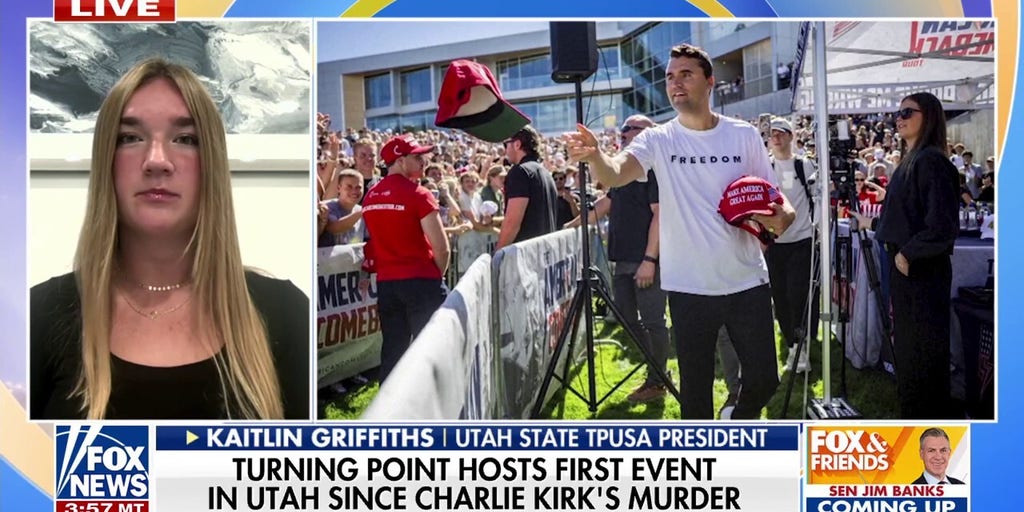
Utah State Turning Point USA President Kaitlin Griffiths joins ‘Fox & Friends First’ to discuss the organization’s return to Utah three weeks after the assassination of founder Charlie Kirk.

Utah State Turning Point USA President Kaitlin Griffiths joins ‘Fox & Friends First’ to discuss the organization’s return to Utah three weeks after the assassination of founder Charlie Kirk.

Source: Utah News

From drones to police presence, Utah campus where Kirk was shot lacked key public safety tools

The Utah college where conservative leader Charlie Kirk was assassinated lacked several key public safety measures and practices that have become standard safeguards for security at events around the …

The Utah college where conservative leader Charlie Kirk was assassinated lacked several key public safety measures and practices that have become standard safeguards for security at events around the country, an Associated Press review has found.

Utah Valley University’s outdoor courtyard, where Kirk showed up on Sept. 10 to debate students, was surrounded by several tall buildings, leaving Kirk vulnerable. That was made all the more potent because campus police didn’t fly a drone to monitor rooftops or coordinate with local law enforcement to secure the event. It deployed only six officers from a force that was already small for a campus its size. There were no bag checks or metal detectors.

A sniper took position on a nearby roof and killed Kirk with a single shot about 20 minutes after the event began, escaping notice from campus police.

Advertisement

Advertisement

Security at Utah Valley University will come into sharper focus in the coming months as lawmakers and the public seek answers about what could have been done differently.

“Absolutely there were security failures; it left him exposed,” said Greg Shaffer, who oversaw Kirk’s security from 2015 to 2022. “It was egregious enough that someone was able to take advantage and kill him.”

In an interview, the AP asked the university president, Astrid Tuminez, if there was a security failure on campus surrounding the Kirk assassination. “Somebody was killed and that’s a tragedy, I think that’s what I would say right now,” she responded. Tuminez declined to answer more detailed questions about campus security, citing a pending external review. A university spokesperson also declined to answer questions about staffing, equipment, security planning and budgets.

No drones monitoring rooftops

Advertisement

Advertisement

The day Kirk spoke at UVU, it was clear and sunny — the perfect weather for a drone to have had a clear view of the roofs of the surrounding buildings, including where the assassin fired a deadly shot from a bolt action rifle at Kirk from about 400 feet (122 meters) away.

But no drone had been deployed, though security experts said rooftop sniper attacks were a clear threat. That was evident as recently as last year when a rooftop gunman in Butler, Pennsylvania, fired shots at a rally held by President Donald Trump during his campaign, killing one, injuring two and wounding Trump.

Ty Richmond, president of event services for security firm Allied Universal, said the attempted assassination Trump exposed the risk of failing to secure elevated areas. He said drones, which cost as little as $2,000, and video surveillance should be part of the tools used to assess and address threats at any outdoor event.

“It was either not done comprehensively or not done at all, because that should have been a natural ability to identify and detect any high ground risk and exposures that you would have in a situation like that,” Richmond said.

Advertisement

Advertisement

The UVU campus had numerous cameras, including at least one overlooking the buildings around the courtyard. A university spokesperson declined to say whether someone was actively monitoring it or if it was operating.

More in U.S.

A smaller than average police force

UVU has an enrollment of 48,000 students, though Tuminez said that includes 16,000 students who are in high school and don’t take classes on campuses.

The university has 23 police officers, or one for every 1,400 on-campus students, according to a 2024 UVU report. The average public university has around one officer for every 500 students, according to a 2024 U.S. Department of Justice study.

Advertisement

Advertisement

“There is not a campus police department in this country that could provide the level of security necessary for a large scale outdoor event with 3,000 people,” said S. Daniel Carter, a campus safety consultant. “They would need help, typically from a local law enforcement agency.”

UVU had six campus police officers present at the event along with Kirk’s personal security detail, campus police Chief Jeffrey Long said after the shooting. Utah County Attorney Jeffrey Gray said during a news conference that a UVU police officer had been watching the crowd from an “elevated position.”

Officials at the Utah County Sheriff’s Office and Orem Police Department, both of which have drones, said they were not involved in security for the event.

A UVU spokesperson said unlike other schools with larger security staffs, they don’t have dormitories to secure. However, other Utah schools of similar size with largely commuter populations have higher ratios of officers to students.

Advertisement

Advertisement

Weber State University, a mostly commuter public school with more than 33,000 students, about half of whom are also enrolled in high school, has a public safety drone and 41 full and part-time police officers. And the University of Utah, with 36,000 primarily commuter students, has 46 officers.

Overall spending on public safety varied at those universities in 2025 — $2.3 million at Weber State and $16.2 million at the University of Utah where a 2018 murder of a student led to more spending on security. UVU officials declined to share a current budget for their department, but a legislative audit showed $1.6 million was earmarked for public safety in 2020 out of a nearly $250 million campus budget.

Safety resources didn’t match school’s growth

UVU, located between Salt Lake City suburbs and Brigham Young University in Provo, grew from a community college of less than 9,000 in the early 1990s to roughly 48,000 this year thanks to the addition of four-year degrees and campus expansions. But public safety failed to keep up, said two former campus public safety leaders. Both spoke on condition of anonymity because they feared repercussions.

Advertisement

Advertisement

Val Peterson, UVU’s vice president for administration & strategic relations, rejected pleas for more safety resources, including hiring more officers and offering higher salaries to keep skilled personnel, the former public safety leaders said. Peterson, who is also a Republican state lawmaker leading state appropriations, oversees UVU’s public safety and has been with the university for more than 30 years.

Both former campus public safety officials each recalled Peterson telling them multiple times in meetings related to public safety funding about a decade ago that because a shooting had not occurred on campus in decades, it would not happen in the future. Peterson believed the sleepy campus was safe from harm, they said. UVU’s president declined to comment on Peterson’s alleged remarks.

Former UVU police Sgt. Bryan Cunningham also recalled those comments and, he said, officers warned the administration in budget discussions related to public safety that the campus could be the scene of an “active shooter nightmare” due to its layout and understaffed police department.

Peterson did not respond to requests for comment sent by phone and email to his private and public offices.

Advertisement

Advertisement

A sub-par emergency response system

At the time of the shooting, the university was without a fire marshal to help plan for safety at large events. And as recently as 2023, two of the university’s three emergency radio channels did not meet state standards for signal strength, according to an internal review shared with the AP. The review did not include information about the third channel.

Patchy reception was a serious problem that could hamper public safety personnel from coordinating during emergencies, one of the former campus public safety officials noted.

The university boosted the signal at one building in the past year, Utah Communications Authority Executive Director Tina Mathieu said. She was not aware of any other improvements.

Advertisement

Advertisement

A university spokesperson didn’t respond to questions about campus emergency radio signal strength.

Campus safety assessments removed from proposed state law

Utah lawmakers pushed to improve public school security after the deadly 2022 elementary school shooting in Uvalde, Texas, by creating a task force, appointing a state security chief and requiring an “armed guardian” be present at every public school. They also mandated all K-12 schools conduct rigorous safety assessments.

Rep. Ryan Wilcox, a Republican who chairs the task force, introduced legislation this year to require public universities to conduct the same assessments, but the provision was removed by the state senate.

Advertisement

Advertisement

“I don’t believe the provision in the bill would have changed the outcome of the current situation,” said Republican Sen. Ann Millner, who co-chairs the task force. She said that public universities should be entrusted to implement their own public safety practices “aligned with institutional realities” and that any assessments would likely have taken a long time to complete.

But Wilcox said the lack of mandatory security assessments can allow for vulnerabilities to go unnoticed: “Because those assessments haven’t been done, I don’t know what I don’t know about how prepared we are.”

“We’re going to learn everything we can possibly learn from that,” he said of Kirk’s death. “It’s a complete disaster.”

___

Associated Press reporter Claudia Lauer in Philadelphia contributed to this report. Brook is a corps member for The Associated Press/Report for America Statehouse News Initiative. Report for America is a nonprofit national service program that places journalists in local newsrooms to report on undercovered issues.

Source: Utah News

Utah Jazz 2025-26 season preview: Lauri Markkanen trade? Ace Bailey the real deal? Get ready for more tanking

Breaking down the biggest question, best- and worst-case scenarios, and win projection for the Jazz in 2025-26.

The 2025-26 NBA season is here! Over the next few weeks, we’re examining the biggest questions, best- and worst-case scenarios, and win projections for all 30 franchises — from the still-rebuilding teams to the true title contenders.

2024-25 finish

  • Record: 17-65 (15th in the West, missed playoffs)

Offseason moves

  • Additions: Ace Bailey, Walter Clayton Jr., John Tonje, Jusuf Nurkić, Kyle Anderson, Kevin Love, Georges Niang

  • Subtractions: Collin Sexton, Jordan Clarkson, John Collins, Johnny Juzang, Jaden Springer

(Grant Thomas/Yahoo Sports Illustration)

Will Lauri Markkanen be on the move this season? (Grant Thomas/Yahoo Sports Illustration)

The Big Question: Where do the Jazz want to go, how do they want to get there, and will any of these players still be on the roster when they arrive?

After the 2021-22 NBA season, the Jazz made dual dynamiting deals, ending what had been a successful-but-not-championship-level era in Utah basketball and heralding the start of a new one. And three years later … well, it’s not clear anything has actually started.

Advertisement

[Yahoo Sports TV is here! Watch live shows and highlights 24/7]

The Jazz own the NBA’s fifth-worst record since those trades and finished with a league-low 17 wins last season. Unfortunately, the vicissitudes of a lottery-based draft system have kept them from reaping the maximum benefits of all that badness. Rather than landing an über-prospect like Victor Wembanyama or Cooper Flagg, the Jazz have compiled a surfeit of mid-to-late-lottery types who haven’t yet shown they’re capable of turning things around.

There is talent here, headlined by Lauri Markkanen. After struggling through back injuries and, shall we say, strategic absences last season, the sweet-shooting 7-foot wing looked to be fully back to All-Star level in a strong summer turn for Finland at EuroBasket:

In theory, pairing Markkanen with fourth-year center Walker Kessler — quietly one of the NBA’s top shot-blockers and screen-and-dive big men — should give the Jazz a frontline capable of propelling them to something approaching stability. Fun fact: The Jazz, who have been outscored by 4.9 points per 100 possessions over the past three seasons combined, actually have a positive point differential in the 2,573 minutes Markkanen and Kessler have shared the floor!

Advertisement

Add in 2024 second-rounder Kyle Filipowski (who averaged just under 14 points and 8 rebounds in 25 minutes per game on .608 true shooting after the trade deadline before winning Summer League MVP), mystery-box 2023 first-rounder Taylor Hendricks (reportedly ready to go after missing nearly all of last season with a gruesome leg injury) and 6-foot-8 wing Bailey, a home run swing with the No. 5 pick in June’s 2025 NBA Draft, and Utah could have the makings of a fairly nasty frontcourt rotation.

In practice, though, the Jazz have continued to suffer from an inability to develop quality backcourt complements capable of efficiently generating NBA offense. Keyonte George has juice off the dribble, but shot under 40% from the field in each of his first two pro seasons and has seen his comportment come in for criticism. Last year, George lost his starting job to Isaiah Collier … who, for all his gifts as a facilitator, shot just 31.2% outside the restricted area last season.

Clayton Jr., the Most Outstanding Player of Florida’s 2025 national title run, brings the promise of higher-ceiling shooting as a rookie; as an undersized, offense-first guard, though, he also brings some of the same potential pitfalls as Collier and George. Cody Williams, the 6-7 swingman Utah took 10th overall in 2024, brings more size, length and theoretical versatility … but missed more than two-thirds of his field-goal attempts and nearly three-quarters of his 3-pointers as a rookie, looking miles away from consistently contributing.

Advertisement

[Get more Jazz news: Utah team feed]

That level of uncertainty isn’t really what you’d prefer to see three years into a rebuild … which is why it’s interesting that Sarah Todd of the Deseret News reported in March the Jazz “do not view the 2024-25 season as the third year of a rebuild,” but rather “as part of the teardown” for a rebuild that hadn’t yet begun. It also seems notable that new president of basketball operations Austin Ainge said the Jazz wouldn’t prioritize losing games just to improve their draft position … and then promptly moved on from veterans Collins, Clarkson and Sexton without making any significant free-agent additions.

In a related story, the Jazz owe their 2026 first-round draft pick to (who else?) the Thunder, dating back to the 2022 trade that dumped Derrick Favors’ salary on Oklahoma City. The pick only conveys if it falls outside the top eight, though — a fate the Jazz can avoid by finishing with one of the four worst records in the league this season, at which point the pick obligation is extinguished, and Utah doesn’t owe OKC squat.

That’s a pretty good reason to, if not outright tank, then, um, “continue to prioritize the development of our young prospects, without worrying too much about wins and losses.” But how does that square with the commitment Utah made to Markkanen, now 28 years old, on the books for just under $196 million through 2029 and likely to be one of the most sought-after trade targets in the league? What does it mean for Kessler, who’s poised to hit restricted free agency next summer if he doesn’t reach an agreement on an extension before the season? And at what point might Will Hardy, now entering his fourth year on Utah’s bench, actually get a roster with a legitimate chance to compete? (Judging by that contract extension, it might be a while.)

Best-case scenario

Markkanen carries over his EuroBasket form long enough to remind a league desperate for difference-makers that there’s one available in Salt Lake City, and the Jazz command a king’s ransom for his services. The newcomer vets spend the season’s opening months showing the kids the ropes before heading off to sunnier climes come February, in exchange for whatever pick compensation Ainge can scrounge up.

Advertisement

Bailey hits the ground running, looking like a no-back-injuries variant of Michael Porter Jr. — high-end tough shot-making, real juice as a finisher on the interior and in transition, complementary rebounding and rim protection — to establish himself as Utah’s premier bona fide building block. Several other members of the 22-and-under crew — including, ideally, at least one of the guards — seize the opportunity to join him, allowing the Jazz to hit mid-April with both a bad enough record to keep their 2026 first-round pick and legitimate reason to hope they’ve drawn meaningfully closer to a return to competitive basketball.

If everything falls apart

Markkanen stumbles, gets hurt or both, scuttling any ideas of turning him into a bounty of picks and/or higher-upside young talent. Bailey struggles to get shots off against bigger, stronger, more athletic defenders, effectively neutering his impact. The rising sophomores and third-year pros all underwhelm, leaving lingering questions about whether any of the prospects Utah has drafted of late can be part of the next competitive iteration of the Jazz.

And, to top it all off, outbreaks of rancid incompetence elsewhere in the NBA — looking at you, Bottom of the East — result in the Jazz finishing with the fifth- or sixth-worst record in the league rather than a bottom-four mark … and, thanks to a brutal bounce of the ping-pong balls on the night of the draft lottery, Utah hands a mid-to-late-lottery pick over to the defending champions in Oklahoma City.

2025-26 schedule

  • Season opener: Oct. 22 vs. LA Clippers

While it’s not impossible to put together consecutive sub-19-win seasons — the Wizards just did it, the Pistons did it in 2022-23 and ’23-24, the Process Sixers did it a decade ago, etc. — it is pretty hard to be that bad in back-to-back years, even if you’re incentivized (say, by trying to keep a draft pick) not to try too hard to win.

Advertisement

If the Jazz get mostly healthy seasons from Markkanen and Kessler (who combined to miss 59 games last year), if they get any progress from the likes of Williams and Collier in Year 2 (who graded out as two of the least valuable rotation players in the league as rookies) and if Bailey offers any spark, they’ll be … well, they’ll still probably be bad. But more like “win total in the low-to-mid-20s” bad.

More season previews

East: Atlanta Hawks • Boston Celtics • Brooklyn Nets • Charlotte Hornets • Chicago Bulls • Cleveland Cavaliers • Detroit Pistons • Indiana Pacers • Miami Heat • Milwaukee Bucks • New York Knicks • Orlando Magic • Philadelphia 76ers • Toronto Raptors • Washington Wizards

West: Dallas Mavericks • Denver Nuggets • Golden State Warriors • Houston Rockets • Los Angeles Clippers • Los Angeles Lakers • Memphis Grizzlies • Minnesota Timberwolves • New Orleans Pelicans • Oklahoma City Thunder • Phoenix Suns • Portland Trail Blazers • Sacramento Kings • San Antonio Spurs • Utah Jazz

Source: Utah News

Utah Jazz Media Day: When will Utah compete for the playoffs again? Get comfy.

For the Utah Jazz, the questioning media didn’t waste any time in asking about the state of today’s Utah Jazz and the path of the team to come. Straight from the jump, Ryan Smith and Austin Ainge were …

The NBA season is an 82-game car trip. Full of bumps, potholes, irritation, jubilation, absolute joy, and complete disdain. But before the ball is tipped on opening night, the path this station wagon takes is undefined — an absolute mystery. Media day is an opportunity for the front office to offer a road map. A line drawn from point A to point B. Some semblance of direction for those tuning into the live feed.

For the Utah Jazz, the questioning media didn’t waste any time in asking about the state of today’s Utah Jazz and the path of the team to come. Straight from the jump, Ryan Smith and Austin Ainge were caught in the crosshairs with the following question: When will this team compete for the playoffs again?

Advertisement

Three seasons into a rebuild, this is a question born of anticipation, anxiety, and compounding pressure. And the decision-makers’ response? Hopefully, you’ve gotten comfortable losing, because that will be the new normal for the foreseeable future.

Q: When is the team going to be competitive again? When is this going to be a playoff team again?

A: It’s hard to do timelines. We’re focused so much on just helping these guys get better every day. Whenever we make that transition, however we add to this team in the future, whether it’s through free agency next summer or trades at any point, a lot of our development has to come internally. We have to. The salary cap dictates it, our market dictates it, we have to improve with a lot of these young guys in the room.

Austin Ainge didn’t beat around the bush when describing Utah’s blueprint for roster construction. Given the Jazz’s circumstances, there is no other way to build a lasting framework for winning without building through the draft and developing the assets at hand. It’s a harsh reality for the Jazz, but this isn’t breaking news.

Advertisement

In a market like Los Angeles, you can build a foyer and master bedroom fit for LeBron, a swimming pool for Bronny, and even an in-home weight room for blossoming workout warrior Luka Doncic. Why? Because they’ve got the funds, they’ve got the draw, and they’ve got plenty of hands to get the renovations finished in a snap.

The Jazz don’t stumble upon success. Constructing a championship core must be done through self-reflection and internal development. Meditation and inner peace may be the prevailing sentiment around this iteration of Jazz basketball.

So let’s draw the line. At what point does the “development” phase end and the “advancement” phase begin? Where’s the tangible evidence that progress is being made, even if the timeline isn’t taking a linear trajectory?

Q: When it comes to leading and developing a young team, what is it about development that doesn’t make it a straight line?

Advertisement

A: I think that’s just the human experience. […] [there’s not] any challenge we face that we can just program in linear growth. Luckily, we have an amazing coach who has developed some of the best players in our game through his career, and we’ve got a great staff. They’ve worked really hard this summer.

So, how will that player development actually look on the floor? How often will we see the youngsters on the floor, and how often will we be sharpening pitchforks and lighting torches to demand Jusuf Nurkic and Kyle Anderson stop stealing Ace Bailey’s minutes? Enter: Will Hardy into the hot seat.

Q: What’s the philosophy on young players and their playing time?

A: There’s a lot of different ways you could look at it. The word “earned” is very appropriate. If you don’t set it up in a way that has meritocracy, it’s split. You have a group that knows they’re going to play no matter what they do, and a group that knows they’re not going to play no matter what they do. So then neither group really cares that much about what they’re doing, and that’s unproductive. I think development is not a linear thing; we want them to improve, but it goes up and down along the way. Timelines are hard to put on young people […] it’s hard to know when they’re going to be ready to take on the full responsibilities that are necessary.

Advertisement

[…]

“When you have as many young players as we do, we all want it now, but that’s not how it works. It’s our responsibility every day to try to cultivate the environment where these players can grow, and they’re all going to grow at different rates. The veteran players are important because they have what our young players want, which is longevity in the NBA.”

So get comfortable. Find the sunken cushion on your favorite easy chair and recline for a while. The Utah Jazz will not be in the business of winning basketball games until the cement in the foundation has solidified. As of right now, this team’s foundation is still a pit in the ground.

There is no timeline for competitive hoops in Utah, but that doesn’t mean nothing is going on behind the scenes. The wheels are in motion, but don’t expect 0-to-60 for a few more seasons.

Calvin Barrett is a writer, editor, and prolific Mario Kart racer located in Tokyo, Japan. He has covered the Utah Jazz and BYU athletics since 2024.

Source: Utah News

Did Utah football appear in the AP Top 25 poll after win over West Virginia?

The Utah football team got back on track with a blowout win of its own Saturday, a week after getting thumped in its Big 12 opener. Devon Dampier led the charge …

The Utah football team got back on track with a blowout win of its own Saturday, a week after getting thumped in its Big 12 opener.

Devon Dampier led the charge with a career-high four touchdown passes, spearheading a 48-14 victory on the road over West Virginia to give the Utes some much-needed momentum heading into their bye week.

The 34-point win, however, did not get Utah a spot in the latest media poll.

Four Big 12 teams were represented in the most recent Associated Press Top 25 poll, though the Utes sat on the outside looking in after their bounce-back game against the Mountaineers.

Utah received 52 votes from the panel of voters, one fewer than South Florida (53) and well behind the No. 25 team in the poll, Arizona State (107).

Utah Utes quarterback Devon Dampier

Sep 27, 2025; Morgantown, West Virginia, USA; Utah Utes quarterback Devon Dampier (4) reacts after running the ball for a touchdown during the first quarter against the West Virginia Mountaineers at Milan Puskar Stadium. / Ben Queen-Imagn Images

The Sun Devils, who visit Salt Lake City after Utah’s bye week, pulled off a come-from-behind victory over TCU to remain undefeated in league play. Arizona State, which trailed by 17 early on, tied things up with under 2 minutes to play after Sam Leavitt connected with Jordyn Tyson for a score. TCU fumbled on its ensuing drive, setting up Arizona State kicker Jesus Gomez for his second clutch field goal in as many weeks to give the Sun Devils a 27-24 win.

Arizona State will pay a visit to Rice-Eccles Stadium on Oct. 18. Utah is idled next weekend.

“You don’t want to sit on a loss ever, but to sit on it for two weeks is double the torture,” said Utah head coach Kyle Whittingham after the game. “And so it’s really big to be able to end that, what, first half, almost first half of the season on a positive and get some guys healed up hopefully, and gives us momentum into the next contest.”

Here’s a look at the rest of the latest AP Top 25 poll.

  1. Ohio State (4-0) [46 first-place votes]
  2. Oregon (5-0) [16]
  3. Miami (4-0) [4]
  4. Ole Miss (5-0)
  5. Oklahoma (4-0)
  6. Texas A&M (4-0)
  7. Penn State (3-1)
  8. Indiana (5-0)
  9. Texas (3-1)
  10. Alabama (3-1)
  11. Texas Tech (4-0)
  12. Georgia (3-1)
  13. LSU (4-1)
  14. Iowa State (5-0)
  15. Tennessee (4-1)
  16. Vanderbilt (5-0)
  17. Georgia Tech (5-0)
  18. Florida State (3-1)
  19. Missouri (5-0)
  20. Michigan (3-1)
  21. Notre Dame (2-2)
  22. Illinois (4-1)
  23. BYU (4-0)
  24. Virginia (4-1)
  25. Arizona State (4-1)

Dropped out:

TCU (No. 24), USC (No. 21)

New to the poll:

No. 24 Virginia, No. 25 Arizona State

Biggest riser:

Ole Miss (+9)

Others receiving votes:

South Florida 53, Utah 52, Mississippi St. 46, Memphis 38, Louisville 36, Southern Cal 22, Maryland 7, North Texas 7, TCU 6, UNLV 3.

MORE UTAH NEWS & ANALYSIS

Source: Utah News

Opinion: The Point Development is the latest proof of Utah’s geothermal energy leadership

The latest example: The Point of the Mountain development, which will convert the former site of the Utah State Prison into a major mixed-use district in Draper.

American energy dominance isn’t just about oil and natural gas. It also means tapping into new sources of reliable and affordable energy whenever it makes sense to do so.

For this reason, the Trump administration is strongly in favor of advanced geothermal energy — a technology that leverages existing oil and gas drilling technologies to provide 24/7 heat and power with zero emissions.

This is great news for Utah because we are a national leader in this promising new technology that converts the heat in deep underground rock formations into energy that can be used at the surface.

We are already the third largest geothermal state in the nation and the level of interest in new projects is surging.

The latest example: The Point of the Mountain development, which will convert the former site of the Utah State Prison into a major mixed-use district in Draper.

The Utah Office of Energy Development is exploring how to upgrade an existing geothermal reservoir to heat and cool buildings at the new development. Pump testing and other feasibility work will take place over the coming months.

Geothermal’s potential — both here and across the nation — was a major theme of Utah Energy Week, which was recently held at the University of Utah.

During the event, I was part of a panel discussion on the topic that included experts from Utah State University, the Idaho National Laboratory and geothermal developer Zanskar.

The panel also featured one of the country’s top experts from FORGE, or the Frontier Observatory for Research in Geothermal Energy, Dr. Joseph Moore. Dr. Moore is the managing principal investigator for FORGE, a technology accelerator for advanced geothermal located just outside Milford, about 200 miles southwest of Salt Lake City. This $300 million grant from the U.S. Department of Energy is managed by Dr. Moore and his team at the University of Utah’s Energy and Geoscience Institute. The DOE grant is the largest ever for geothermal research.

FORGE is a public-private partnership that’s breaking new records in geothermal efficiency and power output.

Those breakthroughs are already being used by tech giants like Google to power data centers, which are a massive source of new electricity demand — and essential to winning the race against China in the field of artificial intelligence.

Exporting Utah’s geothermal breakthroughs to the rest of the country could be a game changer for both energy and AI dominance.

America as a whole has an estimated 5,000 gigawatts of potential geothermal capacity, according to the U.S. Department of Energy. For perspective, that’s roughly the same capacity as 5,000 nuclear power plants — or more than 10 times the number of nuclear plants currently operating across the world.

Imagine the possibilities for our country if just a fraction of this potential could be harnessed.

Geothermal is based on decades of American expertise in drilling and hydraulic fracturing and — unlike other renewables like wind and solar — geothermal energy is available at all hours of the day and night and does not rely on the weather to work.

So, how do we speed up the expansion of geothermal energy across Utah and the rest of the nation?

Just like many other energy sources, including oil and gas, geothermal developers face far too much red tape — especially on federal lands in the American West.

Geothermal projects need the same kind of comprehensive permitting reform as the mines that produce critical minerals, the power lines that move electricity across the country, and the pipelines that transport oil and natural gas from where they’re produced to where they’re consumed.

Federal policymakers also need to support continued investment in advanced geothermal technologies through public-private partnerships like FORGE and through favorable tax policies for new projects.

Likewise, state and local officials need to embrace the game-changing potential of advanced geothermal energy and do everything possible to encourage innovative projects, like the heating and cooling system being considered for The Point.

It’s hard to overstate the positive impact of the fracking revolution and the wave of domestic energy production it unleashed across the U.S.

But in geothermal energy, we could be looking at something just as big, if not bigger, than the fracking boom — and Utah is leading the way. Let’s keep it that way.

Source: Utah News

3 takeaways from Utah State’s loss to No. 18 Vanderbilt

The Aggies fell to No. 18 Vanderbilt 55-35 Saturday, USU’s second loss of the season. USU was competitive for much of the first half before Vanderbilt pulled away in the third quarter. With the loss, …

For the second time this season, Utah State made a trip to SEC country to take on a ranked opponent.

And much like that first trip — to College Station to play Texas A&M — the trip to Nashville ended with a Utah State loss.

Advertisement

The Aggies fell to No. 18 Vanderbilt 55-35 Saturday, USU’s second loss of the season.

USU was competitive for much of the first half before Vanderbilt pulled away in the third quarter.

With the loss, Utah State falls to 3-2 on the season, with Mountain West Conference play kicking off in earnest with an Oct. 11 trip to Hawaii up next.

Here are three takeaways from the Aggies’ latest loss.

Overwhelmed up front

It wasn’t too surprising, but nonetheless was the deciding factor in the game — Utah State was consistently outmuscled and outplayed up front by Vanderbilt.

Defensively, that meant Vanderbilt QB Diego Pavia had plenty of time to attack the Aggies defense and it showed. Pavia finished the game with over 300 yards passing and a career-high five touchdown passes, and he also rushed for nearly 100 yards and a score. He was sacked just once and hurried only one other time.

Advertisement

Utah State’s defensive line simply couldn’t get off blocks for most of the game.

That also showed up in the run game with the Commodores rushing for over 200 yards while averaging better than seven yards per carry.

A lot of blame will — and could be — placed on the Aggies’ secondary for being unable to compete with Vandy’s receivers, but much of that was because Pavia had more than enough time to wait for his receivers to get open.

On offense, USU’s struggles up front were abundantly clear. Utah State’s run game has been a strength this season, but the Aggies struggled to get any sort of consistent push from their offensive line. The result? Less than 100 rushing yards in the game prior to a 58-yard run by Javen Jacobs during garbage time, and an average of less than 3 yards per carry.

Advertisement

Barnes had a good game, great at times, but he was definitely affected by USU’s struggles up front. While only sacked twice, he was hurried seven times and was rarely comfortable in the pocket.

Injuries definitely hurt the Aggies’ cause along the O-line, but the group was also just soundly outplayed by Vanderbilt.

Bryson Barnes still has it

Despite the blowout loss, Barnes was his increasingly usual self Saturday. At least most of the time.

The sixth-year QB finished the game with 161 yards and three touchdowns through the air (he completed nearly 70% of his pass attempts) and rushed for 48 yards, 64 if you take away sack yardage.

Advertisement

Realistically, Barnes was better than those numbers.

Frequently, in the first half especially, when everything else was going wrong for USU’s offense, it was Barnes who would step up and make a play. Often that was a side-arm throw that evaded a defender and found an open Aggie receiver. Or it was a rollout of the pocket to avoid pressure and then a pass delivered on target to a receiver who’d gotten open in the middle of Vanderbilt’s secondary.

Barnes has been excellent this season and his development is a big reason — if not the reason — the Aggies have appeared as improved as they have so early in the Bronco Mendenhall era.

Advertisement

There was a question as to whether Barnes could maintain his success against higher-level competition than UTEP, Air Force and McNeese State. Barnes proved he can against Vanderbilt.

Utah State can’t abandon its rushing attack

Utah St Vanderbilt Football

Utah State quarterback Bryson Barnes (16) throws a pass over Vanderbilt linebacker Langston Patterson (10) during the first half of an NCAA college football game Saturday, Sept. 27, 2025, in Nashville, Tenn. (AP Photo/George Walker IV) | George Walker IV

Utah St Vanderbilt Football

Vanderbilt running back AJ Newberry (23) runs the ball against Utah State linebacker William Holmes, right, during the first half of an NCAA college football game Saturday, Sept. 27, 2025, in Nashville, Tenn. (AP Photo/George Walker IV) | George Walker IV

Utah St Vanderbilt Football

Vanderbilt wide receiver Junior Sherrill (0) runs into the end zone after a catch for a touchdown past Utah State cornerback Bryson Taylor (11) during the first half of an NCAA college football game Saturday, Sept. 27, 2025, in Nashville, Tenn. (AP Photo/George Walker IV) | George Walker IV

Utah St Vanderbilt Football

Vanderbilt defensive lineman Jaylon Stone (92) pressures Utah State quarterback Bryson Barnes, right, during the first half of an NCAA college football game Saturday, Sept. 27, 2025, in Nashville, Tenn. (AP Photo/George Walker IV) | George Walker IV

Utah St Vanderbilt Football

Vanderbilt edge Miles Capers, right, sacks Utah State quarterback Bryson Barnes, left, during the first half of an NCAA college football game Saturday, Sept. 27, 2025, in Nashville, Tenn. (AP Photo/George Walker IV) | George Walker IV

Utah St Vanderbilt Football

Vanderbilt quarterback Diego Pavia (2) dives into the end zone for a touchdown past Utah State cornerback Noah Avinger (1) during the first half of an NCAA college football game Saturday, Sept. 27, 2025, in Nashville, Tenn. (AP Photo/George Walker IV) | George Walker IV

Utah St Vanderbilt Football

Utah State tight end Josh Sterzer (83) scores a touchdown during the first half of an NCAA college football game against Vanderbilt, Saturday, Sept. 27, 2025, in Nashville, Tenn. (AP Photo/George Walker IV) | George Walker IV

Utah St Vanderbilt Football

Utah State running back Miles Davis (2) celebrates his touchdown with quarterback Bryson Barnes (16) dduring the first half of an NCAA college football game against Vanderbilt, Saturday, Sept. 27, 2025, in Nashville, Tenn. (AP Photo/George Walker IV) | George Walker IV

Utah St Vanderbilt Football

Utah State head coach Bronco Mendenall walks the sideline during the first half of an NCAA college football game against Vanderbilt, Saturday, Sept. 27, 2025, in Nashville, Tenn. (AP Photo/George Walker IV) | George Walker IV

Utah St Vanderbilt Football

Vanderbilt running back Makhilyn Young (22) runs the ball against Utah State cornerback Bryson Taylor, left, during the first half of an NCAA college football game Saturday, Sept. 27, 2025, in Nashville, Tenn. (AP Photo/George Walker IV) | George Walker IV

Utah St Vanderbilt Football

Utah State head coach Bronco Mendenall looks onto the field during the first half of an NCAA college football game against Vanderbilt, Saturday, Sept. 27, 2025, in Nashville, Tenn. (AP Photo/George Walker IV) | George Walker IV

Utah St Vanderbilt Football

Vanderbilt quarterback Diego Pavia (2) runs the ball against Utah State cornerback Noah Avinger (1) during the first half of an NCAA college football game Saturday, Sept. 27, 2025, in Nashville, Tenn. (AP Photo/George Walker IV) | George Walker IV

Utah St Vanderbilt Football

Vanderbilt quarterback Diego Pavia (2) runs for a first down during the first half of an NCAA college football game against Utah State, Saturday, Sept. 27, 2025, in Nashville, Tenn. (AP Photo/George Walker IV) | George Walker IV

Utah St Vanderbilt Football

Utah State running back Miles Davis (2) is tackled by Vanderbilt linebacker Bryce Cowan (22) during the second half of an NCAA college football game Saturday, Sept. 27, 2025, in Nashville, Tenn. (AP Photo/George Walker IV) | George Walker IV

Utah St Vanderbilt Football

Vanderbilt defensive lineman Linus Zunk (95) pressures Utah State quarterback Bryson Barnes, left, during the second half of an NCAA college football game Saturday, Sept. 27, 2025, in Nashville, Tenn. (AP Photo/George Walker IV) | George Walker IV

Utah St Vanderbilt Football

Utah State quarterback Jacob Conover, center, is sacked by Vanderbilt defensive linemen Linus Zunk, below, and Jaylon Stone (92) during the second half of an NCAA college football game Saturday, Sept. 27, 2025, in Nashville, Tenn. (AP Photo/George Walker IV) | George Walker IV

Utah St Vanderbilt Football

Vanderbilt running back Sedrick Alexander (28) runs the ball past Utah State linebacker John Miller (20) during the second half of an NCAA college football game Saturday, Sept. 27, 2025, in Nashville, Tenn. (AP Photo/George Walker IV) | George Walker IV

Utah St Vanderbilt Football

Vanderbilt quarterback Diego Pavia (2) throws a pass against Utah State Utah State defensive tackle Tyree Morris (9) and linebacker Bronson Olevao Jr. (14) during the second half of an NCAA college football game Saturday, Sept. 27, 2025, in Nashville, Tenn. (AP Photo/George Walker IV) | George Walker IV

APTOPIX Utah St Vanderbilt Football

Vanderbilt tight end Eli Stowers (9) scores a touchdown during the second half of an NCAA college football game against Utah State, Saturday, Sept. 27, 2025, in Nashville, Tenn. (AP Photo/George Walker IV) | George Walker IV

Utah St Vanderbilt Football

Vanderbilt wide receiver Richie Hoskins (5) catches a pass for a touchdown over Utah State safety Bobby Arnold (12) during the second half of an NCAA college football game Saturday, Sept. 27, 2025, in Nashville, Tenn. (AP Photo/George Walker IV) | George Walker IV

Utah St Vanderbilt Football

Vanderbilt quarterback Diego Pavia (2) runs the ball past Utah State linebacker John Miller (20) during the second half of an NCAA college football game Saturday, Sept. 27, 2025, in Nashville, Tenn. (AP Photo/George Walker IV) | George Walker IV

In wins against UTEP, Air Force and McNeese State, the Aggies were dominant on the ground.

Some of that was due to Barnes, his effectiveness running the RPO (run-pass option) proving too much for USU opponents. But a lot was also do to the play of running backs Miles Davis, Javen Jacobs and Noah White, as well as the Aggies’ O-line.

Against Vanderbilt, USU’s run game was pretty non-existent.

Advertisement

There were the occasional successes, mostly from Barnes but also a notable run from Jacobs, but overall the Aggies had little success on the ground.

As previously mentioned, much of that falls on the O-line, but neither Davis nor Jacobs did much to help USU’s offensive line either. Both have breakaway speed — Davis also has some bruising ability — but neither were able to make many Vanderbilt defenders miss in the open field.

Their lack of success made Utah State fairly one dimensional for most of the game, which put more pressure on Barnes.

As good as Barnes has played, the Aggies need an effective rushing attack to contend in the MWC going forward. And if Utah State is going to make a run at the conference title, Davis and Jacobs will need to be much better — more productive and more impactful — than they were against Vanderbilt.

Utah St Vanderbilt Football

Utah State head coach Bronco Mendenall looks onto the field during game against Vanderbilt, Saturday, Sept. 27, 2025, in Nashville, Tenn. | George Walker IV

Source: Utah News

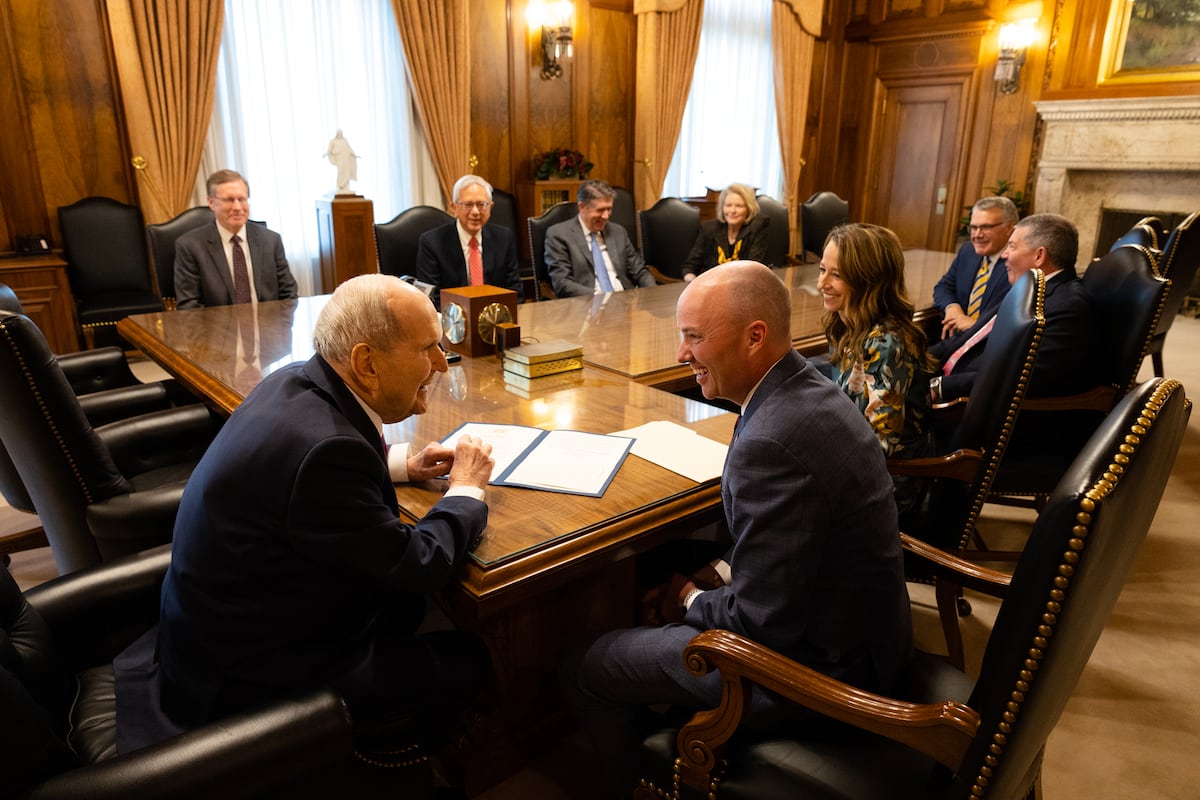
‘He will be greatly missed’: Utah leaders react to the death of LDS President Russell M. Nelson

Here’s what Utah leaders said about Russell M. Nelson, the LDS Church prophet and president who died Saturday night.

Utah and national leaders, including members of the state’s predominant faith, are waking up Sunday morning to news of the death of Russell M. Nelson, the president of The Church of Jesus Christ of Latter-day Saints.

Nelson was 101 and died around 10 p.m. Saturday night.

Here’s what national and state leaders are saying about Nelson:

“President Russell M. Nelson was a bold, visionary leader prepared by God to testify of Jesus Christ in the very times in which we now live. … For as long as I’ve known him, he has exuded — and for me, he’s come to personify — the kind of faith, humility and quiet confidence that tends to be the constant companion of a devoted servant and follower of Jesus Christ. To the day he died, he remained a healer — of hearts and of souls.” [Lee also related an anecdote about how Nelson performed open-heart surgery on Lee’s two maternal grandparents on the same day, when Lee was 7 years old.]

— Mike Lee, U.S. senator from Utah, on the social media platform X.

“Few lives have been lived as fully and faithfully as that of President Russell M. Nelson. His remarkable 101 years were a testament to service, faith, and vision. I am grateful for the insight, inspiration, and teachings he shared so generously. As we mourn his passing, we also celebrate a life that lifted countless people and left an enduring legacy of hope and strength.”

— John Curtis, U.S. senator from Utah, on X.

“President Russell M. Nelson will be known for the scores of new temples, accelerating the growth of the church, centering the gospel in the home, his prophetic words and his love for Jesus Christ, but for Ann and me, one thing touched us most personally and profoundly: his kindness.”

— Mitt Romney, former presidential candidate and former U.S. senator from Utah, on X.

“We mourn the passing of President Russell M. Nelson — a prophet of God, a gentle leader, and a voice for peacemaking. He built bridges across faith traditions and cultures, serving God’s children throughout the world. Abby and I will forever treasure our moments with him. ‘Hail to the Prophet, ascended to heaven!’”

— Spencer Cox, Utah governor, on X.

“The teachings and example of President Russell M. Nelson have had a profound impact on my life. I am deeply grateful for the goodness, love, and inspiration that has poured from this Prophet of God to bless my life and millions of others. He will be greatly missed.”

— Deidre Henderson, Utah lieutenant governor, on X.

“President Russell M. Nelson was a visionary leader who lifted us higher and called us to be peacemakers. A pioneer in open-heart surgery and a bridge-builder in faith, his devotion and love will inspire generations. Today we celebrate his remarkable life of faith and service and mourn his passing.”

— Celeste Maloy, U.S. House member from Utah’s 2nd District, on X.

“Katrina and I mourn the passing of President Russell M. Nelson, who dedicated his life to healing and service — first as a physician, and then as a prophet and leader of The Church of Jesus Christ of Latter-day Saints. His teachings of faith, love, and discipleship in Jesus Christ have strengthened families, inspired hope and lifted lives across the world. We are grateful for his example and the steady testimony he shared throughout his remarkable life. Our prayers are with his family, and with all who mourn his passing. His legacy will continue to bless generations to come.”

— Mike Kennedy, U.S. House member from Utah’s 3rd District, on X.

“With profound gratitude and heavy hearts, we remember the life of President Russell M. Nelson, a prophet and healer, both physically and spiritually. We mourn his passing while celebrating a lifetime devoted to peace, faith and unwavering service. His enduring legacy will continue to inspire and uplift us all.”

— Stuart Adams, Utah Senate president, on X.

“A long life well lived. President Russell M. Nelson was a man of vision, faith and service whose guidance blessed countless lives, including mine. I will always be grateful for his example of Christ-like love and steady leadership. My prayers are with his family and all who feel this loss.”

— Mike Schultz, Utah House speaker, on X.

“A great leader who led us during a tumultuous time. His leadership will be greatly missed. God bless.”

— Jason Chaffetz, former congressman from Utah, on X.

“A wise and thoughtful man, President Nelson dedicated nearly four decades of leadership service to his faith and the church — outwardly demonstrating the call to practice Christ-like love. His service to others was not limited solely to his faith, but to his country and his fellow soldier[s], having served as a member of the United States Army Medical Corps. President Nelson was a renowned surgeon and medical researcher, earning many awards and recognitions for his revolutionary and groundbreaking medical procedures. He was an exceptionally kind leader whose lifetime focus centered on embodying the love of Jesus Christ. His was a life well lived, and I join other members of the church in mourning his passing. My prayers are with President Nelson’s wife, children and many grandchildren as they grieve his loss here on earth, but celebrate in the hope of one day rejoining him in perfect peace in heaven.”

— Mike Crapo, U.S. senator from Idaho, in a statement.

“Loved this man. Grateful for his remarkable life and teachings.”

— Ryan Smith, Qualtrics founder and chair/CEO of Smith Entertainment Group, on X.

Source: Utah News