It would have been perfectly noble for Utah State’s graduating seniors to ride into the sunset two weeks ago after a sixth-place finish at the MWC.
It would have been perfectly noble for Utah State’s three graduating seniors to ride into the sunset two weeks ago after a sixth-place finish at the Mountain West Conference. That’s the best conference finish for a Utah State team in 12 years. Every player finished under par – a program first.
For one thing, the team had already dispersed – to Colombia, Mexico, Texas – but one of the best things about this team, from where head coach Dean Johansen is sitting, is that they indeed came back.
Advertisement
Advertisement
Advertisement
Utah State hasn’t played a postseason event since 1981. An invitation to the National Golf Invitational broke that nearly 50-year drought, and one very savvy travel coordinator at the university in Logan, Utah, brought the five men back from parts the world over to meet within an hour of each other at Phoenix International Airport.
“It means a lot to me personally – just the young men that they are, the sacrifice they’re willing to make for their team and their coaches and their school,” said Johansen, who puts a premium on developing the whole player, and always has in his 25 years at the helm of the Aggie program.
Utah State went 11 under in the opening round of the NGI at Ak-Chin Southern Dunes in Maricopa, Arizona, for a one-shot lead on Ohio State. It’s a course with which the Aggies are familiar, having played in the Wyoming-hosted Cowboy Classic here the past two years.
Advertisement
Advertisement
Advertisement
“This is our third event at this golf course in two years,” Johansen said. “. . . I think that’s a pretty good advantage.”
In all the teams he’s coached, Johansen puts this one at the top of the list when it comes to depth of talent. That’s a testament to him as well, considering that a small recruiting budget and cold, snowy weather make it no small feat to draw a squad like this one to Logan.
“It is validating,” Johansen said of the NGI opportunity, “and these kids worked hard all winter long. We’re hitting balls indoors, we’re driving five and a half hours to find grass to play on for a weekend and they came out at the conference championship and played as good as we’ve ever played at the Mountain West, broke a few school records for us, best finish ever for us. . . . We weren’t really planning on this (NGI start). They all were willing to come back from their respective countries.”
For Esteban Jaramillo and Julio Arronte, that meant delaying the start of professional careers. Johansen’s third senior, John Cook, already planned to hold off turning pro until playing the Utah State Amateur and the team’s home course, Logan Country Club in July.
Advertisement
Advertisement
Advertisement
Arronte contributed a 5-under 67 for Utah State on Friday that went a long way in pulling his team up the leaderboard. Sophomore Enrique Karg did two better, posting a bogey-free round of 7-under 65.
“All of the guys on the team, if you look at our spring and even last fall, any one of them can get it going at any time and just get on the birdie train and today, we had a ton as a team,” Johansen said.
Karg leads the individual race with Utah Valley’s Clement Lepine one shot behind him.
The next 36 holes will be bittersweet for Johansen but fun to watch regardless. This team, he said, has made an impact not just on the program, but on the community. They’re well respected at Logan Country Club, the team’s home course where Johansen is also the golf pro, and they’ve already shown that they have the guts to overcome the realities of a Utah climate that’s not particularly golf friendly.
Advertisement
Advertisement
Advertisement
“This is a win for us no matter how we finish in the tournament,” Johansen said when asked to look ahead at how an NGI berth positions his program for the future. “It just elevates my program that we’re in the postseason, how well they played today and I’m planning on them playing good the next two days.”
Eight years after he abruptly resigned from Congress, Jason Chaffetz is raising money for a possible political comeback — but he is coy about whether he will run for governor in 2028.
It’s still three years until Utahns elect the next governor, but former Congressman Jason Chaffetz may have already begun to lay the groundwork for his possible return to political office.
Chaffetz created a political action committee, the Utah Victory Fund, early last year and used it to help a handful of candidates and cover expenses to attend county conventions.
In March, he moved $113,634 from his federal PAC, the American Victory Fund, to his state PAC. That money could now be used if he decides to mount a campaign for state office.
“I’m thinking about the potential of possibly running for governor in 2028, but that’s still a long ways off,” Chaffetz said Thursday during a short break from hosting a FOX News radio program.
For the past two years, he said, the money he has moved through the state PAC has mainly been to boost conservatives running for office.
“I want to help the state stay conservative, so I’m helping raise money. I’ve given away some money,” he said. “I want to help conservatives up and down the state.”
Chaffetz has not had to file a disclosure for the PAC this year but said he has about $200,000 in the account. Last year, he made small donations to Derek Brown’s race for attorney general, a few Salt Lake County races and gave money to several county parties.
Jason Perry, director of the Hinckley Institute of Politics at the University of Utah, said there are a few signs that indicate a person may run for office.
“One of them is [forming] a PAC,” Perry said, “and [Chaffetz] was in a unique position before he left to put some money into that PAC for use down the road.”
If he does decide to run in 2028, Perry said, “Jason Chaffetz comes with a record that people already know, which is going to be an advantage to some degree.”
If Chaffetz makes a bid for governor, there will be competition. Former state Rep. Phil Lyman — who battled Gov. Spencer Cox in a caustic contest for the GOP nomination for governor last year and has relentlessly attacked him since — has said he plans to run again in 2028.
“I do plan on running in four years, and the truth is, I plan on fighting this fight on whatever front,” Lyman told a gathering last November in Orem, where, according to the Daily Herald, he resurfaced allegations of fraud in the 2024 race.
Cox has said this is his last term as governor.
Other possible GOP contenders include his No. 2, Lt. Gov. Deidre Henderson, House Speaker Mike Schultz, R-Hooper; and Republican National Committeeman Brad Bonham.
“It’s going to be a very crowded field,” Perry said, “so you may see someone get to that Republican primary and win with a very low percentage of the vote, so you need to be very strategic.”
One week after the controversy developed, the NWSL has addressed its decision to continue the Utah Royals’ game against Angel City FC on May 9 following an on-field medical scare involving a player.
One week after the controversy developed, the NWSL has addressed its decision to continue the Utah Royals’ game against Angel City FC on May 9 following an on-field medical scare involving a player.
In the 74th minute, 20-year-old Angel City FC defender Savy King collapsed on the field in Los Angeles. The game was paused while King received medical attention.
Advertisement
Advertisement
Advertisement
King was eventually placed on a stretcher and taken to California Hospital Medical Center.
Players on both teams were visibly shaken, but the game continued in the 85th minute after King left the field and 12 minutes of stoppage time were added.
Royals midfielder Alex Loera led both teams in a prayer on behalf of King, a former teammate, following the game.
Should the Angel City-Utah Royals game have continued?
On the day following the match, the NWSL released a statement that said “league protocols were followed from both a medical and game operations perspective” but the league would “review and determine if changes to that protocol need to be made.”
The NWSL appears to have completed its review.
Advertisement
Advertisement
Advertisement
In a statement posted on social media Friday, the league said it regretted the decision to continue the game.
“Having reviewed our protocols and how they were implemented, and in listening to feedback from our stakeholders, the Angel City vs Utah game last Friday night should not have continued and we regret that it did,” the NWSL said. “The health and well-being of the entire NWSL community remains our top priority, and in any similar situation going forward the game should and would be abandoned.”
The league’s conclusion aligns with what Royals head coach Jimmy Coenraets and the NWSL Players Association said following the match.
The NWSLPA said on Wednesday that “any medical emergency that requires the administration of life-saving care should bring play to an end,” according to ESPN.
Advertisement
Advertisement
Advertisement
In his post-game press conference, Coenraets expressed his disagreement with the decision to continue the game, per KSL’s Caleb Turner.
“In those moments, I’m not sure if we should have continued the game,” Coenraets said. “Not only (Angel City FC) but also our players were just scared, and I think that’s not the right position or not the right situation to be in. But in the end we played on. That’s a decision other people are making, which is fine. But I think it was really a tough moment.”
Coenraets said he wanted to make sure his players felt “safe, healthy, good and they can actually move on” after the game.
How is Savy King doing?
King underwent successful surgery at Cedars-Sinai Medical Center after doctors discovered she had a heart abnormality, per a statement from Angel City on Tuesday.
Liberal arts programs are taking the brunt of cuts at Southern Utah University and Utah Tech University under a legislative mandate to reduce budgets. Here’s what’s on the chopping block.
Liberal arts programs are taking the brunt of cuts at Utah’s two southern universities as the schools work to comply with a legislative mandate to reduce their budgets by millions of dollars.
Faculty had largely expected — and feared— that those programs would be the first to go. But the latest cutsannounced at Cedar City-based Southern Utah University and Utah Tech University in St. George significantly reduce humanities and social science offerings for Utah’s public university students geographically, leaving fewer options south of Orem.
Both SUU and Utah Tech released their proposals earlier this month.SUU’s share of the cut is $3.2 million, and Utah Tech must come up with $2.6 million.
For its plan, SUU is eliminating 24 academic programs. Of the four majors and two minors among those for undergraduates, all are in the liberal arts. That includes art history, French and philosophy.
The university is home to the long-running Utah Shakespeare Festival, which draws summer crowds to several campus shows at the Beverley Taylor Sorenson Center for the Arts.
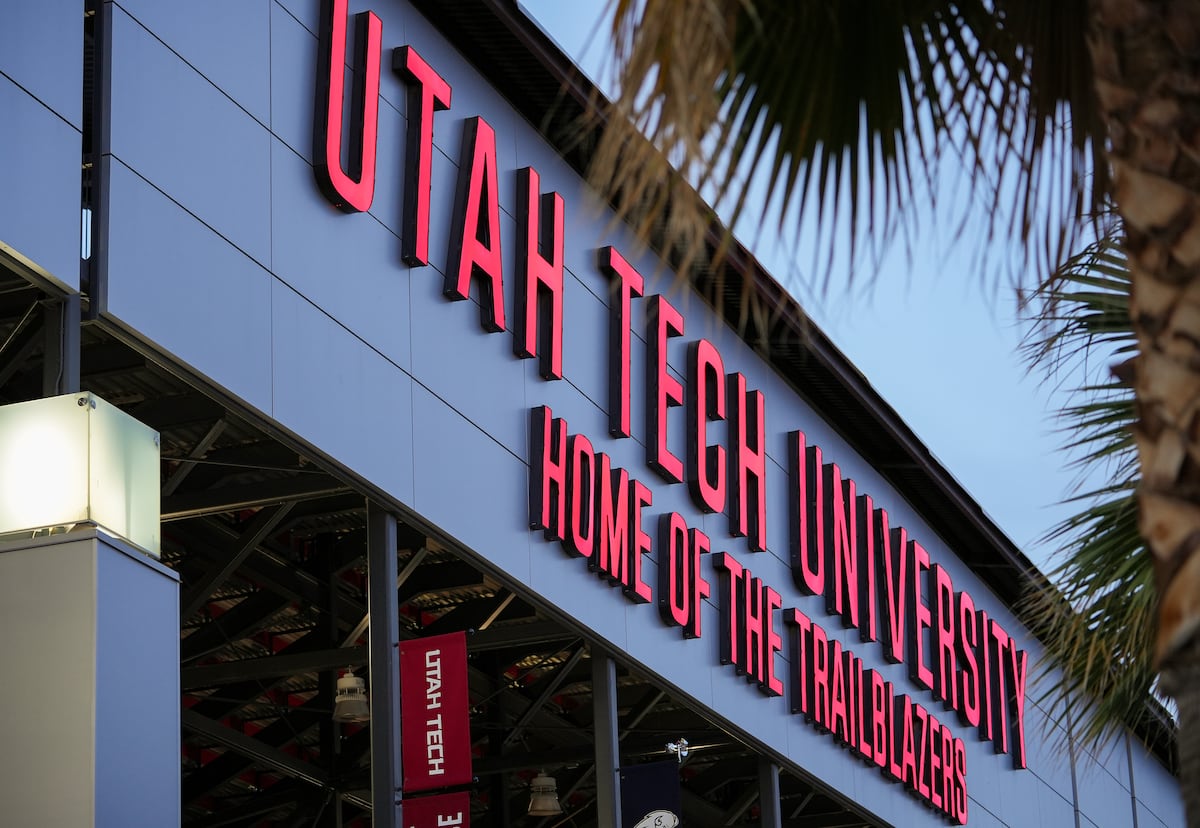
Utah Tech University is cutting majors for students who want to become educators in Spanish and theater, as well as a theater directing emphasis. It’s also eliminating its standalone College of Arts, merging those programs into other departments at the school.
Utah Tech had considered slashing its full Spanish and American Sign Language majors, too, but said in a release that it chose not to “based on feedback” from faculty.
“Please know that this has been a rigorous and thoughtful process,” the school said in a letter to campus on May 13. “We considered a wide range of factors — enrollment data, program costs, open positions, workforce demand and your valuable input.”
Both universities will also eliminate staff and faculty positions — as other institutions have announced — to meet their designated reduction amounts.
The state’s schools have been pressed to quickly draft their plans. The first version of their plans was due to the Utah Board of Higher Education this month, with a formal presentation to follow in June. Final approval from the Legislature will come in August and September.
Here is a breakdown of SUU and Utah Tech’s plans:
SUU’s proposed cuts
SUU says it looked at every possible metric — using both university and state data — before making determinations. The programs it is eliminating are:
• Athletic training, master’s
• Arts administration, master’s (only the in-person option; the online version will remain available.)
• Art history, bachelor’s
• French, bachelor’s
• Philosophy, bachelor’s
• French education, bachelor’s
• Ethnic studies, minor
• Women and gender studies, minor
• Criminal justice, associate degree
• Equine studies, associate degree
• Legal studies, associate degree
• Agriculture with a focus in livestock farm management, associate degree
• General technology associate degrees for business, construction technology, culinary arts management, integrated health sciences and livestock management
It’s also cutting emphases for several of its programs, including hospitality and tourism with its master of business administration and the piano performance emphasis for music. Two certificates will be terminated, too.
“Our responsibility is to ensure that our degrees remain relevant and powerful tools for our graduates, opening doors to meaningful work, service and impact in a rapidly evolving economy,” the school said in a statement.
All schools will have three years under the law to teach out the programs so students currently enrolled can finish their degrees.
(Francisco Kjolseth | The Salt Lake Tribune) Mindy Benson, president of Southern Utah University, speaks during a meeting of the Utah Board of Higher Education in Salt Lake City on Friday, March 28, 2025.
Overall, the school is eliminating 25.35 positions. A school spokesperson said that’s being done through a combination of retirements, merging positions and resignations.
A total of $1.2 million in savings will come from eliminating 6.5 administrative positions among those, including a vice president role in the university president’s office. There are 13.6 faculty position eliminations and 5.25 for staff; an advising role is also being cut, as well as a staff member in the school’s disability center.
Those account for most of the savings that SUU has to come up with, with reductions in professors mostly aligning with the discontinued programs.
The school, though, hopes it can reinvest in 23 new positions, with time, if it earns its share of the cuts back. Those plans, overall, focus on expanding psychology, nursing, business and engineering programs. All have been highlighted by state leaders as areas of study where they would like to see more learning opportunities.
What Utah Tech plans to cut
Utah Tech University is cutting 16 academic programs. Those are:
• Spanish with an emphasis in education, bachelor’s
• Theater with an emphasis in education, bachelor’s
• Theater with an emphasis in directing, bachelor’s
• Population health with an emphasis in long-term care, bachelor’s
• Applied and computational math with an emphasis in scientific computing, bachelor’s
• Criminal justice with an emphasis in digital defense and security, bachelor’s
• Information technology with an emphasis in cybersecurity, bachelor’s
• Professional studies, bachelor’s
• Earth and environmental science associate degrees with emphases in environmental science and geoscience
• Digital defense and security, minor
• Long-term care administration, minor
• Emergency medical technician and advanced EMT, certificates; those will be transitioned to Dixie Technical College
• Modeling and simulation, certificate
• Cryptography I and II, certificates
The school said in a letter to the campus community from Provost Michael Lacourse and Vice President Paul Morris that most of eliminated programs are taught by adjunct faculty.
“As a result, once funds are fully reallocated, the percentage of full-time faculty will increase,” they wrote. “We remain committed to ensuring students can complete their degrees in their current majors with no disruption.”
Until then, though, the school is reducing staff, faculty and administrative positions to save about $700,000. Utah Tech did not provide specific numbers for those reductions. It did note, though, that it will include cutting one administrative position in athletics and another in the president’s office. The cuts to the Spanish and theater education majors will each mean eliminating one faculty member.
The university is merging its College of Arts into its existing humanities and social sciences departments, which will also eliminate a dean and five administrative support positions, the school said. That will save $615,000.
And Utah Tech is reducing its marketing budget, plus ending a standing software contract.
Like SUU, it plans to reinvest in business, engineering, psychology and health sciences, as well as some in digital media arts. The proposal, it said, will continue to evolve.
“As you know, Utah Tech has long operated efficiently with limited resources,” the administration’s letter said. “Our intention is that these changes will strengthen the University and enhance our ability to serve students and the community.”
So, fair question, is the 15-year pro baseball veteran poised for his own Rich Hill-like return to the mound?
“Nope, I’m not — as much as I wish I still had enough life in my arm to be signed,” he deadpanned.
Guthrie may be “unsigned” and on the front end of middle age, but he’s kept trim enough to easily blend in with the youngsters in any baseball dugout.
And he may never outgrow the electric charge he still feels whenever he steps atop the pitcher’s mound and sizes up guys standing in the batter’s box, 60 feet and 6 inches away.
Former pro baseball player Jeremy Guthrie and his wife, Jenny Guthrie, served as mission leaders of the Texas Houston South Mission for The Church of Jesus Christ of Latter-day Saints from 2018-2021. | Jeremy Guthrie
“I still pitch to kids — whether it’s in high school or Little League, or to my son — and I still try to get them out,” he said.
Advertisement
Advertisement
Advertisement
“That’s what I enjoy doing. I enjoy throwing a baseball — and making a person swing at it and miss.”
And plenty of very well-paid people have stood in the batter’s box and swung-and-missed at Guthrie’s pitches. He fanned over 1,000 hitters over the course of a long major league career, highlighted by two starts for the Royals in the 2014 World Series.
‘JGuts’ and President Guthrie: Baseball and missionary memories
Baseball fans in Kansas City and in the other towns where Jeremy Guthrie plied his pitching trade still know him, affectionately, as “JGuts.”
But for hundreds of young men and young women who served in the Texas Houston South Mission for The Church of Jesus Christ of Latter-day Saints from 2018 to 2021, he will forever be “President Guthrie.”
Jeremy Guthrie, president of the Texas Houston South Mission of The Church of Jesus Christ of Latter-day Saints, joins full-time missionaries in 2019 to share Spanish-language versions of the Book of Mormon. Guthrie was a mission president from 2018-2021. | Jeremy Guthrie
There are not many obvious comparisons between facing elite hitters such as Alex Rodriguez or Ichiro Suzuki and serving as the spiritual leader to scores of young missionaries. But Guthrie misses both unforgettable phases of his life.
Advertisement
Advertisement
Advertisement
In baseball: “I just miss playing the game.”
“Baseball’s what I enjoyed doing as a kid. I ended up playing professionally because I liked playing baseball. So anytime a new season begins, or I see the players on the field, what I miss the most is actually just playing.”
And what does the former mission president miss about full-time mission life?
“That’s easy to answer,” said Guthrie, without pausing. “I just miss that carefree ability to really focus on one thing, and one thing only, and that is: What can I do today to bless and help another person?”
“And how can I demonstrate the love of Christ in my actions and in my words to help that person see Jesus in a new way?”
Serving the elders and sisters of the Texas Houston South Mission
Latter-day Saints called to preside over missions for their church are typically in their 50s or 60s. Some are in their 40s.
Advertisement
Advertisement
Advertisement
Guthrie was still in his 30s when he and his wife, Jenny, were called to be mission leaders in Houston in 2018.
He was just a year removed from making his final start in a Major League Baseball game while competing for the Washington Nationals.
Elder Gary E. Stevenson of the Quorum of the Twelve Apostles of The Church of Jesus Christ of Latter-day Saints, left, and former MLB player Jeremy Guthrie enjoy “JustServe Night” at a Kansas City Royals baseball game on Aug. 6, 2024. Elder Stevenson threw the ceremonial first pitch to Guthrie, a former Royals star. | The Church of Jesus Christ of Latter-day Saints
Being called to preside over a mission of men and women who were likely about the same age as some of his rookie teammates from just a year earlier “was very surprising and humbling,” he said.
Yes, there were advantages to being a 30-something mission president. The Guthries had plenty of physical energy and “emotional zest” for connecting with the missionaries “and striving to help invite them to come unto Christ.”
Advertisement
Advertisement
Advertisement
But on the flip side, the young Guthries felt the emotional weight of the calling.
“Our oldest daughter, at the time, was just 14 years old,” recalled Guthrie. “So we had never parented or raised a teenager ourselves — and now we were arriving in Houston with 165 (similarly-aged) young men and women who were waiting for our leadership and our love to help them on their own personal journeys.”
But despite feelings of inadequacies, the Guthries moved forward and got to work. “We learned to rely upon the Lord and his grace to strengthen us — and to help us do things that really we weren’t qualified or capable of doing on our own.”
Guthrie’s mission in Houston marked his second full-time mission. As a young man, he put his baseball career on hold to serve a mission in Spain — learning a language he later utilized throughout his sports career and his subsequent ecclesiastical duties.
Advertisement
Advertisement
Advertisement
The principles he learned on the mission — as both a young elder and a mission president — anchor Guthrie’s day-to-day life as a husband, a father and now as a businessman.
“I have a better understanding of the principle of agency — choosing for ourselves and learning through our experiences,” he said.
“That’s a principle and a doctrine that I’m still trying to grasp. … Trying to better understand the love that our Heavenly Father has for us and the great plan that he had for us to allow us to come to earth to learn and choose for ourselves.”
Spanish and ‘el idioma’ of baseball
Today’s Major League Baseball rosters are filled with players from Latin American countries.
Advertisement
Advertisement
Advertisement
So it’s no surprise that the foreign language “Elder Guthrie” acquired on his mission to Spain allowed him to bond with countless teammates by speaking in their native tongue.
“I could engage with teammates in our (Spanish) conversations … which naturally lent itself to deeper relationships and a better understanding and support for my teammates,” remembered Guthrie.
“I felt like I could understand those from a different culture a little bit better because I understood more of what was going on in their lives and where they had come from.”
And, yes, it was always an unexpected, sometimes comical surprise when Latin American players discovered that their Japanese American teammate from Oregon could “habla el idioma.”
A lifelong sneakerhead
Folks acquainted with Jeremy Guthrie know of his devotion to his faith and family. They know all about his World Series starts, his 2015 World Series ring and his long MLB pitching career with multiple squads.
Advertisement
Advertisement
Advertisement
They also likely know that Guthrie’s a hard-core sneakerhead.
He may be a father, a retired pro athlete and a beloved mission leader — but he’s also got a passion for all things “kicks.”
He remembers being a kid and lacing-up his first pair of “Sky Jordan 1s” — the youth version of the Air Jordan 1. “What started my love and affinity for Nike — as well as for Michael Jordan — was wearing that shoe.”
Guthrie’s sneaker fever only grew during his athletic career. It continues to this day.
“It’s natural to recognize that the right shoe, in the right moment, can actually enhance your attitude and your energy for what you’re doing — and that leads to better performances,” he said. “There’s a lot of truth to it. It’s not just rhetoric.”
Advertisement
Advertisement
Advertisement
At various times during his baseball career, Guthrie designed his own cleats.
Now he’s several years removed from pro baseball, but his connection to sneakers — and specifically cleats — continues today.
In 2015, Guthrie was an investor in Custom Cleats, a company that converts sneakers into cleats — allowing baseball, football, soccer and softball players and other athletes at all levels to better express themselves and, well, have more fun competing.
After returning from his mission in Houston, he assumed co-ownership of Custom Cleats.
“We are fortunate enough to work with thousands of athletes from all over the world — including a number of Major League players that use our service for their own careers,” said Guthrie.
Advertisement
Advertisement
Advertisement
“That’s one way that I stay close to baseball is by working for baseball players and softball players — and really athletes of all sports that need cleats.”
Big league baseball in Utah: ‘A no-brainer’
A multisport athlete at Oregon’s Ashland High School, Guthrie played at Brigham Young University before finishing his college baseball career at Stanford.
He’s maintained close ties to Utah.
His son, Hudson, is an athlete at Pleasant Grove High School. And Guthrie’s a staunch supporter of bringing a Major League Baseball franchise to the Beehive State.
“Utah is a state that loves their sports — loves to participate in sports and loves to support sports,” he said.
Advertisement
Advertisement
Advertisement
“The Jazz are a perfect example of that, as well as the soccer team, and now hockey. This is just a community that loves to be out, as families and individuals, watching sporting events and having that be a part of their community.”
A big league baseball team in Utah, he insists, “is a no-brainer.”
Guthrie added that well-established, Utah-loving community leaders such as the Miller family are essential to MLB’s future in the state.
The Millers, he said, “are an altruistic family that has done so much good for the Salt Lake City community, and beyond.”
Additionally, said Guthrie, the Millers have already proven their bona fides as a sports franchise ownership group.
Advertisement
Advertisement
Advertisement
“They had one of the best teams in the NBA for an extended period of time in a smaller market,” he said, referencing the Miller Jazz years.
“They were always competitive. They always put a great team on the court. They’ve shown the ability to run a franchise well and compete — even if the amount of money didn’t mirror that of some of the other larger franchises that are known for heavy spending.”
Reagan is the late matriarch to the Reagan billboard company. Over the last year, variations of tribute billboards for her have popped up around the Beehive State — a way for her late husband, William …
The crowd of Trixie Mattel‘s Saturday performance at The Complex were treated to a surprise when a local billboard icon showed up on the screen.
Paige Askerlund captured the moment on her phone: Among the bright visuals, a Julia Reagan billboard twirled on the screen as local drag queen Mia Barbin strutted around the stage.
Mateo Segade, Mattel’s DJ partner, opened up the show alongside Barbin before Mattel came on, Askerlund said.
The TikTok video below shows the billboard displayed during the show. Viewer discretion is advised.
“[Segade] had a bunch of visuals on the screen behind him, and it was a lot of just funny references, LGBTQ history and popular LGBTQ movies, just like clips from that,” Askerlund said. “And then suddenly the Julia Reagan billboard popped up, and everybody in the crowd went crazy.”
Most Utahns are accustomed to see the famous Reagan billboards outside entertainment venues.
Reagan is the late matriarch to the Reagan billboard company. Over the last year, variations of tribute billboards for her have popped up around the Beehive State — a way for her late husband, William Reagan, to pay tribute to her, according to Fox13. The billboards span across to the country.
Reagan died nearly a year ago in June 2024. Her husband has since filed a wrongful death lawsuit against The University of Utah’s hospitals and clinics.
Askerlund said the billboard stayed on screen for 30 seconds, but neither Segade, Mattel or Barbin explained why they decided to add it.
Mattel is an American drag queen who is a veteran of “RuPaul’s Drag Race.” Her Saturday performance in Salt Lake City was a part of her “Solid Pink Disco: Blonde Edition” tour — a live DJ show.
A representative for Mattel declined to comment for this story.
At Monday’s draft lottery, Utah’s worst fears were realized as the team fell to the No. 5 spot in the 2025 NBA Draft. The team had a 48% chance of doing so, but the pain of losing out on talents like …
At Monday’s draft lottery, Utah’s worst fears were realized as the team fell to the No. 5 spot in the 2025 NBA Draft. The team had a 48% chance of doing so, but the pain of losing out on talents like …
The NWSL has admitted that the Angel City vs. Utah Royals game should not have continued following Savy King’s on-field collapse. A league spokesperson confirmed to The Athletic that it had come to …
The NWSL has admitted that the Angel City vs. Utah Royals game should not have continued following Savy King’s on-field collapse.
A league spokesperson confirmed to The Athletic that it had come to that conclusion following a review of its protocols and “listening to feedback from our stakeholders.”
Advertisement
King received on-field medical attention after collapsing around the 74th minute of the game at BMO Stadium last Friday. The match was stopped for around 16 minutes before resuming, with King taken off the field on a cart and transported to California Hospital Medical Center. Angel City said Wednesday that King had undergone successful surgery to address a heart abnormality at at Cedars-Sinai Medical Center, describing her prognosis as “excellent.”
“Having reviewed our protocols and how they were implemented, and in listening to feedback from our stakeholders, the Angel City vs Utah game last Friday night should not have continued,” an NWSL spokesperson said Friday. “The health and well being of the entire NWSL community remains our top priority, and in any similar situation going forward the game should and would be abandoned.”
Utah head coach Jimmy Coenraets told reporters after the game that he was not sure the game should have continued after King’s collapse. The NWSL Players Association later said the match should have been abandoned.
“These moments demand humanity, sound judgment and restraint,” the Players Association said in its statement. “Any medical emergency that requires the administration of life-saving care should bring play to an end. The match should not have continued.
“Our members are elite, world-class competitors who have proven they can perform under unimaginable conditions. That does not mean they should have to.”
The NWSL said Wednesday it was reviewing how it deals with serious medical incidents on the field. As reported earlier this week, the league has the final say when it comes to playing on following major incidents — whether medical, weather-related, or anything else — according to internal policies seen by The Athletic. Beyond that, league commissioner Jessica Berman has the final say in overruling any protocol to make a decision.
Angel City was ahead 1-0 when the incident happened and won the match 2-0. After full-time, the two teams gathered in a circle and Utah defender Alex Loera, a teammate of King’s at Bay FC in 2024, appeared to lead them in a prayer.
“On behalf of our entire family, along with Savy, we have been so moved by the love and support from Angel City players, staff, fans, and community, as well as soccer fans across the country,” King’s family wrote in a statement released by the team Tuesday. “We are blessed to share Savy is recovering well, and we are looking forward to having her home with us soon.”
Just a season ago, Utah Hockey Club was a brand-new team trying to fit into its new Utah environment and transition away from its former identity in Arizona.
Image
Just a season ago, Utah Hockey Club was a brand-new team trying to fit into its new Utah environment and transition away from its former identity in Arizona.
Come the 2025–26 season, change will come again, as Utah Hockey Club will no longer suit up under that name, making way for its new identity: the Utah Mammoth.
Advertisement
Advertisement
Advertisement
Anything beats the old Utah Hockey Club puck logo from the team’s first season, and the aggressive Mammoth logo is already seen as a major upgrade.
But now that Utah has a real logo for the foreseeable future, it also faces added scrutiny, especially since it’ll be compared to 31 other NHL teams.
So in this article, Utah’s new logo will be evaluated based on three categories: Creativity, Originality, and Historical Impact. Each category will receive a letter grade, followed by an overall final grade.
Without further ado, let’s get started.
For starters, the ‘Mountain Mammoth’ does a nice job of incorporating the current colors of the team’s uniforms while maintaining a more serious and intimidating design with the actual mammoth.
Advertisement
Advertisement
Advertisement
Credit is due to the design team for adding creative details to the logo as well.
Instead of simply focusing on the mammoth itself, the design cleverly includes the shape of Utah’s mountains at the top of its head, the Utah state outline as its ear, and a U-shaped tusk that ties in nicely with the team’s ‘U’ letter logo.
While the tusk isn’t as immediately recognizable as some other letter-based logos—like Calgary’s flaming ‘C’ or the semi-hidden ‘V’ in the Vegas’ Golden Knight logo—just incorporating a ‘U’ at all is a step above, as most NHL logos tend to commit to either a letter or a mascot, not both.
While the added details in Utah’s logo are certainly fun, it’s hard to forget how bold and creative the old Arizona Coyotes logo was. Though the serious-looking mammoth fits this mascot better, it’s difficult to compete with the uniquely artistic design of the Coyote.
Advertisement
Advertisement
Advertisement
The full-body depiction of the coyote gives it an edge, breaking from the modern trend of overly simplistic and polished logos. Its chaotic color palette and distinction as one of only two full-body logos in the league—alongside the Pittsburgh Penguins—make it particularly memorable.
Still, the Utah Mammoth logo is a strong start and adds another interesting design to the NHL’s already impressive collection. It also is much better than the Coyotes alternative red coyote head logo.
Paired with a strong uniform, Utah Mammoth stands out well, but it’s still tough to top Arizona’s previous design.
Besides the Alabama Crimson Tide having an iconic elephant mascot in “Big Al”, there is hardly any major sports team that has anything comparable to Utah Mammoth.
‘Ice Age Rivalry’ Is A Perfect Name For Utah vs. Nashville Game
Though some fans may still wish Utah had chosen the Outlaws, that name is much less original among major sports franchises, with teams like the Tampa Bay Buccaneers and Pittsburgh Pirates having similar themes.
Compared to other NHL teams, Mammoth feels like a distinctive name, with the only connection being its ‘Ice Age’ link to the Nashville Predators.
But even with that prehistoric connection, it still feels unique. It doesn’t quite earn an A+ since Utah’s first logo choice, the Yetis, would have been even more original, but the Mammoth is a really strong alternative.
This is certainly a tricky task for a new team, as much of the history behind a logo develops over time in the league. That’s what makes logos like the Detroit Red Wings and Boston Bruins so impactful, along with their well-received designs.
Advertisement
Advertisement
Advertisement
But credit must be given to the team for finding a Mammoth connection to Utah, given that actual Mammoth fossils have been found in the state.
So for that alone, Utah gets a boost in its grade for having an actual historical tie. But when people think of Utah, it’s more well known for the Mormon Pioneers, its unique landscapes, and even notorious outlaws like Butch Cassidy.
The main reason the logo receives the grade it does is simply because of its new look. The historical impact of a logo is about more than just the context behind the team’s name, it’s also about the logo’s impact within the NHL.
Utah Mammoth Is Here: Instant Review Of New Name, Logos And Jerseys
When teams like the Winnipeg Jets or Minnesota Wild were established in the 2000s, their logos carried more impact because both cities had previously lost teams—to Dallas in Minnesota’s case, and, interestingly, Arizona in Winnipeg’s.
So while other teams have been reestablished or undergone new names, there still is important NHL history that helps strengthen their logos.
Similarly, NHL teams like the Montreal Canadiens and Boston Bruins may have simple letter-based logos, but their century-old history gives those logos incredible weight.
For Utah, the new logo currently holds historical significance mainly tied to the state itself, rather than the NHL. Compared to its old Arizona Coyotes logo, it has less historical depth in its actual, as the Coyotes’ logo incorporated distinctive Native American-style art.
Advertisement
Advertisement
Advertisement
But Utah Mammoth also is shedding light on some Utah history that many people may not be aware of with its new name.
Utah’s logo is an above-average design. While it lacks the historical depth of other new expansion teams like the Golden Knights and Seattle Kraken, it makes up for it by offering a unique concept and design.
The design is modern but bold, incorporating subtle details rather than opting for a simplistic look.
Although its predecessor is the ‘Kachina Coyote’ design of the old Arizona Coyotes, Utah’s new logo still feels fresh because it pairs well with the icy tundra Utah has.
Utah Mammoth Mourns Loss of Utah Grizzlies’ Kevin Bruder
Utah also has the advantage of being able to strengthen its brand appeal, as it has yet to announce its mascot or even play a game as the Utah Mammoth.
Overall, a B grade feels fair. It’s certainly an exciting concept that is sure to satisfy the thousands of Utah fans who voted in favor of the Utah Mammoth name.
While it’s probably too soon to call it a top logo in the league due to how new it is, it deserves respect for its unique look.
Time will only tell if this logo grows more popularity. But for now, its certainly a fun development to see happen in real time.