
Around three dozen Republican lawmakers gathered at the Utah Capitol Tuesday to outline their next steps two weeks after 3rd District Judge Dianna Gibson rocked Utah politics by selecting her own …
This is a breaking news story and will be updated.
Utah legislative leadership announced Tuesday they will take immediate action to end the latest round of litigation in the state’s multiyear redistricting legal battle so they can appeal the entire case to the Utah Supreme Court.
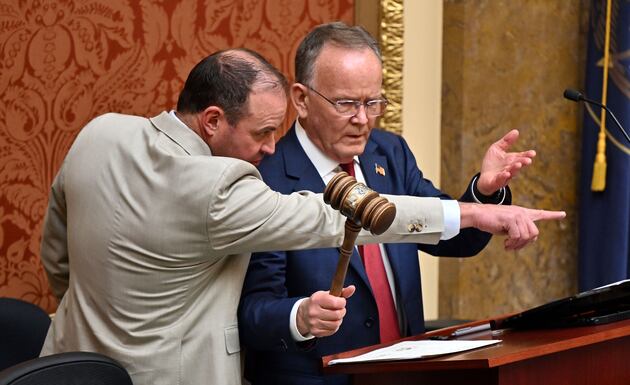
Around three dozen Republican lawmakers gathered at the Utah Capitol Tuesday to outline their next steps two weeks after 3rd District Judge Dianna Gibson rocked Utah politics by selecting a congressional district map put forward by special interest groups for the 2026 midterm elections, while rejecting one put forward by the Legislature.
In an effort to reverse Gibson’s Nov. 10 decision, Senate President Stuart Adams and Speaker Mike Schultz said they are asking for a permanent injunction to rapidly secure a final ruling from Gibson so that they are able to file a full appeal to the state’s highest court.
The Legislature decided on this course of action in consultation with Utah Gov. Spencer Cox, who they said will call lawmakers into special session on Dec. 9 where they may postpone candidate filing deadlines to make time to adjust the state’s electoral boundaries yet again.
“This is a defining moment for Utah’s governance,” said Schultz, R-Hooper. “Two branches of government, those branches chosen by Utah voters, are standing together to correct this wrong, to restore order and ensure our system works the way our constitution was intended.”
How did we get here?
Over the past 18 months, Utah courts have ruled that the state’s GOP majority violated the Utah Constitution by amending the Better Boundaries initiative known as Proposition 4 in 2020 and by skirting the law’s anti-gerrymandering requirements in 2021.
While legislators begrudgingly complied with Gibson’s orders to redraw the state’s congressional seat boundaries, they argued that courts should not have any role in the redistricting process, which the state constitution places under legislative authority.
GOP lawmakers erupted when Gibson ultimately rejected their remedial map, which made two more competitive districts, in favor of one submitted by plaintiffs in the case, creating four uncompetitive districts, including a +20 Democratic seat in northern Salt Lake County.
“By design or by default, Judge Gibson has authorized the most partisan, and thus the most gerrymandered map in the history of the state of Utah,” said Adams, R-Layton. “I assume she didn’t intend or set out to gerrymander herself, but anyone who looks at the donut hole map sees very clearly it’s gerrymandered.”
State election officials have already begun adjusting the state’s election process to accommodate the new map. But legislative leaders said they still believe there is a possibility they can succeed in court to throw out the so-called “Map 1″ before next November.
In the long-term, legislators committed to resolve the disagreement over separation of powers in the state by placing a constitutional amendment on the ballot that clarifies their ability to amend or repeal ballot initiatives, including those that alter the structure of government.
This would be similar to the Amendment D option lawmakers planned to include on the 2024 ballot which was voided by Gibson because she said it did not meet thresholds for ballot language clarity and for adequate advertising.
Source: Utah News