Utah Announce Permanent Head Coach To Replace Kyle Whittingham

After 21 years in Salt Lake City, University of Utah head coach Kyle Whittingham is officially walking away from the program he helped build into a perennial contender in the Big 12, Pac-12 and …

After 21 years in Salt Lake City, University of Utah head coach Kyle Whittingham is officially walking away from the program he helped build into a perennial contender in the Big 12, Pac-12 and Mountain West.

On Friday, Whittingham announced Dec. 31’s game in the Las Vegas Bowl will be his last with the Utes — putting an end to one of the longest tenures in college football.

Advertisement

Whittingham’s 177 wins ranks third amongst active FBS coaches and has led to three conference titles, two Rose Bowl appearances and a pair of top-five finishes in the AP poll — along with two national Coach of the Year awards.

Now as the school prepares to turn the page on the Kyle Whittingham era, the university has already named the 66-year-old’s successor.

Jul 9, 2025; Frisco, TX, USA; Utah head coach Kyle Whittingham speaks with the media during 2025 Big 12 Football Media Days at The Star. Mandatory Credit: Raymond Carlin III-Imagn Images© Raymond Carlin III-Imagn Images

Jul 9, 2025; Frisco, TX, USA; Utah head coach Kyle Whittingham speaks with the media during 2025 Big 12 Football Media Days at The Star. Mandatory Credit: Raymond Carlin III-Imagn Images© Raymond Carlin III-Imagn Images

Whittingham: ‘The time is right’

In a statement announcing the move on Friday, Whittingham shared that he would no longer be the coach for the Utes past this season.

Advertisement

“The time is right to step down from my position as the head football coach at the University of Utah,” Whittingham said. “It’s been an honor and a privilege to lead the program for the past 21 years and I’m very grateful for the relationships forged with all the players and assistant coaches that have worked so hard and proudly worn the drum and feather during our time here. The opportunity to guide so many talented young men as they pursued their goals — both on and off the field, has truly been a blessing.”

But even though Utah’s longtime HC is walking out the door, a familiar face will remain on the program’s sideline moving forward.

Utah announces DC Morgan Scalley as full-time head coach

“Morgan Scalley has proven over the course of his outstanding coaching and playing career at the University of Utah that he is uniquely equipped to take over as the program’s next leader,” said Utah athletic director Mark Harlan (via ESPN’s Adam Rittenberg). “He not only has great knowledge and perspective of what makes Utah football special, but his passion and love for the University of Utah position him to carry the mantle of leadership forward and continue the program’s legacy of success.”

Advertisement

“As we honor a legendary chapter in Utah Football, we are looking ahead with great optimism to what comes next,” University of Utah president Taylor Randall added. “I have complete confidence in Morgan Scalley’s leadership as the next head coach of Utah Football. Morgan is the future of this program.”

“As an alum, a former All-America player, and a coach who has been instrumental in shaping our culture of development, toughness, and student-athlete success, he embodies everything that makes Utah Football exceptional.”

Advertisement

Utah’s defense currently ranks No. 5 in the nation in passing efficiency defense, 15th in interceptions (14) and 16th in scoring defense. It’s also scored three touchdowns in 2025, good 10th in the FBS.

In his time as an assistant, Scalley has coached 14 All-Americans, 21 first-team All-Conference selections and five Freshman AA’s.

This story was originally published by The Spun on Dec 14, 2025, where it first appeared in the College Football section. Add The Spun as a Preferred Source by clicking here.

Source: Utah News

Utah head coach Kyle Whittingham stepping down following bowl game

A new storyline has been added to Nebraska’s bowl game. Kyle Whittingham will step down as Utah’s head coach following the Las Vegas Bowl. Nebraska and Utah will meet in the SRS Distribution Las Vegas …

A new storyline has been added to Nebraska’s bowl game. Kyle Whittingham will step down as Utah’s head coach following the Las Vegas Bowl.

Nebraska and Utah will meet in the SRS Distribution Las Vegas Bowl at Allegiant Stadium on Dec. 31. Kickoff is scheduled for 2:30 p.m. CT on ESPN.

Advertisement

Whittingham has been the Utes‘ head coach since December 2004 and a member of the Utes’ coaching staff since 1994. He enters his final game with a head coaching record of 177-88.

Whittingham earned three national Coach of the Year awards and finished with a winning record in 18 of his 21 years as head coach. He also had tremendous postseason success, with an 11-6 record in bowl games.

Defensive coordinator Morgan Scalley will take over as head coach following Whittingham’s departure. Scalley has been the DC since 2016 and has been a coach at Utah since 2007.

Contact/Follow us @CornhuskersWire on X (formerly Twitter) and like our page on Facebook to follow ongoing coverage of Nebraska news, notes and opinions.

This article originally appeared on Cornhuskers Wire: Utah head coach Kyle Whittingham stepping down following bowl game

Source: Utah News

Southern Utah Game Preview & How to Watch

Jones is a former JUCO transfer who played last season at Fairleigh Dickinson where he put up almost identical numbers just on better shooting from 3-point range. Over 82% of his career shots have …

How to Watch (and bet)

Date: Saturday, 12/13/25

Tip-Off Time: 3:00 pm PT

TV: Big Ten Network

Radio: Huskies Gameday App, Sports Radio KJR

Location: Seattle, WA

Betting Line: Washington Huskies -26.5

Advertisement

Southern Utah Thunderbirds 2025-26 Statistics:

Record: 4-7 (3-0 against non-D1 schools)

Points For per Game: 67.4 (305th)

Points Against per Game: 87.0 (343rd)

Adjusted Offensive Efficiency: 99.5 (311th)

Adjusted Defensive Efficiency: 112.7 (291st)

Strength of Schedule: 94th

Southern Utah Key Players:

G- Elijah Duval, Sr. 6’3, 180: 13.5 ppg, 3.2 rpg, 3.6 apg, 49.5% FG, 24.1% 3pt, 62.5% FT

Evanmiya.com Stats: -1.64 (4th), 96.6 Adj Off Eff (4th), 109.8 Adj Def Eff (3rd)

Duval has come in as a freshman and taken over the keys to the car as he is 12th nationally in percentage of possessions used in D1 games. The assist rate is very good but the turnover rate is much higher than you’d like and he’s shooting just 21.4% from deep against D1 opponents. A high steal rate suggests he’s already a solid defender but the offense isn’t as efficient as it needs to be for such a high volume player.

Advertisement

G- Dylan Jones, Sr. 6’6, 190: 9.5 ppg, 1.8 rpg, 0.8 apg, 41.9% FG, 33.8% 3pt, 100.0% FT

Evanmiya.com Stats: -2.95 (6th), 99.8 Adj Off Eff (3rd), 118.7 Adj Def Eff (7th)

Jones is a former JUCO transfer who played last season at Fairleigh Dickinson where he put up almost identical numbers just on better shooting from 3-point range. Over 82% of his career shots have come from behind the arc so Washington’s defenders should know that if he gets the ball on the perimeter he’s only looking to shoot it.

G- Tanner Hayhurst, Jr. 6’6, 2048.7 ppg, 2.8 rpg, 1.6 apg, 50.7% FG, 51.3% 3pt, 85.7% FT

Evanmiya.com Stats: -0.41 (2nd), 102.8 Adj Off Eff (1st), 109.2 Adj Def Eff (2nd)

Advertisement

Hayhurst started out at BYU and barely played but has moved into a starting role the last few games thanks to his efficient start on offense. He has lit up their non D-1 opponents (10 of 16) from 3-point range and is also shooting 43.5% against D1 opponents. Hayhurst is more likely to drive it than Jones but is still primarily a shooter and isn’t a huge threat to drive the ball. His free throw rate of 4.1% is one of the lowest I’ve ever seen so he doesn’t draw fouls at all.

F- Jaiden Feroah, Sr, 6’9, 214: 13.3 ppg, 5.5 rpg, 2.2 blk, 57.8% FG, 41.4% 3pt, 96.8% FT

Evanmiya.com Stats: +1.6 (1st), 101.1 Adj Off Eff (2nd), 112.1 Adj Def Eff (4th)

Feroah played last season at Holy Cross where he was an incredibly efficient but incredibly low usage offensive player. He shot nearly 60% on 2-point shots and 39% on 3-pointers last year while somehow averaging fewer than 7 points per game. This year he has seen similar efficiency levels on offense (34th nationally in true shooting percentage) but also taken a huge leap up in block rate into the top 75 nationally. In SUU’s last game against Oregon State he had 27 points on 5/9 3-pt shooting with 5 assists and 4 steals so he is capable of stuffing the stat sheet.

Advertisement

F- Isaiah Cottrell, Sr. 6’11, 245: 8.8 ppg, 5.6 rpg, 1.1 blk, 48.6% FG, 6.7% 3pt, 78.8% FT

Evanmiya.com Stats: -1.46 (3rd), 91.0 Adj Off Eff (7th), 108.8 Adj Def Eff (1st)

Husky fans may remember Cottrell’s name as he was pursued by UW out of high school as a four-star recruit from Las Vegas. Instead, Cottrell went to West Virginia for a few years before transferring back home to UNLV for a pair and now is playing his 6th season at Southern Utah. Things never quite panned out for Cottrell who is playing more than 17 minutes per game for the first time now. He’s averaging by far a career best 23.2% defensive rebound rate but is 1/15 on three-point attempts.

The Outlook

Washington is coming off a week-long break following their massive comeback win at USC last Saturday. Their opponent is coming off the same amount of rest having fallen by 11 at Oregon State in Corvallis a week ago. That’s about where the comparisons between Washington and Southern Utah end.

Advertisement

The Thunderbirds project as by far the worst team in the watered down WAC this season and it’s tough to find many encouraging things to find about their resume. They have won 4 games but 3 of them were against D2/D3 competition while the one D1 win was by 2 points over #341 Stetson. A few of the losses have been respectable. I mentioned the 11-point loss to #179 Oregon State and there was also a 7-point loss at #178 Robert Morris plus a 5-point loss at #245 Nebraska Omaha. SUU has been able to play sort of close on the road against teams worse than Washington but not terrible. There’s also a 72-point loss to Gonzaga on that resume which is their only game against a KenPom top-50 team.

Washington is not going to win this game by 72. But this is Washington’s last game against a sub-300 KenPom team and the Huskies should be able to keep things rolling a bit with a blowout win. The Thunderbirds somehow rank 361st or worse in both 3-point offense and 3-point defense. They’re shooting 25.1% from behind the arc and their opponents are shooting 41.0%. Woof. The only major category in which they rank in the top 100 nationally is defensive free throw rate. They don’t commit many fouls but they also allow opponents to take and make a ton of shots at the rim anyways. It doesn’t seem like a winning combination (and hasn’t been).

If there’s one thing in SUU’s favor it’s that they are much bigger than your average mid-major squad. They rank 35th nationally in average height with a lineup that runs 6’6 or taller at every spot outside of the point guard position. Washington may have an athletic advantage but they won’t be able to physically overwhelm Southern Utah with their size.

As long as the Huskies play close to their abilities though then it shouldn’t matter. If Washington takes care of the ball then the Southern Utah defense won’t put nearly enough pressure on the Dawgs to slow down their offense at all. And when SUU is on offense they struggle to shoot from outside, hold onto the ball, or secure offensive rebounds. Even an uncharacteristically bad shooting night from Washington shouldn’t matter thanks to the extra possession advantage they’re likely to enjoy.

Advertisement

I’m tempted to say that Southern Utah gets the backdoor cover but with another 6 days off between games I could see Coach Sprinkle keeping the foot on the gas a little longer than necessary.

Prediction

Washington Huskies– 92, Southern Utah- 64

Season picks: 6-3 straight up, 4-5 against the spread

Source: Utah News

Sex Offender Pursues Deceased Utah Player’s House Settlement Payout

An incarcerated Texas man claiming to be the father of the late University of Utah football player Ty-Coreous (Ty) Jordan has been asked to provide additional documentation proving his legal right to …

An incarcerated Texas man claiming to be the father of the late University of Utah football player Ty-Coreous (Ty) Jordan has been asked to provide additional documentation proving his legal right to claim Jordan’s share of back pay from the House v. NCAA settlement.

Jordan, the Pac-12 freshman offensive player of the year in the COVID-shortened 2020 season, died on Christmas Day in 2020 from what authorities determined was an accidental, self-inflicted gunshot wound to the abdomen. His death came just four months after the passing of his mother, Tiffany Jordan, from cancer.

Advertisement

More from Sportico.com

In January 2021, a memorial for Ty Jordan was held at AT&T Stadium in Arlington, Texas—only the second time the Dallas Cowboys’ home venue had hosted such a service.

The claimant of Jordan’s back pay, 50-year-old Antwune Jenkins, is serving a 50-year prison sentence after pleading guilty in two separate cases of aggravated sexual assault of a child. He has asserted that, as Jordan’s sole surviving parent, he is entitled to any funds owed to his son’s estate through football-related compensation, including the House settlement.

As a Power Five football or basketball player, Jordan would qualify for the highest compensation tiers under the House settlement, including payments for broadcast NIL, video-game NIL, lost opportunities and pay-for-play damages. However, because these categories are adjusted for seniority and years of participation, Jordan, who only played one eligible season, would earn less than players who had longer college careers.

Advertisement

The settlement agreement does not explicitly address how unpaid benefits are treated if a class member dies before receiving their full distribution. In practice, the remaining payments would most likely be handled in accordance to the probate and intestacy laws of a claimant’s state.

“If the heir has the legal paperwork that she or he has inherited the claim, the settlement administrator would honor that,” class co-counsel Jeffrey Kessler said in a text message.

In both Texas and Utah, as with many other states, the parents are the first in the beneficiary line of a decedent without a spouse or children.

In a status report filed this week, the House class counsel told the court that the settlement administrator previously determined a hand-written affidavit provided by Jenkins was “not sufficient proof of his beneficiary status.” The attorneys also said it was their understanding Jenkins “is not currently listed as Mr. Jordan’s father on his birth certificate.”

Advertisement

Jenkins subsequently sent class counsel a letter, which it received on Dec. 3, asking it to file a declaration with the court overseeing the House settlement to adjudicate Jenkins’ paternity and beneficiary status.

Following his sexual-assault convictions, Jenkins was sentenced to state prison in 2004; Jordan was 3 years old at the time. Two years earlier, Jordan’s mother had filed a child-support action against Jenkins in Dallas County Court and obtained a default judgment. Jenkins has stated in court records that he also has two daughters, who would be half-sisters to Jordan.

In a phone interview with Sportico, Jordan’s maternal grandmother Peggy Pondexter confirmed that Jenkins is Jordan’s biological father. Pondexter said she was unaware of Jenkins’ attempt to pursue potential estate money.

“It hurts my heart,” said Pondexter, who helped raise her grandson. “I don’t see any reason why he should get it. If you didn’t have any hand in helping raise this boy—seeing he got to school back and forth—then why are you trying to cash in on his name?”

Advertisement

Jenkins, according to the Texas Department of Criminal Justice, has a projected release date of 2053, when he will be 73, though he becomes eligible for parole in 2028.

Pondexter said that the University of Utah covered the cost of Jordan’s funeral and that her grandson had insufficient assets upon his death to warrant probate. “He was a college kid,” she said.

Utah established a memorial scholarship in Jordan’s honor, with head Utes football coach Kyle Whittingham and his wife making an initial $100,000 contribution.

Separately, a GoFundMe campaign to raise money for Jordan’s brother A’Jaun (A.J.) Moore, raised over $24,000. Jenkins has recently made a play for those monies as well in a lawsuit he filed in June against Utah. In that complaint, he sought recovery of “any monies paid to private unities, or people in individual capacity, or any. Monies received from private entities or people in their individual capacity including (GoFundMe), memorial fund, trust, scholarship fund and life insurance [or] revenue-generated in the name of ‘Ty Jordan.’”

Advertisement

That case was quickly dismissed on procedural grounds. In August, ahead of the October deadline, Jenkins completed and signed the four-page House settlement claim form and mailed it to the U.S. District Court in San Francisco, requesting that the judiciary help him submit it electronically to the claim administrator. In September, Judge Claudia Wilken ordered class counsel to facilitate this process on Jenkins’ behalf. Wilken further directed that, because Jenkins lacks internet access in prison, all communications related to his claim must be sent in writing by mail to the Huntsville, Texas, state facility where he is being housed.

Jenkins previously invoked Jordan’s death in a 2023 civil-rights lawsuit he filed against three correctional officers, alleging they threatened to physically harm him over his use of a wheelchair. He further alleged the officers attempted to provoke him by confiscating a copy of Jordan’s obituary in the Fort Worth Star-Telegram. “I begged them not to take it, it was all I had left of him,” Jenkins wrote. “This was retaliation.”

A federal judge dismissed that suit, which sought $3 million in damages, in September 2024; Jenkins has since appealed.

Pondexter, Jordan’s grandmother, said she only met Jenkins once and was previously unaware of him making any efforts to communicate with his son once he was imprisoned. Putting aside both the legal implications and her moral objection to his pursuit behind bars, she poses a practical question.

Advertisement

“What are you going to do with that money in prison anyway?” Pondexter said. “You can’t spend it.”

Best of Sportico.com

Sign up for Sportico’s Newsletter. For the latest news, follow us on Facebook, Twitter, and Instagram.

Source: Utah News

Utah Mammoth Make Critical Special Team Plays in 5-3 Win Against Seattle

Now, with the game tied, it was on Utah to make a response of its own. The Mammoth had already done it once this game when Nick Schmaltz singlehandedly stole the puck and scored a breakaway goal to …

It was a must-win game for the Utah Mammoth.

Coming in losing its last three games—all of which Logan Cooley, who will now be out for eight weeks, missed due to injury—the Mammoth needed to rally together and prove that this team could stay strong.

Advertisement

But Utah had no trouble playing without its key star in Cooley, winning 5-3 in its game against Kraken.

Heading into the third, Utah was leading 2-1, but it was clear the Kraken weren’t going away. Both teams were motivated to capture the win, with each player battling for the puck any chance they could get.

Seattle got the first opportunity to strike after two Utah penalties gave the Kraken a two-man advantage for a stretch of 1:42.

At first, Karel Vejmelka made an incredible effort, with many deflections and saves from post to post. In fact, he and the Utah defense did so well that the Seattle Kraken didn’t score on either of their power-play opportunities.

“That’s huge. 5-on-3 for a minute and 40 seconds is no joke,” said Nick Schmaltz. ” It’s usually your goalie that’s your best penalty killer in those situations, and (Karel Vejmelka) was great. He made some crazy saves with guys ringing one-timers off his head and whatnot. He was great.”

Advertisement

Even with Utah’s impressive display on the power play, Seattle wouldn’t give up as the game returned to 5-on-5 hockey. Once the Kraken entered the offensive zone again, Mason Marchment scored the game-tying goal.

The momentum certainly looked to have swung Utah’s way when it kept the Kraken out of the net with dominant penalty-kill play, but when Ryan Lindgren suddenly swung the pass out to Marchment, Vejmelka was just a bit too far away to make a play on the puck.

Now, with the game tied, it was on Utah to make a response of its own. The Mammoth had already done it once this game when Nick Schmaltz singlehandedly stole the puck and scored a breakaway goal to tie the game 1-1 in the second period.

Advertisement

As Utah chipped away at the Kraken’s defense, applying pressure and taking plenty of shots, Utah got the chance it was looking for.

Thanks to a penalty from Lindgren, Utah was given a power play of its own. As soon as Dylan Guenther found himself open, Schmaltz sent a pass his way, and he fired his signature one-timer into the back of the net.

“We’ve talked about loose puck recoveries,” said Guenther. “We did a really good job getting (the puck) back. When (Nick Schmaltz) got in the middle there, it was a tough play for them. He made a really nice pass.”

After that, Utah would never look back, scoring two empty-net goals on its way to a 5-3 win.

Advertisement

Schmaltz certainly had the most points on the night, registering a goal and two assists, but hard play from some of Utah’s role players made a huge difference in getting the win.

No one on Utah’s third line—made up of Michael Carcone, Daniil But and Jack McBain—registered a point. But before Schmaltz scored his game-tying goal, it was the third line that ignited the Mammoth to play with the energy it did.

Without their hits and shots, the momentum never would have swung the Mammoth’s way.

Meanwhile, Utah’s fourth line also had a great night, with Kailer Yamamoto even scoring a goal of his own.

Though the referees originally disallowed the goal, citing Liam O’Brien for goaltender interference. But when replay showed that Seattle’s Vince Dunn actually ran into goalie Philipp Grubauer, the Mammoth immediately challenged the ruling and the call was reversed.

Advertisement

“I think Hunter Cherni and Alec Rippetoe (video coaches) did very well. What you have to understand is the follow-up of daily calls in the NHL, and to stay on top of the rules and how every call goes,” said André Tourigny. “When I saw the play, I said we need to make sure. He was really adamant about it. There was no doubt in his head.”

Cooley may not be able to suit up for the Mammoth for a long time, but Utah’s whole team showed that it can rise up to the challenge.

Now the question will be if Utah can consistently play like this as it waits for Cooley to return.

Source: Utah News

Utah repeals ban on collective bargaining for teachers, firefighters, police unions

Utah has repealed a collective bargaining ban that prevented labor unions serving teachers, firefighters, police and other public employees from negotiating on behalf of their workers …

SALT LAKE CITY — Utah has repealed a collective bargaining ban passed earlier this year that prevented labor unions serving teachers, firefighters, police and other public employees from negotiating on behalf of their workers.

Republican Gov. Spencer Cox on Thursday approved the repeal of a policy that experts had called one of the most restrictive labor laws in the country.

The state’s Republican-controlled Legislature originally approved the policy in February, saying it was needed to allow employers to engage directly with all employees, instead of communicating through a union representative. Thousands of union members from the public and private sector rallied outside Cox’s office for a week, urging him to veto the bill, which he decided to sign.

Pushback continued in the months after it became law, with the Legislature ultimately deciding on a reversal during a special session this month.

Republican state Rep. Jordan Teuscher, the original House sponsor, said the repeal “allows us to step back, to lower the temperature and to create space for a clearer and more constructive conversation.”

He maintained that it was a “good policy” that has been “overshadowed by misinformation and unnecessary division.”

The decision comes as Utah Republicans are preparing to defend their four U.S. House seats in the 2026 midterm elections under a new congressional map that creates a heavily Democratic-leaning district in the Salt Lake City area.

A repeal helps Republicans appease the many police officers and firefighters — groups that often lean conservative — who were frustrated by the ban.

Popular Reads

State employees were still allowed to join unions under the law, but the unions could not formally negotiate on their behalf for better wages and working conditions.

Many public educators, the state’s most frequent users of collective bargaining, viewed the policy as way for Republicans to weaken teachers unions and clear a path for their own education agenda.

Teachers unions have been outspoken opponents of Republican policies in Utah and other states where lawmakers have sought to eliminate diversity, equity and inclusion programs, expand school choice vouchers and restrict transgender bathroom use and sports participation in schools.

Union leaders celebrated the repeal and the work of their members who rallied opposition to the law.

Randi Weingarten, president of the American Federation of Teachers, and Brad Asay, the Utah chapter leader, called the repeal “a historic step in the right direction to return respect and dignity to the workers of Utah.”

Source: Utah News

Longtime Utah football coach Kyle Whittingham stepping down

The Kyle Whittingham era in Utah is over. The longtime Utes football head coach is stepping down before his team takes on Nebraska in the Las Vegas Bowl on New Year’s Eve, according to ESPN’s Pete …

The Kyle Whittingham era in Utah is over.

The longtime Utes football head coach is stepping down before his team takes on Nebraska in the Las Vegas Bowl on New Year’s Eve, according to ESPN’s Pete Thamel.

Advertisement

“The time is right to step down from my position as the head football coach at the University of Utah,” Whittingham said in a statement.

“It’s been an honor and a privilege to lead the program for the past 21 years and I’m very grateful for the relationships forged with all the players and assistant coaches that have worked so hard and proudly worn the drum and feather during our time here.

Utah head coach Kyle Whittingham looks at the scoreboard during the first half of an NCAA college football game, against BYU, Saturday, Oct. 18, 2025, in Provo, Utah. AP

Utah head coach Kyle Whittingham looks at the scoreboard during the first half of an NCAA college football game, against BYU, Saturday, Oct. 18, 2025, in Provo, Utah. AP

“The opportunity to guide so many talented young men as they pursued their goals — both on and off the field, has truly been a blessing. Thank you to the University, the Salt Lake community, all of Ute Nation and most of all my wife and family for your unwavering support that has helped make Utah Football what it is today.”

Advertisement

While he’s leaving Utah, The Athletic’s Stewart Mandel reported that Whittingham isn’t retiring and “could seek other coaching opportunities.”

Taking over for Urban Meyer after the 2004 season, Whittingham, who turned 66 last month, oversaw one of the winningest eras in Utah history, going 177-88 in 21 seasons at the helm.

During his tenure, the Utes had eight seasons of 10-plus wins, including a historic 13-0 season in 2008.

Last season, Utah finished 10-2, losing to ranked opponents BYU and Texas Tech, which were the only teams to finish ahead of them in the Big 12 standings.

Utah defensive coordinator Morgan Scalley is the team’s “head coach in waiting,” per Thamel, which has “long been the school’s planned transition.”

Advertisement

Whittingham had reportedly considered retiring after the 2024 season, but after finishing a disappointing 5-7 during Utah’s first season in the Big 12, the legendary coach decided to give it one more go.

“I couldn’t step away on that note. It was too frustrating and too disappointing,” Whittingham said during Big 12 media days earlier this year.

Source: Utah News

Autistic Utah man missing for weeks survived on ‘small acts of kindness’ from homeless helpers, his mother says

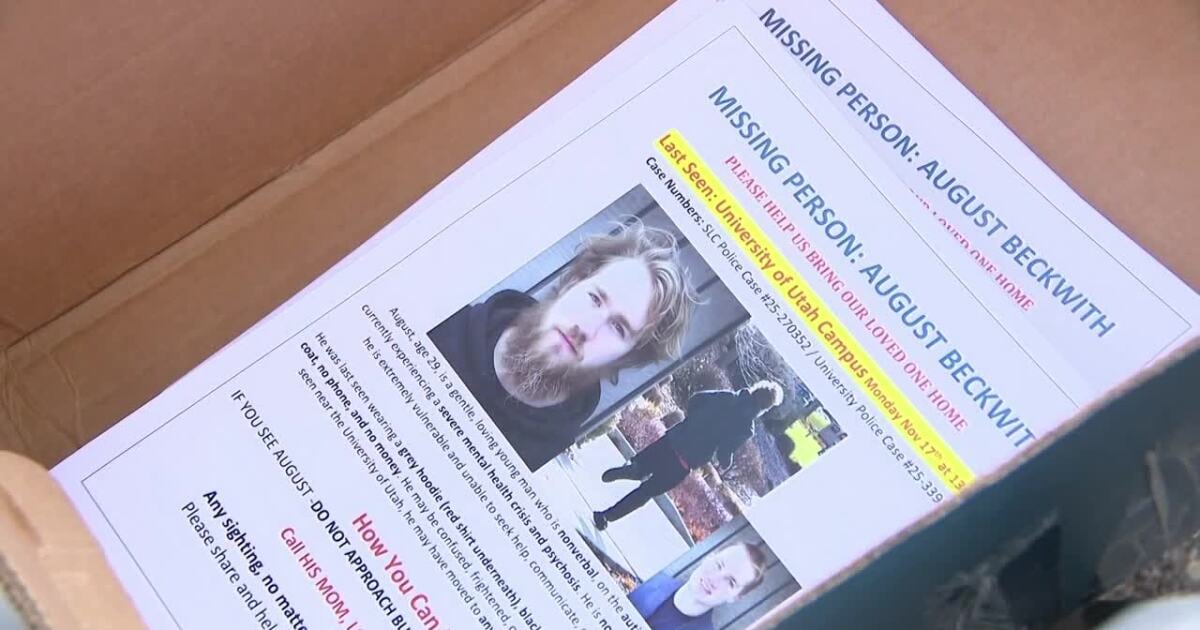
August Beckwith, who went missing on Nov. 17 near the University of Utah, survived thanks to “small acts of kindness,” his mother said.

Lori Beckwith doesn’t know where her son has been for the last three weeks, and she may never know.

But when she saw him Wednesday night, for the first time since he disappeared on Nov. 17, she said he had warm boots and clothing — things he did not have when he went missing.

“To the person — or people — who gave him layers of warm clothing, boots and food: you kept him alive,” she wrote in a Facebook post. “I will never forget it.”

Her son, August Beckwith, 29, is on the autism spectrum and is not verbal. He went missing near the University of Utah while “experiencing a severe mental health crisis and psychosis,” according to a missing person poster from the university’s public safety department.

According to the department, he had no coat, no cellphone and no money.

From that day until yesterday, Lori Beckwith had no idea where her son was. She said she lives a few hours away, and spent most nights in her truck, to stay close to where she thought he might be.

Wednesday evening, someone saw him at the Apollo Burger in Taylorsville, and asked officers to perform a welfare check, according to Aaron Cheshire with the Taylorsville Police Department.

Cheshire said officers identified August Beckwith using a fingerprint scanner, and told his family that they had found him.

“He was moving through various parts of the Salt Lake Valley, and that he managed to survive in extremely cold conditions,” Lori Beckwith wrote on her Facebook post. “What we do know is that he received small acts of kindness along the way that helped keep him alive.”

Throughout the search, Lori Beckwith wrote, people experiencing homelessness consistently tried to help, sharing sightings and showing “a level of compassion that was deeply moving.”

“It is almost certain that people who have very little themselves stepped forward to help him survive,” she added.

In the past, she said, her son has given money, which he earned driving for food delivery apps, to people experiencing homelessness. Then, she added, “when he needed it most, they took care of him.”

When Lori Beckwith got the phone call Wednesday telling her that her son was alive, she said it felt unreal. He is safe, she said, though exhausted. Now, she wrote, she plans to focus on helping him recover from the trauma of his ordeal.

Source: Utah News

People panned the Utah 2034 Olympic logo. Its designers explain their choices.

Designers of the much-maligned Utah 2034 Olympic and Paralympic transitional logo tried to give a nod to the 2002 mark while incorporating a whole-state approach and onerous International Olympic …

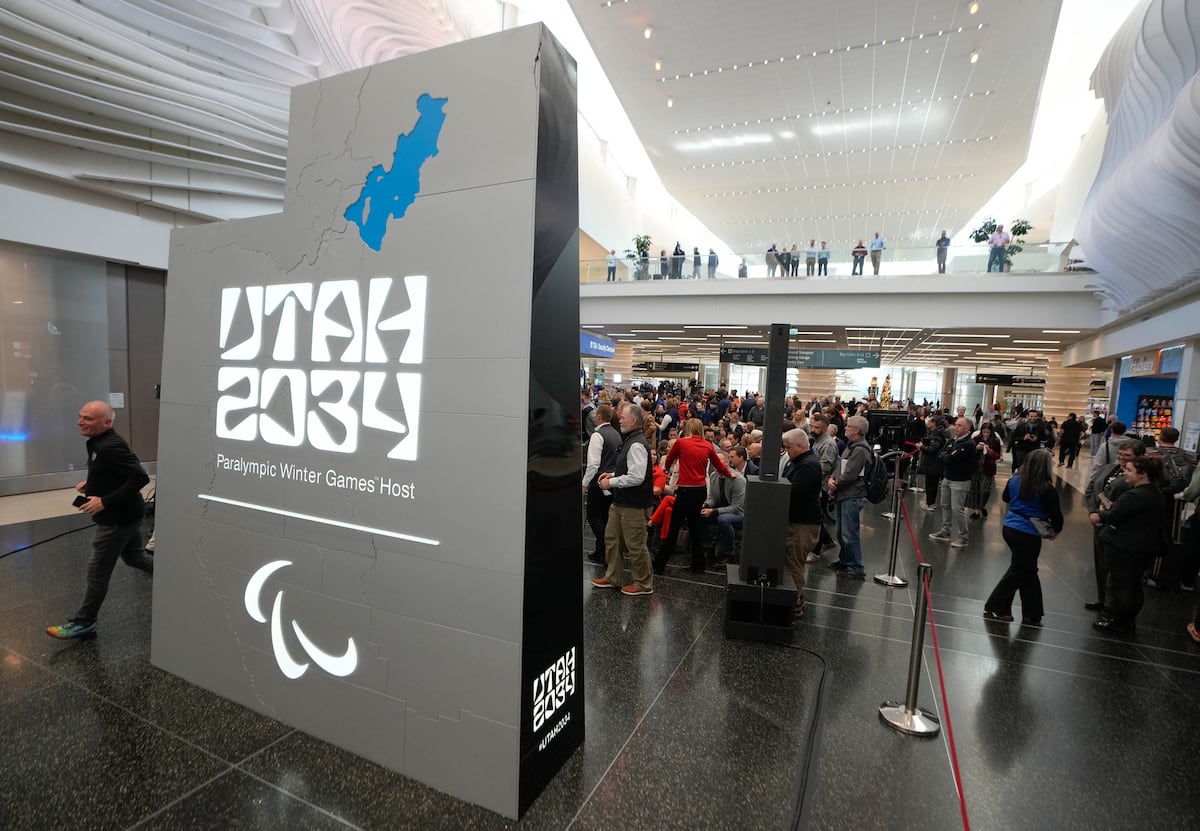
On a Monday, Gov. Spencer Cox stood in front of a crowd at the Salt Lake International Airport as Olympic officials unveiled both the official name and the transitional logo for the 2034 Winter Games. By Tuesday morning, the governor was standing in front of a room full of reporters and joking that the Utah 2034 logo had already fulfilled its purpose.

“It’s really brought people together,” he said, “because everyone seems to not like it.”

The logo has been controversial at best, widely panned at worst. It’s designed with a blocky font that mimics shapes found in Utah’s landscape — the most obvious of which is the “A” that replicates the contour of Delicate Arch. Commenters on social media sites and news articles have quipped it’s the same font used in CAPTCHAs or their fourth-grade book reports. Others complain it’s ugly or simply difficult to read.

To which its designers say: Try looking at it through a different pair of eyes.

The creators of the Utah 2034 transitional logo conferred with visually impaired athletes to, they say, make it as impactful as possible for as many people as possible in as many places as possible. They’ve created a piece that they say reflects the local Olympic and Paralympic committee’s whole-state approach to the 2034 Winter Games. And, they’ve done it all while working within the strict parameters set by the International Olympic Committee for transitional logos — which, in and of themselves, are fairly new.

Plus, noted Nate Morley, the lead designer, it’s art. It’s meant to be provocative.

“Art is subjective. And some people like things, and some people don’t like things. And that’s totally to be expected, and we certainly appreciate that,” said Morley, a Utah native whose company, Works Collective, also designed the LA28 Olympic logo. “I think the intent is to learn kind of why the logo looks the way it looks — what it’s meant to represent — and build that.”

The shape inside the zero, for instance, is evocative of a pictograph, according to a website local Olympic organizers launched to explain the controversial wordmark. The curves of the number two mimic those of a winding mountain road. When stacked, its letters and numbers form a checkerboard pattern reminiscent of Utah’s street grids.

Yet the design goes even deeper than that, said visually impaired athlete Danelle Umstead.

“Every Olympic logo gets backlash,” Umstead, a four-time Paralympian, said in a text. “People forget that logos aren’t created to be trendy — they’re designed to be recognizable for decades, across stadiums, uniforms, merchandise, tiny smartphone screens, and global broadcasts.

“A lot of the early criticism focused on aesthetics alone, without understanding that accessibility was part of the design story.”

And that is a process into which Umstead has special insight.

Meant to be seen

As a decorated Paralympic skier, Umstead has sat through more than a few logo reveals. They can be more difficult for the Park City athlete to navigate than the alpine ski courses she races with the guidance of her husband. While the crowd around her cheers, she said she’s often scrambling to pull segments of a logo up on her phone using “extreme zoom technology.”

“The world is celebrating, and I’m thinking, ‘Hang on — give me five more seconds so I can see it, too,’” Umstead said.

That’s why she said it meant so much to her when creative director Molly Mazzolini consulted with Umstead and four other visually impaired athletes on the design.

Umstead, who also competed on “Dancing with the Stars,” is legally blind from retinitis pigmentosa. Though she does have some sight, she said most logos, with their thin swoops or indeterminate colors, are lost on her.

“I ski 70 mph down a mountain, no problem,” she said. “But if you put a low-contrast logo on a website, that’s where I wipe out.”

(Lee Jin-man | AP) Danelle Umstead, right, and guide Rob Umstead of the United States compete in the women’s super-G, visually impaired, at the 2018 Winter Paralympics in Jeongseon, South Korea, Sunday, March 11, 2018.

Conversely, a unique logo with thick lines, a sans-serif font and high-contrast colors stands out. That’s not the case just for people like her, Umstead said, but for everyone.

“If I don’t have to squint, zoom, and pray to read your logo,” she said, “that’s good design.”

Mazzolini and local Olympic organizers introduced the new logo in black and white — which has the highest contrast — as a nod to the Paralympians. She noted, however, that colors can and will be added to the design, depending on where and how it will be used.

In some instances, the name of the host city — Provo or Salt Lake City, for example — will appear beneath the wordmark as well. Mazzolini said she can also see the design of the characters morphing to fit a certain sport or locale.

(Francisco Kjolseth | The Salt Lake Tribune) Monday marks 3,000 days until the Olympic Winter Games return to the state, as state and local Olympics organizers reveal a new name — Utah 2034 — at Salt Lake City International Airport on Monday, Nov. 24, 2025.

“I think it’s something that is all a possibility, because this transition logo process is so new within the Olympic space,” said Mazzolini, the founder of the Utah design firm Infinite Scale. “And I think we also need to think about it from the perspective of, it has a lot of growing to do.”

That growth will be closely regulated by the IOC.

Staying within the guidelines

It’s not like Mazzolini and her design team had a blank canvas when, last December, they began to imagine the kind of logo they would want to stand as the symbol of the Utah 2034 Olympics at least until 2029. (After which, Utah will have permission to begin soliciting sponsors and will be able to reveal its official mascots, symbols and logo).

The IOC had set strict parameters for the transitional logo — or, more accurately, the wordmark. Per the IOC guidelines, “These official marks are limited to typography — without symbols or icons — reserving the full creative expression for the official Games emblem released closer to the Games.”

But the restrictions don’t end there.

(Natacha Pisarenko | AP) IOC president Thomas Bach holds the board Salt Lake City during the 142nd IOC session at the 2024 Summer Olympics, Wednesday, July 24, 2024, in Paris. Salt Lake City was confirmed as host for the 2034 Winter Games by International Olympic Committee.

The logo had to be rectangular and match the height and width of the Olympic rings. It could be a maximum of two lines, but the IOC prefers it be one. When the Olympic rings and the Paralympic Ajitos are used, the IOC has dictated that the size of the rings must be “no larger than ⅓ of Y where Y is the total surface defined by drawing a rectangle around the Olympic rings, the Games signature, the designation and the Agitos (excluding the divider lines).”

It’s no wonder that the two other Games that have adopted transitional logos — The French Alps 2030 and Brisbane 2032 — went with a simple, bolded font.

“They just communicate a place. They’re not trying to evoke any story or emotion,” Morley said. “So I just give a lot of credit to the organization for looking for ways to sort of tap into the passion of the people of Utah and their excitement for the games.”

With that as his charge, Morley found some inspiration, and some wiggle room, within those restrictions.

Picking a font

The IOC guidelines may not allow the use of symbols in transitional logos, but they do explicitly permit the host to choose the font. So, he began playing with creating a font that evoked landscapes found in Utah, from tip to tail.

Delicate Arch as the “A” was an easy choice. For other characters, he drew inspiration from a collection of photographs, from city streets to the bobsled track to mountain peaks. Some were aerial views, others were closely cropped to focus on a particular bend or squiggle.

“The intent was not to necessarily represent any one feature literally in the letter forms,” Morley said, “but to have the totality of the letter forms feel like they were evocative of the totality of all the topography and all the features of the state.”

Morley said he submitted several options to the Utah 2034 design team. The one picked was no doubt among the most audacious. So, it was no surprise to him that it also provoked a strong response.

“People care a lot about their community. They care a lot about the culture that they’re part of. They care a lot about sports. They care a lot about the Olympics, whether it’s far away or whether it’s in their hometown,” he said. “A brand like this sits at sort of the epicenter of all those things coming together.”

Letting 2002’s logo ‘live within itself’

The same can be said for the 2002 Winter Games. That logo, a stylized, colorful snowflake dubbed the “Crystal,” is beloved by many Utahns but more widely is generally considered simply serviceable. Milton Glaser, the designer of the I (heart) NY logo, in 2022 rated it a 70 out of 100 — far from the highest among Olympic logos but tied for best for all of the Winter Games since.

Mazzolini worked in design during the 2002 Olympics, helping sponsors use that logo and the Olympic rings in their ad campaigns. For the 2034 Games, she said, the design team wanted to give a nod to the 2002 brand while allowing it to “live within itself.”

The transitional logo does that, she said.

“That bold choice does provide a strong legacy for us,” she said, “as well as gives us the runway to continue to tell the story.”

As for the backlash — which included members of the public posting their own, often AI generated, alternatives — she said that’s a common part of the design process. And while she didn’t go so far as to say there is no such thing as bad publicity, she did note that the logo was viewed more than 600,000 times between Facebook and Instagram in the first 48 hours after its airport unveiling.

Members of the Utah 2034 executive committee also stood by their choice, for now.

During a media scrum last week, following the monthly steering committee meeting, Utah 2034 CEO Brad Wilson and president Fraser Bullock said they don’t expect the logo to change much in the next three or four years. After that, though, they aren’t making any guarantees.

Next time a Utah governor unveils an Olympic logo, it just might be a little less bold.

“2029 or 2030 will be a different process,” Brad Wilson said, “And this will be a good platform for us to move from and work from and learn from.”

Note to readers • This story is available to Salt Lake Tribune subscribers only. Thank you for supporting local journalism.

Source: Utah News