A 7-year-old boy from Utah has officially broken a world record, becoming the youngest documented person to complete the 21-mile Rim-to-Rim hike of the Grand Canyon.
A 7-year-old boy from Utah has officially broken a world record, becoming the youngest documented person to complete the 21-mile Rim-to-Rim hike of the Grand Canyon.
Everee, a leading payroll software built for staffing and gig work, today announced that Chief Commercial Officer Dana Gagnon has been named to the Utah Business 2026 Women to Watch list. The …
Everee’s Chief Commercial Officer recognized for driving company growth and lifting the next generation of leaders
SALT LAKE CITY, May 19, 2026 /PRNewswire/ — Everee, a leading payroll software built for staffing and gig work, today announced that Chief Commercial Officer Dana Gagnon has been named to the Utah Business 2026 Women to Watch list. The recognition honors women across Utah who are driving meaningful change in their industries and communities.
Utah Business’s Women to Watch program recognizes leaders who combine professional excellence with a genuine commitment to developing others. Gagnon was selected for her role in scaling Everee’s commercial organization, her track record of mentorship, and her contributions to Utah’s tech community.
“Dana is the reason Everee shows up the way it does in the market,” said Brett Barlow, CEO of Everee. “She brings the same clarity, discipline, and empathy to revenue leadership that she brings to storytelling. She is constantly mentoring, developing talent, and raising the standard for everyone around her. If I could build a company with 1,000 Danas, I would.”
Gagnon joined Everee as CMO and has since expanded her leadership across the entire commercial organization, building the company’s go-to-market function from the ground up and developing the brand, messaging, and commercial strategy that has helped drive more than 200% company growth. Among her most notable efforts, she led a full company rebrand in just six weeks and spearheaded several integrations with leading staffing and workforce platforms.
Gagnon previously held marketing leadership roles at Pluralsight, where she was part of the team that guided the company through its IPO. She also serves as the Local Ambassador for Exit Five in Salt Lake City, where she hosts networking and professional development events for B2B marketers, and volunteers with organizations focused on economic mobility and food justice.
“Being named to this list is a reflection of the people I’ve had the privilege of working alongside,” said Gagnon. “They’re what make a hard job feel worth it and a great job feel electric. I’m proud of what this team has built at Everee and grateful to be recognized with so many remarkable women who are doing amazing work in their fields.”
The full honoree list can be seen in the May 2026 issue of Utah Business.
About Everee Everee is the real-time payroll platform built for businesses with flexible workforces. With Everee, companies can pay W-2 employees and 1099 contractors the moment work is done — daily, weekly, or on demand — without the manual processes, fixed pay cycles, or compliance headaches that come with legacy systems. From automated multi-state compliance and built-in payroll financing to white-label integrations and pay cards, Everee gives businesses the tools to pay people faster, scale without adding complexity, and stop losing workers to competitors who do. Everee serves staffing, home care, mortgage, delivery, gig, and SaaS businesses across all 50 states. Learn more at everee.com.
Add another guest to Utah football’s growing list of high school recruiting visits. Braxton Daniel, a tight end prospect out of Jenks High School (Oklahoma), ha …
Add another guest to Utah football’s growing list of high school recruiting visits.
Braxton Daniel, a tight end prospect out of Jenks High School (Oklahoma), has lined up an official visit with the Utes.
The 2027 recruit is slated to check out the campus in Salt Lake City during the weekend of June 5-7, according to a recent post from his X account.
Ranked by 247Sports as the No. 61 tight end in the class, Daniel has been fielding interest from Power 5 programs for the past several months. Utah, which extended an offer on Feb. 2, was one of the first schools in the mix for the three-star prospect, along with Arizona, Duke and Oklahoma State.
More recently, Daniel has received offers from Iowa State, SMU, Maryland, Baylor, West Virginia and TCU, as well as a few Group of 6 schools.
According to 247Sports, Daniel has visits lined up with Oklahoma State (May 29) and Duke (June 12). The recruiting service also has him down for an SMU visit for the June 5 weekend, and it’s unclear whether that trip to Dallas has been rescheduled in light of his Utah visit.
The Utes have yet to land a commitment from a tight end recruit in the 2027 class. They currently hold pledges from running back Jonah Mailei, defensive lineman Tiki Teeples and edge rusher Jack Henderson. All three prospects are rated by 247Sports as three-stars.
At the very least, landing Daniel’s commitment would help fill out Utah’s depth at the position. He’s the No. 3-ranked tight end from the state of Oklahoma and is coming off a productive junior season in which he hauled in 16 catches for 545 yards and six touchdowns for the Trojans, who advanced to the semifinal round of the state 6A-I playoffs this past season.
The weeks following Memorial Day weekend are going to be a pivotal stretch for Morgan Scalley and his staff. In addition to Daniel, Utah is set to host offensive linemen Tye Kennedy and Kelvin Eiwo, plus edge rusher Josh Christensen and linebacker Cam Pettijohn, during the June 5 weekend.
The Utes are also going to have blue-chip wide receivers Blake Wong (May 29) and Bode Sparrow (June 12), as well as four-star offensive tackle recruit, Jake Hildebrand (June 15), in the coming weeks.
Utah’s three-man recruiting class is ranked by 247Sports as the No. 71 class in the country and the No. 14 class in the 16-team Big 12.
A federal jury in Salt Lake City found multiple business owners guilty for their participation in a nationwide scheme to defraud victims out of more than $30 million.
SALT LAKE CITY (ABC4) — A federal jury in Salt Lake City found multiple business owners guilty for their participation in a nationwide scheme to defraud victims out of more than $30 million.
After a five-week trial, three individuals were found guilty of a scheme that induced victims to invest in Noah’s Event Centers, promising “impressive long-term financial returns,” a press release from the U.S. Attorney’s Office, District of Utah, states.
Christopher J. Ashby, 52, of Salt Lake County; Jordan S. Nelson, 45, of Salt Lake County; and Scott W. Beynon, 49, of Davis County, were each found guilty of 17 counts of wire fraud and one count of conspiracy to commit wire fraud.
Victims of the scheme were defrauded out of more than $30 million after being persuaded by the defendants, including three others who pleaded guilty earlier this year, to invest in Noah’s Event Centers as part of 1031 exchanges. Despite their promises that the investments were safe, assuring them that Noah’s was a reliable corporate partner, the event centers were actually an unprofitable enterprise sustained only through infusions of new investor funds.
According to the DOJ, five promised buildings were never built and investor funds were diverted elsewhere. Trial evidence showed that these individuals misrepresented important information about the financial health of the event centers and falsely promised to safeguard victims’ money during construction.
“Marketing materials displayed at trial depicted luxurious Noah’s event spaces and boasted of Noah’s ‘demonstrated . . . ability to examine and modify their business to achieve maximum profitability,’” the release states.
Advertisement
Meanwhile, the defendants were reportedly aware that Noah’s was not profitable and facing “dire financial straits,” according to the DOJ.
“Investors were left with empty, undeveloped lots rather than the promised venues, while the defendants received millions of dollars for their role in the scheme,” the release states.
During trial, prosecutors presented satellite images of the undeveloped event centers, including unbuilt sites in Dublin, Ohio, Independence, Ohio, Toledo, Ohio, Jacksonville, Florida, and Carmel, Indiana.
The defendants will be sentenced before a U.S. District Court Judge at the Orrin G. Hatch United States District Courthouse in downtown Salt Lake City in the coming months. This case is being investigated by the United States Postal Inspection Service (USPIS).
The three other codefendants who pleaded guilty this year are identified as:
William J. Bowser, 63, of St. George, Utah, who is the founder of the company and pleaded guilty in the middle of trial on April 16, 2026, to conspiracy to commit wire fraud.
John D. Hamrick, 67, of Franconia, New Hampshire, who pleaded guilty on January 21, 2026, to three counts of wire fraud
Scott L. Rutherford, 54, of Utah County, Utah, who pleaded guilty on June 9, 2025, to wire fraud.
No further information is available at this time.
Latest headlines:
Copyright 2026 Nexstar Media, Inc. All rights reserved. This material may not be published, broadcast, rewritten, or redistributed.
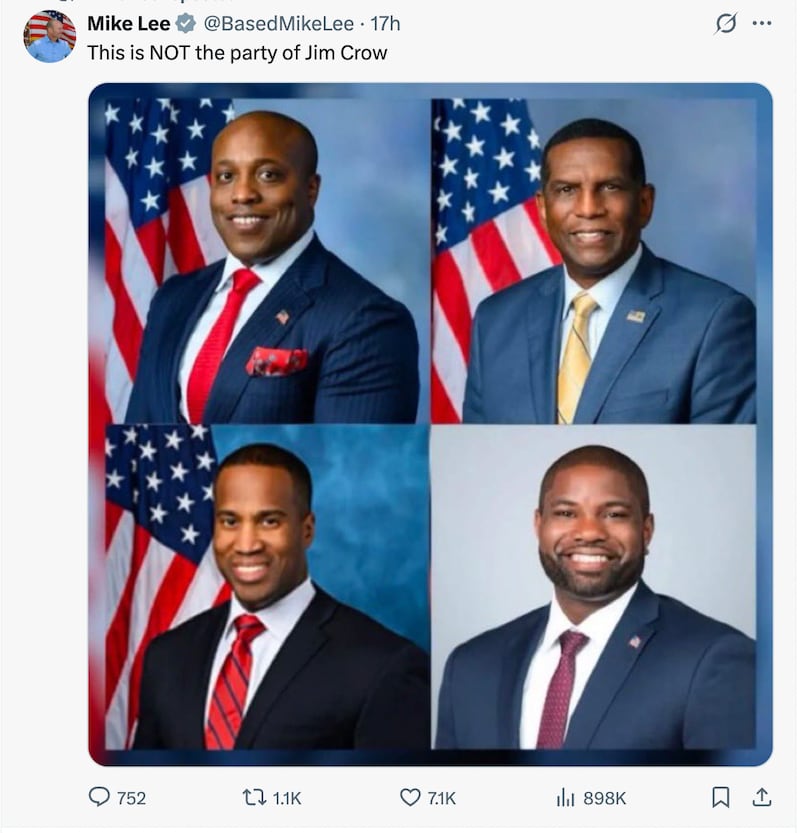
Utah Senator Mike Lee has received backlash after posting a collage of the four Black Republican House members to his personal X account to prove his party doesn’t have a diversity problem. “This is …
Utah Senator Mike Lee has received backlash after posting a collage of the four Black Republican House members to his personal X account to prove his party doesn’t have a diversity problem.
“This is not the party of Jim Crow,” he wrote, above the four headshots.
X/Mike Lee
The problem is, come January, none of them will be in Congress anymore. None of the four men are running for re-election, and Republicans are not expected to add any other Black faces to their congressional delegation at the midterms.
The four departing congressmen are Wesley Hunt of Texas, John James of Michigan, Byron Donalds of Florida, and Burgess Owens of Utah.
James and Donalds are running for governor in their respective states, Hunt took a tilt at a Senate slot and lost, and Owens is retiring because redistricting in Utah remade his seat as nominally Democrat.
“These are the only 4 black ppl in the Republican caucus and they’re all leaving office next year. Yet here you are flexing like your entire political ideology isn’t undergirded by racism, lol,” one X user replied.
Another user pointed out that even if the four were sticking around it wasn’t a shining example of representation.
“4 entire black men (no black women) in a body of 435??? You really made it!” they pointed out.
The four men were specifically recruited to the GOP as part of former Speaker Kevin McCarthy’s diversity push. The effort to increase Black representation within the party appears to have departed with McCarthy.
Come January, just one Black Republican will remain on Capitol Hill: Senator Tim Scott of South Carolina.
X
“When I look at my party, we look like the most restrictive country club in America,” McCarthy said in 2023 speech after leaving Congress.
Despite being reminded of all this by X users after he posted the picture, Lee continued to post memes about the Democrats being the real “party of Jim Crow,” a line popular among MAGA mouthpieces due to the history of Jim Crow laws being implemented by Southern Democrats.
That line of attack ignores the realignment of the two parties in the first half of the twentieth century, when Democratic President Franklin D. Roosevelt expanded the social safety net, led America through the Great Depression, and secured the votes of 75 percent of Black American voters.
One-day conference and evening celebration spotlighted Latina leadership, economic impact and new community hub in West JordanSANDY, Utah, May 18, 2026 (GLOBE NEWSWIRE) — Mountain America Credit …
Mountain America Credit Union
One-day conference and evening celebration spotlighted Latina leadership, economic impact and new community hub in West Jordan
SANDY, Utah, May 18, 2026 (GLOBE NEWSWIRE) — Mountain America Credit Union recently partnered with the Utah Hispanic Chamber of Commerce (UHCC) for two special events on May 7, 2026. The day began with the Power of Latinas in Business conference and ended with the UHCC’s monthly Contactos networking event, which included a special ribbon cutting to celebrate the UHCC’s new offices located inside the Mountain America Business Center in West Jordan, Utah. These events highlighted the credit union’s continued investment in empowering Latina entrepreneurs and strengthening community partnerships.
As title sponsor, Mountain America welcomed UHCC business leaders, community organizations and entrepreneurs to the conference from 12:30 to 4:30 p.m. The event featured keynote presentations and panel discussions focused on economic growth, leadership development and opportunities for Latina-owned businesses.
“The Utah Hispanic Chamber of Commerce is in a powerful season of growth, and a key part of that evolution has been building strategic partnerships that meaningfully expand our ability to serve our members,” said Victoria Petro, executive director of the UHCC. “Our partnership with Mountain America exemplifies that shared commitment. Their support, through our signature programming and our new office in West Jordan, strengthens the resources and opportunities we can offer Hispanic‑owned businesses across the region. This ribbon cutting represents an exciting next step in deepening our impact and creating long‑term value for our community.”
The program opened with remarks from Mountain America representatives, including Sharlene Wells, chief public affairs officer, followed by a keynote presentation on the economic impact of U.S. Latinas from Jennifer Tarazon, director of multicultural engagement.
Panel discussions and presentations focused on empowering Hispanic female entrepreneurs and offering insights for organizations seeking to serve and collaborate with Latina professionals. Expert insights were provided by representatives from the Suazo Business Center, Utah SOMOS Foundation, Latinos in Action, Mujeres Unidas de Utah and the UHCC.
Following the conference, the UHCC hosted its Contactos networking event at 6 p.m. The event included an official ribbon cutting to celebrate the chamber’s new office space, marking a milestone in its continued growth and partnership with Mountain America. Attendees included West Jordan Mayor Dirk Burton and other elected officials, Mountain America senior leadership and local chamber presidents.
During the celebration, Mountain America was recognized by the UHCC as the Best Workplace for Hispanic Employees of 2025. Rob Brough, chief marketing officer of Mountain America, accepted the award and delivered remarks.
“Mountain America is dedicated to providing opportunities for economic empowerment and inclusive growth. I’m proud to accept this award, which reflects our commitment to fostering opportunity and creating spaces where our communities can connect and thrive,” Brough said. “We are proud to partner with organizations that are making a lasting impact.”
For more information about Mountain America, visit macu.com.
About Mountain America Credit Union With more than 1 million members and $22 billion in assets, Mountain America Credit Union helps its members define and achieve their financial dreams. Mountain America provides consumers and businesses with a variety of convenient, flexible products and services, as well as sound, timely advice. Members enjoy access to secure, cutting-edge mobile banking technology, over 110 branches across multiple states; and more than 50,000 surcharge-free ATMs. Mountain America—guiding you forward. Learn more at macu.com.
Federally insured by NCUA. Mountain America Federal Credit Union does business as (dba) Mountain America Credit Union. Loans on approved credit.
Utah’s heavily Mormon population is largely opposed to all gambling, even on financial exchange platforms …
Utah is home to some of the strongest anti-gambling laws in the US, with vehement opposition dating back more than a century. But as prediction markets have surged – allowing users to bet on almost anything, from elections to sports to geopolitical events – the state has not escaped the nationwide boom.
Its Republican leaders are fighting back, setting up a battle between one of the country’s most conservative states and a rapidly growing industry that is embraced by a Republican administration in Washington – and members of the US president’s own family.
“It’s a unique issue,” Brady Brammer, a Republican state senator in Utah, said. “Because you have a lot of very conservative Republicans [in Utah] who are standing up to a conservative administration, essentially without dissent among them.”
Prediction markets such as Kalshi – recently valued at $22bn – and Polymarket allow users to “trade” on events from Oscar picks to election outcomes, and have surged in popularity in recent years.
The platforms have long contended that they do not facilitate gambling – an argument they have used to bypass the conventional regulatory landscape for gambling firms – and they operate almost nationwide.
With the backing of federal regulators under Donald Trump, they classify their products as financial exchanges, governed by federal commodities law, rather than state gambling rules.
Unlike casinos or traditional sports books, which set the odds on customers’ bets, prediction market users “trade” against one another while the platforms collect transaction fees. A Kalshi spokesperson said the platform “operates like any other derivative market”.
But around the country, an increasing number of state officials are taking a different view. Prediction markets are simply gambling by another name, they argue, and an encroachment on state authority.
So far, roughly 20 federal lawsuits have been filed nationwide over the platforms, with early rulings seeing split results. Among the most outspoken opponents of these platforms are Republican lawmakers in Utah, a key battleground in this escalating engagement.
Spencer Cox, the Republican governor of Utah, has no time for the industry’s arguments. Prediction markets are “gambling – pure and simple”, he declared in February, and have “no place in Utah”.
Before Trump’s return to power in January 2025, the federal government appeared equally concerned about some of the platforms’ offerings.
Under then president Joe Biden, the Commodity Futures Trading Commission (CFTC), the government agency that regulates the US derivatives markets and oversees prediction markets, sought to impose restrictions on the platforms and ban certain event contracts tied to elections, politics and sports. The FBI raided the home of Polymarket’s founder in November 2024, as the site faced scrutiny.
Under Trump, however, the CFTC has reversed course, defended its jurisdiction over the sector and curtailed the Biden-era crackdown.
At the same time, the president’s eldest son, Donald Trump Jr, serves as an adviser to both Kalshi and Polymarket. The president’s own company the Trump Media and Technology Group, which operates his Truth Social platform, has also explored launching its own prediction market product.
“We have a president who operates casinos,” said Brammer, the state senator, referring to Trump’s past ownership of casinos. “He clearly has no problem with gambling, and so it’s not overly surprising that his agency heads, particularly in this space, are much more gamble-friendly than they previously have been, but Utah is not.”
Brammer and his colleagues are prepared to push back. “It doesn’t matter whether it’s Trump, or Biden or whatever administration it is, we’re going to stand up for what we believe needs to happen in Utah,” he said.
After the CFTC said in February that it was filing a friend-of-the-court brief defending its “exclusive jurisdiction” over the platforms, Cox vowed that he would use “every resource within my disposal as governor” to challenge them in court.
Derek Brown, Utah’s attorney general, has taken a similar stance,arguing that placing a “trade” on these platforms is “simply a bet, dressed up in different clothing”. In an opinion piece for the Deseret News, Brown wrote: “Betting. Wagering. Trading on futures. A wolf in sheep’s clothing is still a wolf …
“I was recently asked whether I plan to do anything about the rapid rise of prediction market apps that are now operating in Utah,” he added. “My response? You can bet on it.”
The industry tried to get in first, taking the fight to court. In February, Kalshi sued Cox and Brown, alleging that Utah was preparing to block the company “from offering event contracts for trading on its federally regulated exchange”. The pair had “repeatedly represented that they believe Kalshi is operating unlawfully under Utah anti-gambling laws”, the company said.
Kalshi, which is seeking an injunction against any such ban, contends that any move by Utah to prohibit it from operating in the state would interfere with federal regulations – specifically those legislated by Congress to oversee financial derivatives and their exchanges. The litigation remains ongoing.
In a statement, a spokesperson for Kalshi said: “Whether a state has gambling operations or whether they ban it is irrelevant to federal law, which says you can have nationwide exchange for event contracts.”
“This is for the CFTC to decide, not the states,” it added. The CFTC and Polymarket did not respond to requests for comment from the Guardian.
Kalshi recently secured a victory in Arizona, where a federal judge blocked the state from pursuing criminal charges tied to alleged violations of state gambling laws. But the company has faced setbacks in Nevada and Tennessee.
“When we look around the country, they win some, they lose some,” John Holden, a business law professor at Indiana University who focuses on sports and gambling law, said of the prediction market platforms. “A lot of people would look at a state like Utah and basically say, well, they don’t have gambling, of course [Kalshi] is going to lose.
“But the reality is, when the federal judges are looking at these cases, they’re looking at, legally, is this something under the CFTC jurisdiction, in their view? And there’s clearly a lot of dispute here, because we’re getting these different court cases and decisions around the country.”
The complex patchwork of rulings raises a larger question, according to Holden: will the US supreme court take on this question?
With Utah’s legal battle ongoing, state lawmakers have moved to reinforce their position by amending the state constitution.
In March, the GOP-controlled Utah state legislature expanded the state’s legal definition of gambling in its ban to include “proposition bets” – defined as “a gambling bet on an individual action, statistic, occurrence or non-occurrence” – in a bid to ensure prediction markets will be covered. Cox signed the measure later that month.
Prediction market platforms are “unacceptable” in Utah, and should not operate in the state, Brammer, the Republican state senator who sponsored the bill behind the constitutional amendment in the state senate, said.
They carry “every characteristic of gambling”, he argued – a view shared by a majority of Utahns. A recent poll found that 50% of adults in the state consider prediction markets to be gambling, while 30% do not.
Brammer believes that lawmakers in Utah will “fight to the bitter end, to the US supreme court, before we would acknowledge that it is appropriate to have prediction markets in Utah”, he said. The legislation passed unanimously in the state senate.
Democratic state senator Stephanie Pitcher, who also backed the measure, said she was concerned about the potential “of insider trading and a type of either market manipulation or certain outcomes that could come forward” on these platforms.
Even Trump, when asked last month about concerns that federal employees might be using insider information on the prediction markets, claimed he was “never much in favor” of the practice.
The companies say that they monitor for such risks. Earlier this year, Kalshi expanded its surveillance and enforcement efforts to detect and remove accounts engaging in insider trading and market manipulation.
Pitcher was not surprised Utah lawmakers have been so outspoken in their opposition. The state, along with Hawaii, remains one of the few without any form of legalized gambling, prohibiting everything from casinos to lotteries to sports betting.
Utah is heavily influenced by the teachings of the Church of Jesus Christ of Latter-day Saints, which counts more than 2 million members in the state – over half its population. And the church “really views gambling as a vice that leads to addiction, selfishness, destructive behaviors”, Pitcher said. “I think that is why you’re seeing Utah maybe a slightly different position than other red states.”
Patrick Mason, a professor of religious studies at Utah State University, added that Latter-day Saints are still “far the single biggest group in terms of powerbrokers in the state”, adding: “All of the Utah congressional delegation are Latter-day Saints – the governor, lieutenant governor, the senate and the house leadership are all Latter-day Saints.”
For the church, Mason explained, gambling is seen “as a moral issue” and “as a character issue” that can be tied to harmful social effects.“The church has also always had a very strong emphasis on a work ethic, on independence, on self-reliance. And they see gambling as trying to get something for nothing.”
Utah lawmakers are taking this fight to Washington, where the representative Blake Moore, a Republican from Utah, introduced the Event Contract Enforcement Act alongside representative Salud Carbajal, a Democrat from California, in March. The legislation, they said, would prohibit trading contracts tied to wars, illegal activity, elections and sports – and empower states to decide whether to allow the practice in their communities.
Moore has introduced 94 bills to the House floor in the five years since he was first elected, according to his congressional profile. “I’ve never had more interest in a single bill we just introduced,” he said. “So that’s a good sign.”
A Kalshi spokesperson said the company “already prohibit[s] markets directly tied to wars and illegal activity” and that “sports and elections markets are regulated by the CFTC”.
In the US Senate, another Utahn, Republican John Curtis, has introduced legislation alongside Adam Schiff, a Democrat from California, that would bar CFTC-registered entities from offering any contract that resembles a sports bet or casino-style game.
Curtis and Schiff, along with the Democratic senator Elissa Slotkin and the Republican senator Todd Young, have also introduced a bill that would ban federal officials and government employees from using insider information to trade on prediction contracts.
The Kalshi spokesperson said the firm is “supportive of legislation that codifies into law what we already do – ban federal officials and government employees from using insider information to trade on prediction markets”.
But Utah Republicans are not prepared to stand down.
“Let’s call a spade a spade: sports prediction markets are gambling, and gambling is regulated by states, not the @CFTC,” Curtis, the US senator, wrote on X in February. “Some wagers just aren’t smart – and betting against Utah is one of them.”
Compass Minerals plans to jump back into the lithium market by partnering with technology startup EnergyX to extract the battery metal from Utah’s Great Salt Lake, a move that comes as prices …
Compass Minerals plans to jump back into the lithium market by partnering with technology startup EnergyX to extract the battery metal from Utah’s Great Salt Lake, a move that comes as prices …
The Utah Jazz have enough draft capital to chase the Washington Wizards’ No. 1 pick, but it’s only to a point.
After years of stockpiling draft capital and developing young talent, Utah Jazz suddenly find themselves within striking distance of the No. 1 overall pick in the 2026 NBA Draft. That pick is currently owned by the Washington Wizards. Of course, with elite prospect AJ Dybantsa viewed by many evaluators as a potential franchise-altering superstar, the temptation to move up one spot from No. 2 has become impossible to ignore. The question facing Danny Ainge and GM Justin Zanik is how far they should actually go before the price becomes self-destructive.
Foundation in place
Gabriel Mayberry-Imagn Images
Utah’s 2025-26 season was defined by intentional patience and the steady evaluation of their young core. The Jazz allowed their young backcourt and versatile wing depth to play through mistakes, building a foundation of resilience. The team flashed dynamic offensive potential and an intriguing, modern style of play under Will Hardy. However, they ultimately prioritized the preservation of their pristine asset chest over a forced playoff push.
Winning the No. 2 pick in the lottery validated the organization’s long-term vision. The Jazz proved they already possess the culture and developmental ecosystem necessary for sustainable success. What they still lack, however, is that singular offensive alpha. Utah has complementary pieces such as Lauri Markkanen. What it does not yet have is the centerpiece. That is precisely where Dybantsa’s upside comes in.
Roster and draft capital
As the Jazz pivot toward the 2026-27 season, their primary objective is to acquire a true franchise cornerstone. Utah already boasts versatile defenders and ascending young talent. Players like Markkanen, Walker Kessler, and Keyonte George provide the kind of structural support many rebuilding teams spend years trying to find.
Holding the No. 2 pick alone already places Utah in a phenomenal position. Prospects like Darryn Peterson are viewed as potential future stars in their own right. That said, Dybantsa’s ceiling changes the calculus entirely. He projects as the type of two-way player capable of becoming the face of an era.
More importantly, Utah possesses the draft flexibility necessary to make the Washington Wizards seriously consider moving down. Few organizations can compete with the Jazz’s collection of future first-round picks. That asset surplus allows Utah to negotiate aggressively without completely gutting its own roster.
Absolute limit
When discussing a move from No. 2 to No. 1, perspective matters. This is, objectively speaking, a luxury upgrade. Of course, luxury upgrades should never come at the cost of organizational stability.
Article Continues Below
The framework of any realistic deal must begin with the No. 2 overall pick. That alone gives Washington the opportunity to select another elite prospect like Peterson while remaining firmly positioned within the top tier of the draft. From there, Utah should be willing to include two future first-round picks. These should be selections acquired from other franchises rather than their own unprotected picks. That distinction matters enormously.
The Jazz cannot mortgage their own long-term flexibility chasing one player, regardless of Dybantsa’s talent. Utah’s rebuild has worked specifically because the organization resisted desperation. Sacrificing future unprotected Jazz picks would fundamentally undermine their entire long-term strategy.
In addition to draft compensation, Utah could include a promising young rotational player to sweeten the package. Someone outside the franchise’s untouchable core could help Washington accelerate its rebuild while preserving Utah’s overall structure. Of course, there are names that must remain completely off the table. Markkanen, Kessler, and George cannot be included.
Utah can walk away
Rob Gray-Imagn Images
The danger in pursuing the No. 1 pick is becoming so obsessed with the mystery box that you forget how valuable your current position already is. The Jazz are guaranteed access to an elite prospect at No. 2. That is clear leverage.
If Washington demands a king’s ransom, such as multiple premium players, unprotected Jazz picks, or foundational pieces, then Utah must certainly walk away. Danny Ainge understands this better than most executives alive.
If the Wizards are willing to make a reasonable deal, the Jazz should absolutely pursue it aggressively. However, if the price becomes organizational self-sabotage, Utah should stay put, draft an elite talent at No. 2, and continue building one of the league’s brightest futures.
After years of stockpiling draft capital and developing young talent, Utah Jazz suddenly find themselves within striking distance of the No. 1 overall pick in the 2026 NBA Draft. That pick is currently owned by the Washington Wizards. Of course, with elite prospect AJ Dybantsa viewed by many evaluators as a potential franchise-altering superstar, the temptation to move up one spot from No.
Utah Gov. Spencer Cox warned on Monday that Americans have not yet woken up to the high-stakes era of global technological competition that artificial intelligence has unleashed.
SALT LAKE CITY — Utah Gov. Spencer Cox warned on Monday that Americans have not yet woken up to the high-stakes era of global technological competition that artificial intelligence has unleashed upon the world.
If the United States does not prioritize American AI dominance by building infrastructure as rapidly as the country used to, then it will have much bigger problems to worry about than data centers, Cox said.
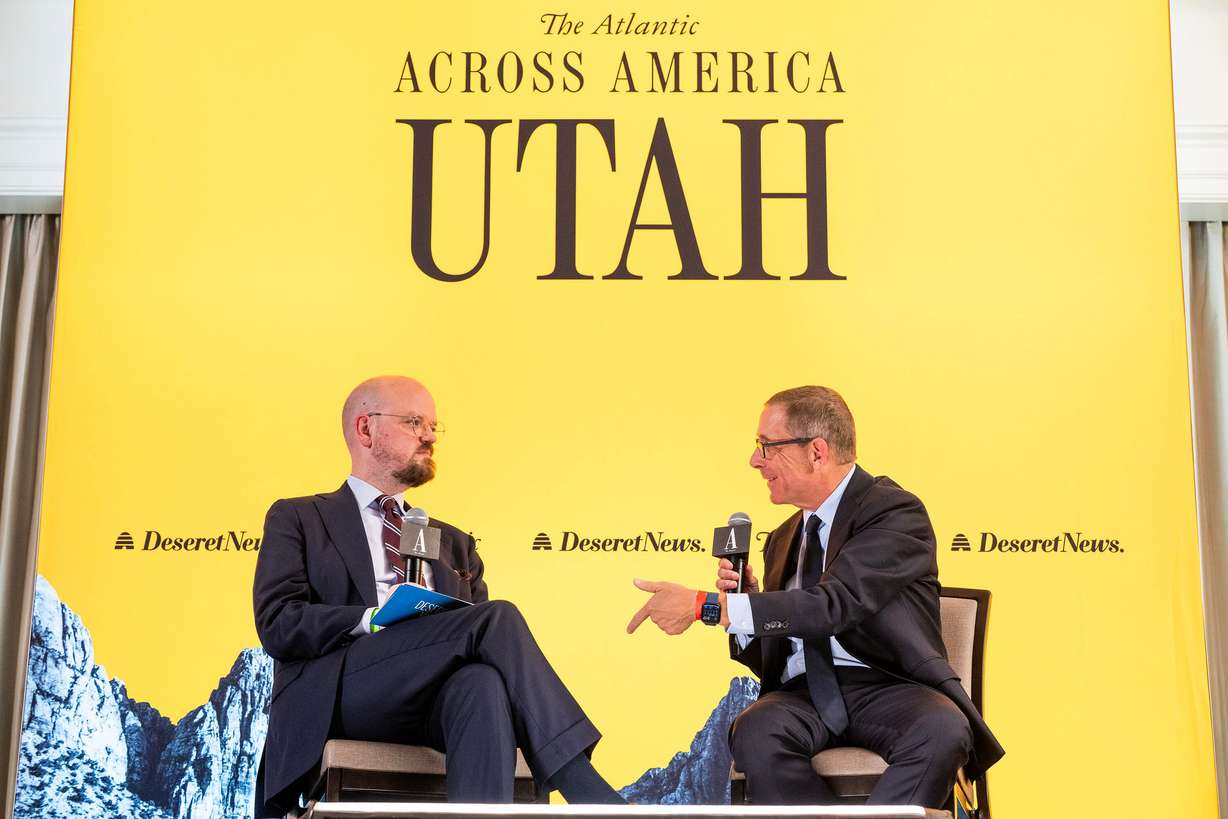
“I don’t know that we have our eyes as open as we should on this,” Cox said during a panel discussion with Deseret Voices host McKay Coppins for the Atlantic Across America tour hosted in partnership with the Deseret News.
President Donald Trump has taken aggressive executive action to accelerate data center development, including by asking top military officials to encourage states to support the administration in an international AI arms race.
On Monday, Cox described what he saw as the existential risk presented by America’s Cold War-esque contest with China over AI models like Claude Mythos, which can autonomously identify and abuse cybersecurity weaknesses.
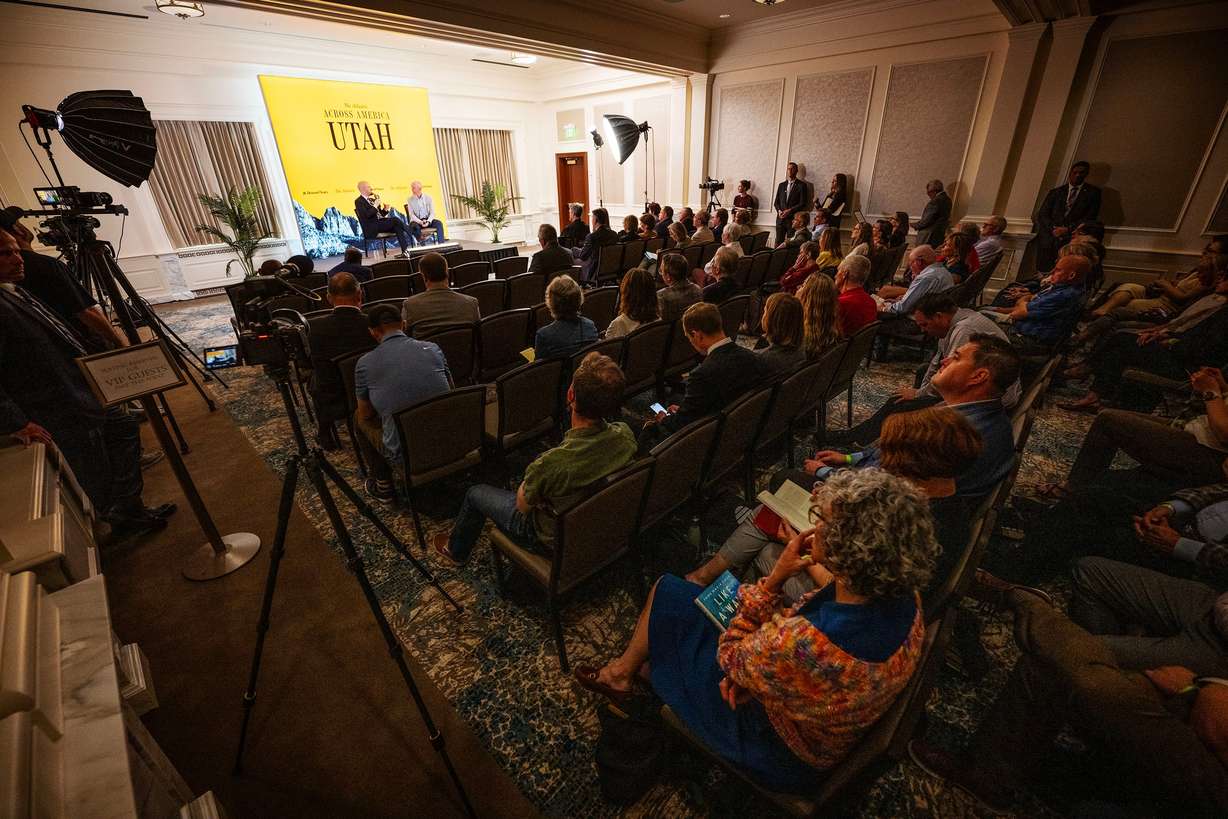
One of the audience members records the discussion between The Atlantic staff writer McKay Coppins and Ashley and Ryan Smith, co-founders of Smith Entertainment Group, on the value of live sports in an AI-driven era, the evolving future of entertainment and their vision for revitalizing Salt Lake City, as The Atlantic Across America tour — a three-year, 50-state event series delving into important topics of our day — partners with the Deseret News in Salt Lake City on Monday, May 11, 2026. (Photo: Scott G Winterton, Deseret News)
“If China had gotten that piece of technology first — that could exploit the vulnerabilities of almost every major company, and government entity in our country — it’s over, we’re done folks,” Cox told the live audience.
This is the perspective missing from some national discussions around the investment needed to come out on top of what has been called the fourth industrial revolution, according to Utah’s Republican governor.
Cox balanced his urgent wake-up call with an evenhanded criticism of the whirlwind sequence of events that has made Utah a national flashpoint for Americans’ anxiety about the impending AI overhaul of the electrical grid.
The pushback of locals and national groups this month led to a reassessment of a massive data center project in rural Utah, with Cox assuring Utahns that the state can enter the AI age without compromising environmental priorities.
How big is the Box Elder data center?
The Atlantic staff writer McKay Coppins listens as Evan Smith, The Atlantic managing director of events, talks about the media industry, as The Atlantic Across America tour — a three-year, 50-state event series delving into important topics of our day — partners with the Deseret News in Salt Lake City on Monday. (Photo: Scott G Winterton, Deseret News)
On April 24, Utah’s Military Installation Development Authority endorsed what celebrity investor Kevin O’Leary of “Shark Tank” fame said would be the largest data center in the world, located in a barren part of Box Elder County.
There are roughly 700 hyperscale data centers across the U.S. Utah already has 48 data centers, drawing 920 megawatts of power, with 2,600 megawatts under construction, a Gardner Policy Institute analysis found.
But O’Leary’s proposed data center would be in a category of its own. At full buildout, it would cover 40,000 acres and consume between 7.5 and 9 gigawatts — or twice the amount of energy used by the entire state of Utah.
While Cox has devoted much of the past year to launching a national campaign to super-charge U.S. energy output ahead of the AI surge, he said he recognized the concerns about how Utah’s latest data center was approved.
“There’s been a tremendous amount of pushback. And people are right to push back,” Cox said on Monday. “The process wasn’t great.”
After it was fast-tracked through the state’s military economic development pipeline in April, the project received very visible backlash from a vocal group of Utahns who believe it will harm the Great Salt Lake.
Currently, a 100-megawatt data center requires approximately 2 million liters of water each day, which is about the daily use of about 6,500 households, as the Deseret News previously reported .
These evaporative cooling systems once commonly used to keep a data center’s massive banks of computer processors cooled down are being replaced by closed-loop systems, which are 70-75% more efficient, and air-cooled systems.
Proponents of the project have said the project will use a closed-loop system drawing from a portion of the 13,000 acre-feet (4 billion gallons) of water rights that come with the property, which is too dry for agricultural use.
The nonprofit Utah Clean Energy estimated that the 9 gigawatt data center could increase the state’s CO2 emissions by 50-75%, if it relies entirely on natural gas combustion to generate its power.
Utah State University physicist Robert Davies calculated a data center this big, with a dry air cooling system, would produce another 7-8 gigawatts of “waste heat,” potentially warming Box Elder’s Hansel Valley by several degrees.
Cox scales back the hyper scale project
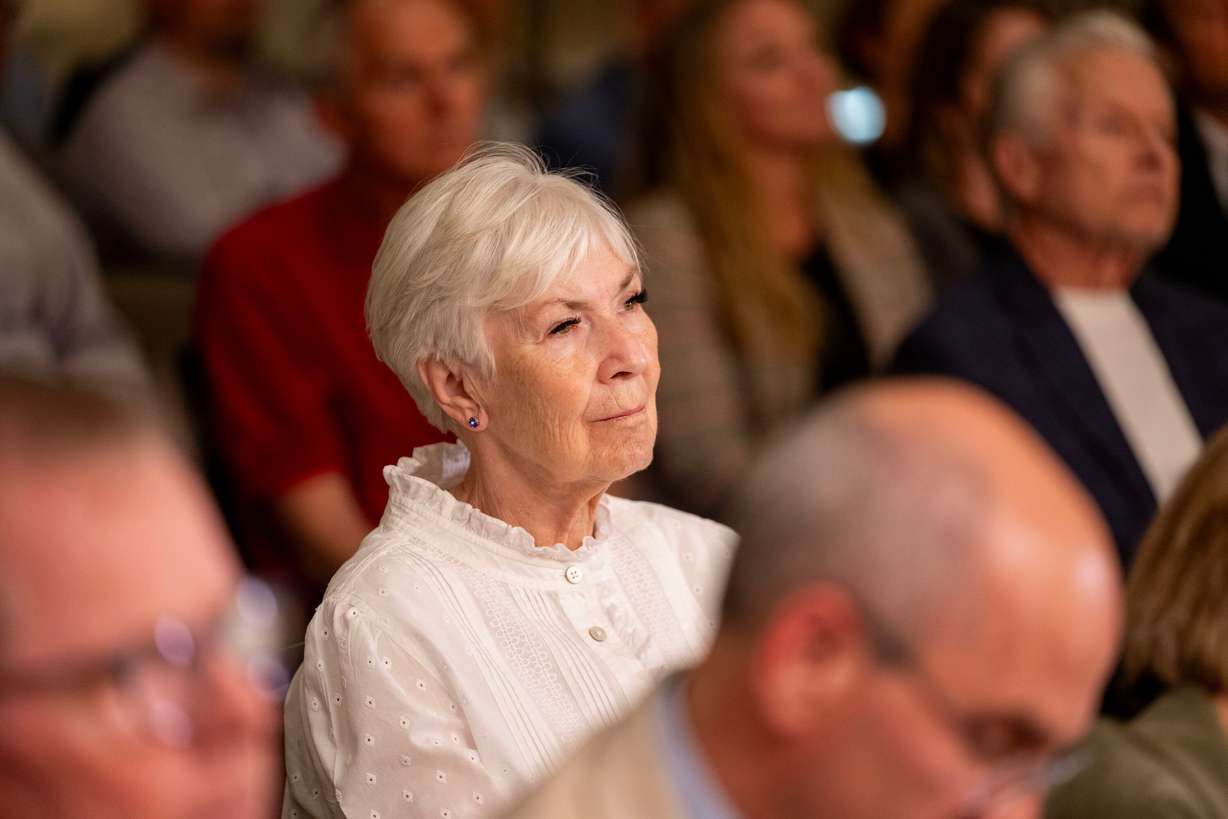
Gail Miller, co-founder of Larry H. Miller Company, listens as The Atlantic Across America tour — a three-year, 50-state event series delving into important topics of our day — partners with the Deseret News in Salt Lake City on Monday. (Photo: Scott G Winterton, Deseret News)
Cox has said that one of the draws of Box Elder County — in addition to Utah’s expedited permitting process —is the convenience of a natural gas pipeline passing through the area which will make on-site power production easier.
A 2025 law, SB132, which was passed unanimously by the Utah Legislature, requires data centers to produce their own power so Utahns do not have to pay higher energy rates because of the huge demand created by AI.
On May 4 — after they were forced to move to a private room because protesters repeatedly interrupted them — Box Elder County commissioners permitted the data center, promising to provide careful oversight of the project.
The commissioners said they had reviewed thousands of public comments, mostly from non-Box Elder County residents, and had done research before making their decision, for which they have since received death threats.
Despite his early, and continued, support for the project, Cox acknowledged on Monday that the messaging around the data center had gotten away from state officials. He outlined some changes to reclaim public confidence.
That’s why Cox said his administration decided to issue a statement on Friday, “taking a step back” from some aspects of the project, “really just rightsizing this for this time because of the feedback that we got.”
The statement said the project developer has agreed to focus all approval requests only to phase I, limited to a 1.5 gigawatt facility, on less than 2,000 acres, and with no reduction to water going to the Great Salt Lake.
“Let’s make sure we are building these data centers in the right places, and in the right way so that we can do all the good things that can come from this,” Cox said.
An incremental approach is different from the “people against virtually everything” mentality that has paralyzed America’s ability to move forward with upgrades to energy infrastructure with endless lawsuits, Cox said last month.
The Atlantic staff writer McKay Coppins listens as Utah Gov. Spencer Cox talks about his efforts to improve online safety for kids, his policy agenda to grow Utah, and the future of American democracy, as The Atlantic Across America tour — a three-year, 50-state event series delving into important topics of our day — partners with the Deseret News in Salt Lake City on Monday. (Photo: Scott G Winterton, Deseret News)
Data centers are coming whether communities like them or not, Cox reiterated on Monday. What gives Cox hope is how Utah has demonstrated with its model approach to AI regulation that it can balance quality of life with innovation.
When asked whether he understood Americans who feel AI is being “shoved down their throats,” Cox said he shared the sentiment. But that doesn’t remove the responsibility to take a proactive stance on this issue, according to Cox.
“If China beats us to that, they lock us down, and I don’t know where we go from there,” Cox said. “So there is a real national security piece of this that I think we have to understand and that we have to be a part of, and Utah is going to be a part of those conversations.”
The Key Takeaways for this article were generated with the assistance of large language models and reviewed by our editorial team. The article, itself, is solely human-written.