Reagan is the late matriarch to the Reagan billboard company. Over the last year, variations of tribute billboards for her have popped up around the Beehive State — a way for her late husband, William …
The crowd of Trixie Mattel‘s Saturday performance at The Complex were treated to a surprise when a local billboard icon showed up on the screen.
Paige Askerlund captured the moment on her phone: Among the bright visuals, a Julia Reagan billboard twirled on the screen as local drag queen Mia Barbin strutted around the stage.
Mateo Segade, Mattel’s DJ partner, opened up the show alongside Barbin before Mattel came on, Askerlund said.
The TikTok video below shows the billboard displayed during the show. Viewer discretion is advised.
“[Segade] had a bunch of visuals on the screen behind him, and it was a lot of just funny references, LGBTQ history and popular LGBTQ movies, just like clips from that,” Askerlund said. “And then suddenly the Julia Reagan billboard popped up, and everybody in the crowd went crazy.”
Most Utahns are accustomed to see the famous Reagan billboards outside entertainment venues.
Reagan is the late matriarch to the Reagan billboard company. Over the last year, variations of tribute billboards for her have popped up around the Beehive State — a way for her late husband, William Reagan, to pay tribute to her, according to Fox13. The billboards span across to the country.
Reagan died nearly a year ago in June 2024. Her husband has since filed a wrongful death lawsuit against The University of Utah’s hospitals and clinics.
Askerlund said the billboard stayed on screen for 30 seconds, but neither Segade, Mattel or Barbin explained why they decided to add it.
Mattel is an American drag queen who is a veteran of “RuPaul’s Drag Race.” Her Saturday performance in Salt Lake City was a part of her “Solid Pink Disco: Blonde Edition” tour — a live DJ show.
A representative for Mattel declined to comment for this story.
At Monday’s draft lottery, Utah’s worst fears were realized as the team fell to the No. 5 spot in the 2025 NBA Draft. The team had a 48% chance of doing so, but the pain of losing out on talents like …
At Monday’s draft lottery, Utah’s worst fears were realized as the team fell to the No. 5 spot in the 2025 NBA Draft. The team had a 48% chance of doing so, but the pain of losing out on talents like …
The NWSL has admitted that the Angel City vs. Utah Royals game should not have continued following Savy King’s on-field collapse. A league spokesperson confirmed to The Athletic that it had come to …
The NWSL has admitted that the Angel City vs. Utah Royals game should not have continued following Savy King’s on-field collapse.
A league spokesperson confirmed to The Athletic that it had come to that conclusion following a review of its protocols and “listening to feedback from our stakeholders.”
Advertisement
King received on-field medical attention after collapsing around the 74th minute of the game at BMO Stadium last Friday. The match was stopped for around 16 minutes before resuming, with King taken off the field on a cart and transported to California Hospital Medical Center. Angel City said Wednesday that King had undergone successful surgery to address a heart abnormality at at Cedars-Sinai Medical Center, describing her prognosis as “excellent.”
“Having reviewed our protocols and how they were implemented, and in listening to feedback from our stakeholders, the Angel City vs Utah game last Friday night should not have continued,” an NWSL spokesperson said Friday. “The health and well being of the entire NWSL community remains our top priority, and in any similar situation going forward the game should and would be abandoned.”
Utah head coach Jimmy Coenraets told reporters after the game that he was not sure the game should have continued after King’s collapse. The NWSL Players Association later said the match should have been abandoned.
“These moments demand humanity, sound judgment and restraint,” the Players Association said in its statement. “Any medical emergency that requires the administration of life-saving care should bring play to an end. The match should not have continued.
“Our members are elite, world-class competitors who have proven they can perform under unimaginable conditions. That does not mean they should have to.”
The NWSL said Wednesday it was reviewing how it deals with serious medical incidents on the field. As reported earlier this week, the league has the final say when it comes to playing on following major incidents — whether medical, weather-related, or anything else — according to internal policies seen by The Athletic. Beyond that, league commissioner Jessica Berman has the final say in overruling any protocol to make a decision.
Angel City was ahead 1-0 when the incident happened and won the match 2-0. After full-time, the two teams gathered in a circle and Utah defender Alex Loera, a teammate of King’s at Bay FC in 2024, appeared to lead them in a prayer.
“On behalf of our entire family, along with Savy, we have been so moved by the love and support from Angel City players, staff, fans, and community, as well as soccer fans across the country,” King’s family wrote in a statement released by the team Tuesday. “We are blessed to share Savy is recovering well, and we are looking forward to having her home with us soon.”
Just a season ago, Utah Hockey Club was a brand-new team trying to fit into its new Utah environment and transition away from its former identity in Arizona.
Image
Just a season ago, Utah Hockey Club was a brand-new team trying to fit into its new Utah environment and transition away from its former identity in Arizona.
Come the 2025–26 season, change will come again, as Utah Hockey Club will no longer suit up under that name, making way for its new identity: the Utah Mammoth.
Advertisement
Advertisement
Advertisement
Anything beats the old Utah Hockey Club puck logo from the team’s first season, and the aggressive Mammoth logo is already seen as a major upgrade.
But now that Utah has a real logo for the foreseeable future, it also faces added scrutiny, especially since it’ll be compared to 31 other NHL teams.
So in this article, Utah’s new logo will be evaluated based on three categories: Creativity, Originality, and Historical Impact. Each category will receive a letter grade, followed by an overall final grade.
Without further ado, let’s get started.
For starters, the ‘Mountain Mammoth’ does a nice job of incorporating the current colors of the team’s uniforms while maintaining a more serious and intimidating design with the actual mammoth.
Advertisement
Advertisement
Advertisement
Credit is due to the design team for adding creative details to the logo as well.
Instead of simply focusing on the mammoth itself, the design cleverly includes the shape of Utah’s mountains at the top of its head, the Utah state outline as its ear, and a U-shaped tusk that ties in nicely with the team’s ‘U’ letter logo.
While the tusk isn’t as immediately recognizable as some other letter-based logos—like Calgary’s flaming ‘C’ or the semi-hidden ‘V’ in the Vegas’ Golden Knight logo—just incorporating a ‘U’ at all is a step above, as most NHL logos tend to commit to either a letter or a mascot, not both.
While the added details in Utah’s logo are certainly fun, it’s hard to forget how bold and creative the old Arizona Coyotes logo was. Though the serious-looking mammoth fits this mascot better, it’s difficult to compete with the uniquely artistic design of the Coyote.
Advertisement
Advertisement
Advertisement
The full-body depiction of the coyote gives it an edge, breaking from the modern trend of overly simplistic and polished logos. Its chaotic color palette and distinction as one of only two full-body logos in the league—alongside the Pittsburgh Penguins—make it particularly memorable.
Still, the Utah Mammoth logo is a strong start and adds another interesting design to the NHL’s already impressive collection. It also is much better than the Coyotes alternative red coyote head logo.
Paired with a strong uniform, Utah Mammoth stands out well, but it’s still tough to top Arizona’s previous design.
Besides the Alabama Crimson Tide having an iconic elephant mascot in “Big Al”, there is hardly any major sports team that has anything comparable to Utah Mammoth.
‘Ice Age Rivalry’ Is A Perfect Name For Utah vs. Nashville Game
Though some fans may still wish Utah had chosen the Outlaws, that name is much less original among major sports franchises, with teams like the Tampa Bay Buccaneers and Pittsburgh Pirates having similar themes.
Compared to other NHL teams, Mammoth feels like a distinctive name, with the only connection being its ‘Ice Age’ link to the Nashville Predators.
But even with that prehistoric connection, it still feels unique. It doesn’t quite earn an A+ since Utah’s first logo choice, the Yetis, would have been even more original, but the Mammoth is a really strong alternative.
This is certainly a tricky task for a new team, as much of the history behind a logo develops over time in the league. That’s what makes logos like the Detroit Red Wings and Boston Bruins so impactful, along with their well-received designs.
Advertisement
Advertisement
Advertisement
But credit must be given to the team for finding a Mammoth connection to Utah, given that actual Mammoth fossils have been found in the state.
So for that alone, Utah gets a boost in its grade for having an actual historical tie. But when people think of Utah, it’s more well known for the Mormon Pioneers, its unique landscapes, and even notorious outlaws like Butch Cassidy.
The main reason the logo receives the grade it does is simply because of its new look. The historical impact of a logo is about more than just the context behind the team’s name, it’s also about the logo’s impact within the NHL.
Utah Mammoth Is Here: Instant Review Of New Name, Logos And Jerseys
When teams like the Winnipeg Jets or Minnesota Wild were established in the 2000s, their logos carried more impact because both cities had previously lost teams—to Dallas in Minnesota’s case, and, interestingly, Arizona in Winnipeg’s.
So while other teams have been reestablished or undergone new names, there still is important NHL history that helps strengthen their logos.
Similarly, NHL teams like the Montreal Canadiens and Boston Bruins may have simple letter-based logos, but their century-old history gives those logos incredible weight.
For Utah, the new logo currently holds historical significance mainly tied to the state itself, rather than the NHL. Compared to its old Arizona Coyotes logo, it has less historical depth in its actual, as the Coyotes’ logo incorporated distinctive Native American-style art.
Advertisement
Advertisement
Advertisement
But Utah Mammoth also is shedding light on some Utah history that many people may not be aware of with its new name.
Utah’s logo is an above-average design. While it lacks the historical depth of other new expansion teams like the Golden Knights and Seattle Kraken, it makes up for it by offering a unique concept and design.
The design is modern but bold, incorporating subtle details rather than opting for a simplistic look.
Although its predecessor is the ‘Kachina Coyote’ design of the old Arizona Coyotes, Utah’s new logo still feels fresh because it pairs well with the icy tundra Utah has.
Utah Mammoth Mourns Loss of Utah Grizzlies’ Kevin Bruder
Utah also has the advantage of being able to strengthen its brand appeal, as it has yet to announce its mascot or even play a game as the Utah Mammoth.
Overall, a B grade feels fair. It’s certainly an exciting concept that is sure to satisfy the thousands of Utah fans who voted in favor of the Utah Mammoth name.
While it’s probably too soon to call it a top logo in the league due to how new it is, it deserves respect for its unique look.
Time will only tell if this logo grows more popularity. But for now, its certainly a fun development to see happen in real time.
TCU baseball heads to Salt Lake City this weekend to close out its regular season with a three-game series against Utah, beginning Thursday night. The Frogs ar …
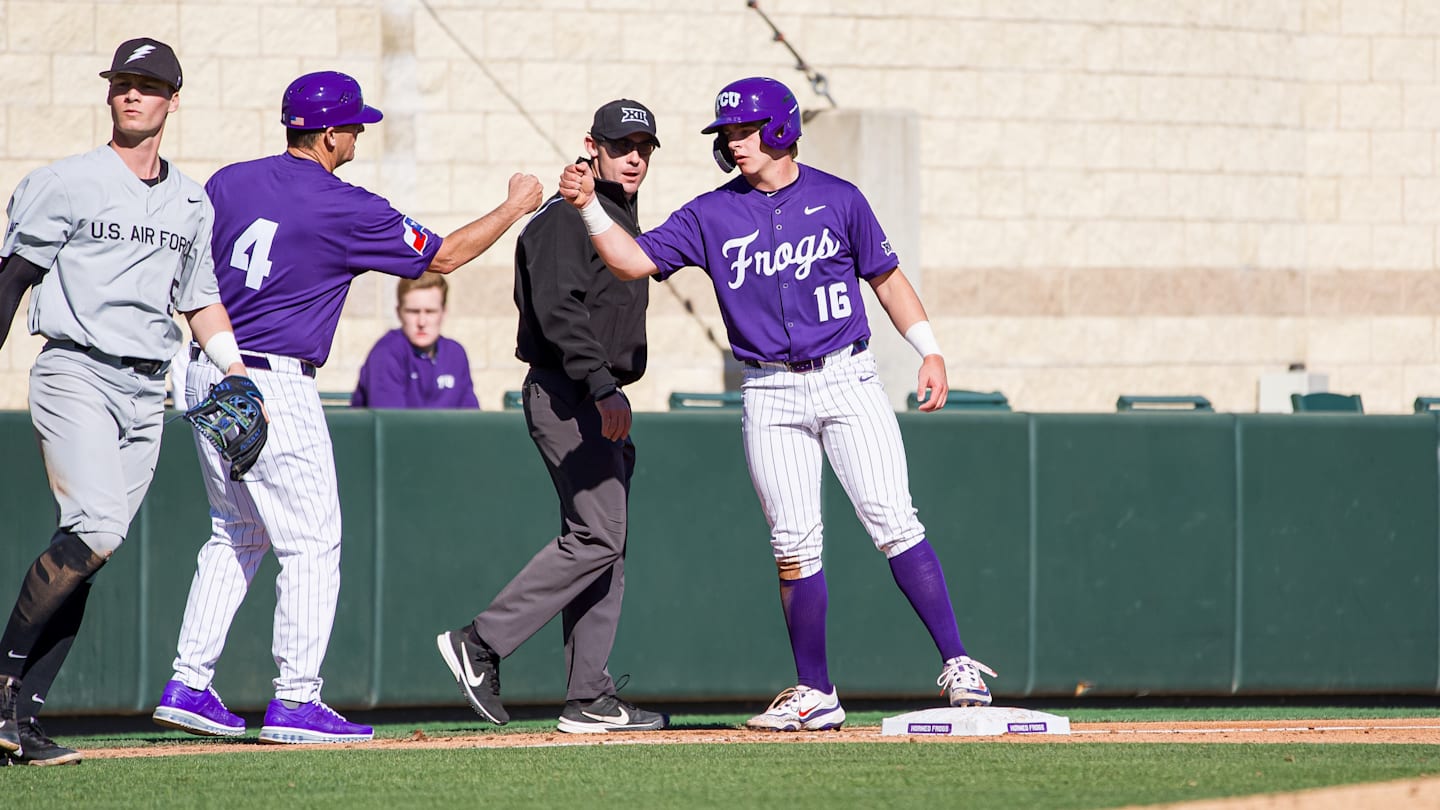
TCU baseball heads to Salt Lake City this weekend to close out its regular season with a three-game series against Utah, beginning Thursday night.
The Frogs are coming off a series win over Cincinnati and have won 21 of their last 31 games. They’ve been especially hot at the plate in recent weeks, hitting .318 since April. Their offense has been powered by standout freshman Sawyer Strosnider, whose nine triples tie the school’s single-season record and lead all Power 4 freshmen. Anthony Silva added some late-season heroics of his own with a walk-off home run last weekend.
On the mound, TCU will start right-handers Tommy LaPour and Caedmon Parker on Thursday and Friday, respectively, as they look to build momentum heading into the postseason.
Utah enters the series following a road win over nationally ranked Arizona but has struggled overall in conference play. The Utes have managed series wins over Oklahoma State and BYU, but pitching has been an issue — they sit last in the Big 12 in team ERA at 6.17. Offensively, Core Jackson leads Utah with a .353 average, 12 home runs, and 19 stolen bases.
This weekend marks a reunion between former conference foes, with TCU and Utah meeting for the first time since 2011. The Horned Frogs lead the all-time series 27-6.
With the Big 12 Tournament on the horizon, TCU has plenty to play for this weekend. A strong showing in Salt Lake City could help solidify their NCAA Tournament resume and potentially improve their seeding. The Horned Frogs have been sharp on the road this season and will aim to carry that momentum into the postseason.
Utah Workforce Housing Advocacy was created in 2023 by Craig Weston, a high-end developer; Derek Brown, later elected as Utah attorney general; Matt Lusty, Cox’s campaign manager; and Steve Waldrip, …
KEY POINTS
Utah Gov. Cox was the keynote speaker at Stanford University’s “Abundance” policy forum.
Cox said the state can improve its messaging on the importance of high density developments.
On Thursday, the Wasatch Front Regional Council considered plans for 15,000 housing units.
Utah Gov. Spencer Cox said Thursday he is preparing to have “uncomfortable, hard” conversations with cities this year about building more high density housing.
As the closing keynote speaker at Stanford University’s Abundance Agenda policy forum, Cox said the state is ready to use a more hands-on approach after struggling to get cities to make municipal affordable housing plans.
“We tried to do it the nice way, and if you want us to do it the heavy way we’ll do that too,” Cox said. “I’m okay being the bad guy on this one.”
Cox recognized that cities have had a lot to keep up with: during the past two years since Cox launched his initiative to catalyze 35,000 starter homes by 2028 the Legislature has approved at least 15 bills reforming zoning, financing and inspection for affordable homes.
One of the most significant pieces of legislation would make $300 million in public investment funds available to help local lenders offer low-interest loans for developers building affordable homes.
The other reforms specifically mentioned by Cox would allow condominiums to qualify for these low-interest loans and would update litigation protection around condos to decrease insurance costs.
“I’m at the stage where I’m just throwing everything against the wall and seeing if anything sticks and actually makes a difference,” Cox said.
As he has on a number of other occasions, Cox touted Utah’s streak of No. 1 rankings which he said were the result of residents’ ability to reject zero-sum thinking.
But, Cox said, the biggest obstacle to addressing Utah’s housing crisis might be public opinion.
Does high density need better PR?
While Utahns worry about their children not being able to afford to live near them, Cox said, that fear is not always tied to an understanding that affordability follows from increased supply.
Speaking to students, scholars and policy advocates, Cox highlighted a recent appropriation Utah lawmakers made for a public opinion campaign about the importance of high density construction like the Daybreak development in South Jordan.
“Showing some real wins, some places where people love to live where there’s actual density just helps change that narrative,” Cox said. “I think we just need to do better PR when it comes to to building and growth.”
Utah Workforce Housing Advocacy was created in 2023 by Craig Weston, a high-end developer; Derek Brown, later elected as Utah attorney general; Matt Lusty, Cox’s campaign manager; and Steve Waldrip, later appointed as Cox’s senior housing adviser, who remains a member of the unpaid board.
“I’ve learned that that we need to do better on the messaging side of this, trying to get the public on our side I think is really important,” Cox said. “Our big focus has been on our kids and grandkids.”
Utah’s founding was based on the positive-sum mindset of pioneers settling an unwelcoming land, Cox said in his opening remarks. In order to maintain the state’s success he said residents will need to prioritize abundance by rejecting “false choices” between growth and quality of life.
Cameron Diehl, the executive director of the Utah League of Cities and Towns, has worked closely with the Legislature in recent years to bring down housing costs while maintaining local control.
On Thursday, Diehl pointed out, the Wasatch Front Regional Council considered five station area plans in Draper, Taylorsville and West Jordan around transit stops, looking to accommodate 15,000 housing units.
“Cities want to see more affordable home ownership opportunities,” Diehl said. “But we plan for housing, we don’t build the housing, and we can’t control the market forces.”
Utah’s reservoirs are currently at 86% capacity, with Echo Reservoir at 99.5%, but southern Utah is facing severe and extreme drought conditions due to a historically low snowpack season.
COALVILLE, Utah (ABC4) — Water resources this year could become very slim in parts of the state plagued with record low snowpack levels, while other parts could be breathing a sigh of relief.
Echo Reservoir is sitting at 99.5% capacity. Currently, Utah ranks second in the West for overall storage capacity, just behind Oregon.
Jordan Clayton, Supervisor of the Utah Snow Survey with Natural Resources Conservation Service, says Utah is in a good spot. “Central Utah and the Wasatch Front are very close to full—if not already full—at many of our reservoirs, including large ones like Echo,” Clayton said.
Advertisement
Advertisement
Advertisement
Advertisement
Utah’s reservoirs (excluding Lake Powell) right now are averaging about 86% capacity—a strong number for this time of year.
“They support agriculture, municipal water, industry—pretty much everything,” Clayton added. “But we are concerned, particularly in southern Utah.”
Southern Utah’s record low snowpack season has led to severe and extreme drought conditions for Southwest Utah. And their reservoirs have likely already seen peak runoff for this year.
Candice Hasenyager, Director of the Utah Division of Water Resources, says water conservation is key right now, no matter where in the State we live.
Advertisement
Advertisement
Advertisement
Advertisement
“If we’re not in drought, we’re preparing for the next one. And if we have a hot, dry summer in northern Utah, that can really diminish our water supply. So using our water wisely is always the right thing to do,” Hasenyager added.
Water resource managers for Echo Reservoir say the reservoir was designed to be a one year supply reservoir. So it’s levels fluctuate drastically each year but don’t expect it to spill this year.
Latest headlines:
Copyright 2025 Nexstar Media, Inc. All rights reserved. This material may not be published, broadcast, rewritten, or redistributed.
Since President Donald Trump took office, Utah has begun the process of asking the federal government for a waiver to implement work and reporting requirements for some Medicaid recipients.
After rushing in during the last minutes of a Wednesday evening hearing for the public to weigh in on whether Utah should move forward with a rule that would push thousands off of Medicaid, Angie Garcia leaned over and whispered to her daughter, “Show your fingers.”
The 5-year-old Aramina looked up from the game she was playing on her mom’s phone and wiggled her right hand in the air. Angie, Aramina and the child’s father have a genetic condition called Apert syndrome, which causes bones in the skull, feet and hands to atypically fuse.
“Now she’s able to do that, thankfully, because of Medicaid,” Garcia said of Aramina, who wants to become a veterinarian, “and that will help her write and work.”
Since President Donald Trump took office, Utah has begun the process of asking the federal government for a waiver to implement work and reporting requirements for some Medicaid recipients.
Wednesday was the last in-person public comment session, but the state’s Department of Health and Human Services will accept input online for another week. The dozens who joined the meeting, both at the Salt Lake City office building and remotely, unanimously opposed the proposal.
This is the second time Utah has sought to impose employment as a prerequisite for some low income Utahns to receive free or discounted health coverage — a maneuver aimed at reducing health care spending by the federal and state government.
Under the last Trump administration, in December 2019, the Centers for Medicare and Medicaid Services signed off on Utah adding a condition that some adult recipients work, or seek work. The state pressed pause on the initiative just a few months later in response to the beginning of the COVID-19 pandemic.
In 2021, President Joe Biden’s administration mandated that Utah and other states reverse previously proposed and approved work requirements. Although such rules have been subject to litigation in the past, the U.S. Supreme Court has never ruled on the matter.
To qualify for Medicaid in Utah, a single person must have a salary below $20,820, and a family of four can’t bring in more than $42,768 annually.
(Francisco Kjolseth | The Salt Lake Tribune) The Utah Department of Health and Human Services holds a public hearing in Salt Lake City on a proposal to impose work requirements on Medicaid recipients on Wednesday, May 14, 2025.
Utah’s DHHS initiated the most recent work requirement request, called an 1115 waiver, said Medicaid Director Jennifer Strohecker. “We did it in consultation with the governor’s office and lawmakers.”
Utah is one of 14 states, all Republican-led, to pursue such a waiver since Trump moved back into the White House, according to a tracker compiled by KFF Health News. The Beehive State’s pending action comes amid a push in Congress to establish Medicaid work requirements nationwide.
“If Utah has a proposal and Congress has a proposal, what happens with that? I’ll just say we don’t exactly know the answer to that right now,” Strohecker told Wednesday’s audience before implying that she expects a federal plan would be more strict.
Strohecker promised attendees that her office would review all of the comments and that they would be shared with the national office that approves waivers. State DHHS officials will meet with lawmakers to discuss the proposal next week.
One current lawmaker, Sen. Nate Blouin, D-Millcreek, joined the public comment session, as did two former Republican representatives — Paul Ray, of Clearfield, who is now DHHS’s director of legislative affairs, and Marsha Judkins, of Provo.
“We’ve had a lot of conversations already in the past about barriers that the most vulnerable Utahns have accessing just basic needs,” Judkins said. “And so when I heard about this waiver application, it just kind of broke my heart, and I felt like I needed to come and engage.”
(Francisco Kjolseth | The Salt Lake Tribune) Marcella Patino talks about her family’s hardships and their need for Medacaid as the Utah Department of Health and Human Services holds a public hearing in Salt Lake City on a proposal to impose work requirements on Medicaid recipients on Wednesday, May 14, 2025.
Having one of a handful of characteristics, like being physically or mentally unable to work, can exempt recipients from the work requirement. But advocates for a variety of vulnerable populations say filing the paperwork and providing the documents to qualify for an exemption can be an insurmountable barrier for some.
Among the people who shared their stories with DHHS Wednesday was Marcella Patino, a nail technician whose child has autism. Because she is an independent contractor, and often has to take time away from work to care for her child, Patino told officials she is concerned she won’t be able to meet the potential work requirements.
“It’s already incredibly hard to be a working mom — please don’t make it harder,” Patino said.
Debbe Jones, a grandmother who cares for both her own mother and her grandson, said if anyone in her family loses Medicaid, “One simple surgical or health-related illness will make me homeless.”
(Francisco Kjolseth | The Salt Lake Tribune) Debbe Jones, who worked as a teacher for 34-years and has two family members on Medicaid says “if either one loses coverage, one simple health related illness will make me homeless,” as she attends a public hearing in Salt Lake City on a proposal to impose work requirements on Medicaid recipients on Wednesday, May 14, 2025.
Groups that support Utahns from a variety of vulnerable backgrounds — from those with mental illnesses, disabilities or struggling with addiction, to people experiencing homelessness or with chronic diseases — have coalesced under Protect Medicaid Utah to oppose this and other proposals to cut Medicaid.
Their representatives Wednesday pointed out how they expect the potential rule would slash more than intended from health care, and where they see exemptions fall short.
Matt Slonaker, who heads the Utah Health Policy Project, opened the meeting with a sentiment that was echoed throughout the evening: “Good health is a precondition to work, not the other way around.”
A former Nebraska football player has announced his transfer destination. Defensive back D’Andre Barnes will play the 2025 season for the Utah State Aggies. Barnes originally came to the Huskers in …
A former Nebraska football player has announced his transfer destination. Defensive back D’Andre Barnes will play the 2025 season for the Utah State Aggies.
Barnes originally came to the Huskers in 2023. He appeared in one game for the program in 2024, making his debut against UTEP. He will have three years of eligibility remaining with Utah State.
Advertisement
Advertisement
Advertisement
He was a productive player in high school and had a promising senior season. According to statistics from MaxPreps.com, he was a key weapon for Regis Jesuit High School, catching 37 passes for 785 yards and nine touchdowns.
Now, he will have an opportunity to contribute to a program that went 4-8 in 2024. The Aggies have not had a winning season since 2021.
Nebraska football has seen several players enter the transfer portal and land on their feet. Barnes’ athleticism and speed could allow him to make an impact at Utah State.
Contact/Follow us @CornhuskersWire on X (formerly Twitter), and like our page on Facebook to follow ongoing coverage of Nebraska news, notes, and opinions.
Utah’s Braxton Watts finished atop the individual leaderboard at the NCAA regionals at Golf Mountain Golf Course in Bremerton, Wash., but the Utes fell just one stroke short of the cut to move on to …
Utah’s Braxton Watts finished atop the individual leaderboard at the NCAA regionals at Golf Mountain Golf Course in Bremerton, Wash., but the nationally-ranked No. 17 Utes fell just one stroke short of the cut to move on to the NCAA championships.
Watts finished 12-under during the three-day event, posting an even par in round one before finishing 6-under in both rounds two and three.
Advertisement
Advertisement
Advertisement
Despite Watts’ excellent performance, the Utes fell just one spot short of the fifth-place finish they needed to advance, posting a three-day total of 1-over.
Utah posted scores of 3-over and 5-over during the first two days, then made a comeback attempt on Wednesday, finishing 7-under for a 1-over three-day score.
“This team has a lot of heart, and they don’t know how to quit,” Utah coach Garrett Clegg said in a press release. “We gave it everything to try to advance today but we just couldn’t get it done. I’m so happy for Braxton. He played incredible golf this week and it’s great that he will finish his season at the NCAA championships. It’s really incredible what the team did during this season, they’re truly a special group.”
The Utes were edged out by South Carolina, who finished the three-day event at even par, for the fifth and final spot. Watts will continue his season as an individual participant in the NCAA championships in Carlsbad, Calif., at Omni La Costa Resort.
Advertisement
Advertisement
Advertisement
Watts led the charge for the finish with his 12-under score, but the rest of the team finished over par, with Gabriel Palacios finishing 1-over, Sergio Jimenez finishing 5-over and Davis Johnson finishing 15-over.
Florida finished 28-under to secure the regional title, while Arizona State (25-under), Colorado (4-under) USF (2-under) and South Carolina (even), all advanced to the NCAA championships.