In the case of cancer patients, tumors can cause symptoms and threaten lives before they are even detected. A person can spend years in pain, confined to a bed or a wheelchair, without a formal …
In the case of cancer patients, tumors can cause symptoms and threaten lives before they are even detected. A person can spend years in pain, confined to a bed or a wheelchair, without a formal …
Gov. Spencer Cox announced Monday that he would not move up the vote on whether to repeal an anti-labor law to this November, meaning it will be on the ballot Nov. 3, 2026.
A vote on whether to repeal a law banning public employee unions from negotiating contracts with their government employers won’t be on the ballot until Nov. 3, 2026, Gov. Spencer Cox announced Monday.
The governor had the option of calling a special election to put it before voters during municipal elections this November, but that would have come with some additional costs and logistical challenges.
In 2023, when the state had a special election to replace retiring 2nd Congressional District Rep. Chris Stewart, lawmakers allocated $2.5 million to cover the extra costs.
While many cities and towns have elections this November, some races are not contested — in Salt Lake City, for example, just four of the seven council districts are up — and voters in unincorporated areas of counties would not normally vote in those elections either.
Holding the vote in 2025, however, could have been beneficial for some lawmakers by ensuring that they would not be up for reelection at the same time as the vote on whether to repeal the anti-labor bill, Utah State University political scientist Damon Cann said recently.
The referendum could drive voter turnout and impact the outcome in swing districts.
Last session, Republican lawmakers passed HB267, a bill banning government entities from negotiating with public employee unions. Its main impact was on teacher unions, but it also impacted some police officers, firefighters, health care workers, librarians, and others.
Labor groups fought back, collecting more than 320,000 signatures in 30 days — 251,590 were eventually deemed valid — from voters to put a measure on the ballot to repeal the law, making it the most successful signature-gathering effort in state history.
The law has been put on hold pending the outcome of the November 2026 election.
Both the labor backers of the repeal effort and a group supporting the law and opposing repeal have said they were indifferent when the vote occurs and that their side would prevail, whether it is held this November or next.
If Cox had decided to call a special election, it would not have been the first time in Utah. In 2007, then-Gov. Jon Huntsman called a special election for a referendum to repeal the Legislature’s school voucher law. Utahns voted two-to-one to repeal the voucher law.
Judge James Blanch signed an order to release Arturo Gamboa after state prosecutors were “unable to make an informed decision” on charges against him.
A man accused of wielding a rifle at a “No Kings” protest in Salt Lake City before an armed safety volunteer opened fire and accidentally killed a protester has been released from jail, court records show.
Utah Third District Judge James Blanch signed an order to release Arturo Gamboa on June 20 after state prosecutors were “unable to make an informed decision” on charges against him before his scheduled release date on June 23, according to court records obtained by USA TODAY. Gamboa, 24, had been arrested on suspicion of murder following a “No Kings” demonstration and march in downtown Salt Lake City on June 14.
As prosecutors review evidence as it becomes available, the order states that Gamboa was released under stipulated conditions agreed upon through his attorney. Under those conditions, Gamboa must maintain residence with his father, not possess any firearms, and hand over his passport to his attorney.
His release came after Salt Lake County District Attorney Sim Gill requested and received a three-day extension to keep Gamboa in custody, The Salt Lake Tribune and KSL.com reported. The extension would have detained Gamboa until June 23, but Gill later said his office was unable to decide Gamboa’s culpability in the shooting, according to The Salt Lake Tribune.
Gamboa was taken into custody after he pulled out a rifle at demonstrators and allegedly moved toward the crowd while holding the weapon in a firing position, Salt Lake City police said. An armed safety volunteer, who police described as a member of the peacekeeping team for the protest, then fired three shots.
Gamboa was wounded in the shooting while a nearby demonstrator, identified as fashion designer Arthur Folasa Ah Loo, 39, was killed, according to police.
Prosecutors and police said the incident remains under investigation. Police have asked the public to contact authorities with any information related to the shooting as investigators work to “understand the full scope of what occurred.”
“We are asking for the public’s help. If you captured any footage, particularly from the moments immediately before, during, or after the shooting, or if you have video of the shooting itself, or the person arrested, please share that evidence with us,” the Salt Lake City Police Department said in a news release. “Even small details may prove vital to this investigation.”
What happened during the shooting at Utah’s ‘No Kings’ rally?
Shortly before 8 p.m. local time, officers reported hearing gunfire at the demonstration, according to an affidavit of probable cause. Police reported that three shots were fired, and a man, who was later identified as Ah Loo, was fatally struck by a round.
Officers immediately responded to the scene and were informed that a man wearing a black mask and all black clothing was seen running away, the affidavit states. Officers then discovered the man, who was identified as Gamboa, with a minor gunshot wound, crouched down among a small group of people.
Officers discovered that Gamboa had an AR-15 style rifle, a gas mask, additional black clothing, and a backpack, according to the affidavit. Other officers in the area found two men wearing yellow high-visibility vests with handguns in their possession.
Police described the two men as members of a “peacekeeping group assigned to assist the planned protest/rally in ensuring everyone’s safety,” the affidavit states. One of the “peacekeepers” told officers that he saw Gamboa move away from the main crowd to a secluded area behind a wall.
“The peacekeepers found this behavior to be suspicious and kept (Gamboa) in view,” according to the affidavit. “One of the peacekeepers observed (Gamboa) remove an AR-15 style rifle from a backpack he was carrying. He observed (Gamboa) begin to manipulate the rifle and they called out to him to the drop the gun after drawing their own firearms.”
Gamboa then allegedly lifted the rifle, and witnesses described seeing him begin to run toward the large crowd of demonstrators while holding the weapon in a firing position, the affidavit states. One of the “peacekeepers” fired three rounds, striking Gamboa and Ah Loo.
“Detectives have not been able to determine, at this time, why Gamboa pulled out his rifle and began to manipulate it or why he ran from the peacekeepers when they confronted him,” police said in a news release after the incident. “Detectives have developed probable cause that Gamboa acted under circumstances that showed a depraved indifference to human life, knowingly engaged in conduct that created a grave risk of death and ultimately caused the death of an innocent community member.”
There are no regulations for how guns are carried in public in Utah, according to Everytown for Gun Safety, a gun control group. And police have not identified the two “peacekeepers” involved in the incident.
Shooting occurred during widespread ‘No Kings’ protests on June 14
“No Kings” demonstrations across the United States drew large crowds on June 14. The protests were held in opposition to President Donald Trump‘s policies and coincided with the controversial parade for the U.S. Army’s 250th anniversary in Washington, D.C.
While the demonstrations were mostly calm and peaceful, some protests were met with violence.
The Salt Lake City shooting occurred as thousands of protesters gathered in the city’s downtown area. Police initially said the protest drew about 10,000 people, but later updated the estimated attendance to 18,000.
In Virginia, a man intentionally drove an SUV through a crowd of departing protesters, striking at least one person, police said. A California man was arrested after allegedly threatening to commit a shooting at the Palm Springs “No Kings” rally, police said on social media.
Police in Los Angeles hit protesters with batons, fired tear gas, and ordered a large crowd in downtown to disperse. At the time, police said they were responding to people throwing “rocks, bricks, bottles,” and “fireworks.”
Two people were charged on June 18 after a woman was critically injured when an SUV sped into a crowd of demonstrators in downtown Riverside in Southern California, according to the Riverside County District Attorney’s Office and the Victorville Daily Press, part of the USA TODAY Network.
Contributing: N’dea Yancey-Bragg, Sarah D. Wire, Jeanine Santucci, and Jonathan Limehouse, USA TODAY
The Utah Grizzlies announced on social media Sunday evening they have begun the process of exploring a potential sale of the team. “This is an emotional and difficult moment for our family and our …
WEST VALLEY CITY, Utah (ABC4) — The Utah Grizzlies announced on social media Sunday evening they have begun the process of exploring a potential sale of the team.
“This is an emotional and difficult moment for our family and our organization,” the Elmore Sports Group, current owners of the Grizzlies, said in a statement. “Utah has been more than a home—it has been part of our identity. But ensuring the Grizzlies have the opportunity to thrive in the future may require new ownership and, potentially, a new home.”
Advertisement
Advertisement
Advertisement
The team says in their statement the decision to explore a sale follows a period of transition for the longtime owners, following the death of former owner Dave Elmore in 2023 and the declining health of current co-owner Donna Tuttle.
The Grizzlies will compete in the 2025-26 season as normal.
No official sale or possible relocation has been finalized as both will require formal approval from the ECHL and other stakeholders.
The Grizzlies have been playing in Utah since 1995 when the team moved from Denver and have been playing at the Maverik Center since its opening in 1997.
Full statement from the Utah Grizzlies:
Advertisement
Advertisement
Advertisement
Copyright 2025 Nexstar Media, Inc. All rights reserved. This material may not be published, broadcast, rewritten, or redistributed.
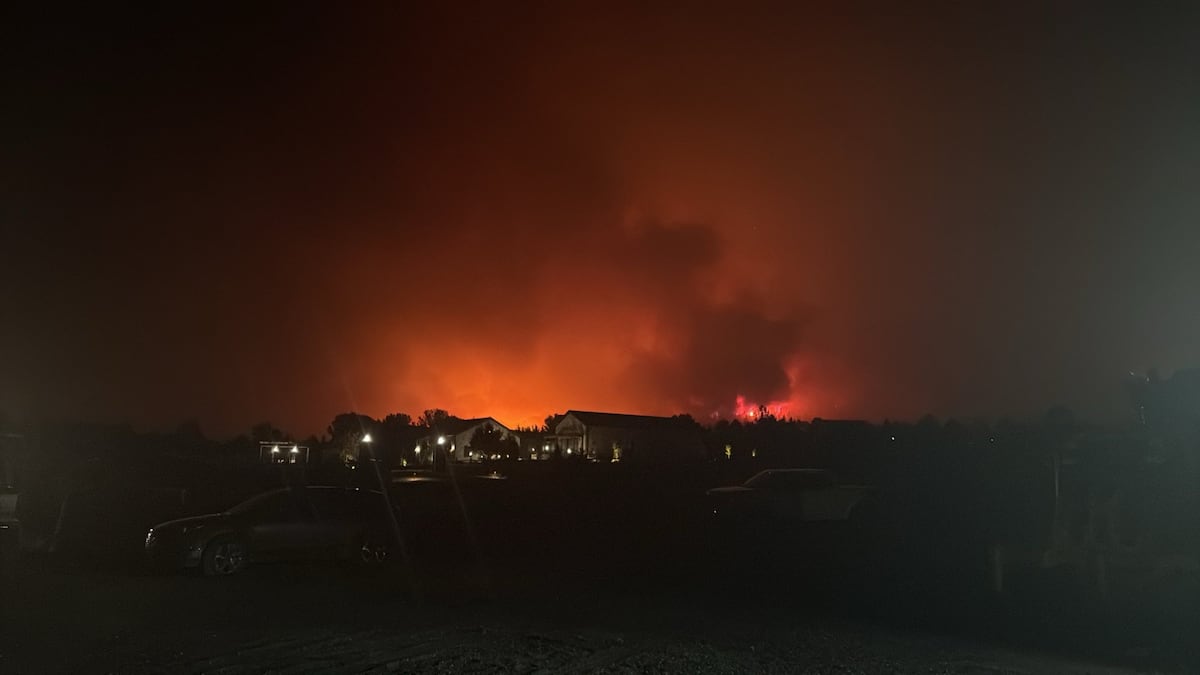
Residents with trucks and trailers were seen leaving the remote settlement, which is only accessible by dirt road and difficult to find on maps. Some evacuees were transporting farm animals from the area’s numerous agricultural properties.
#ForsythFire update: Extreme Fire behavior and gusty erratic winds have pushed the fire east and north of Pine Valley. The fire has pushed over a mile north and up over the next ridge, north of Pine Valley. Pinto and Grass Valley communities are advised to evacuate pic.twitter.com/mj8332qjpo
Others were arriving to help friends and neighbors evacuate their belongings and livestock.
“I came up to get my friend’s camp trailer and maybe drive a side-by-side down to Newcastle just to make sure it was out of the fire if it came down this way,” Jamie Gardner said.
The Salt Lake Tribune and Fox 13 News are content-sharing partners.
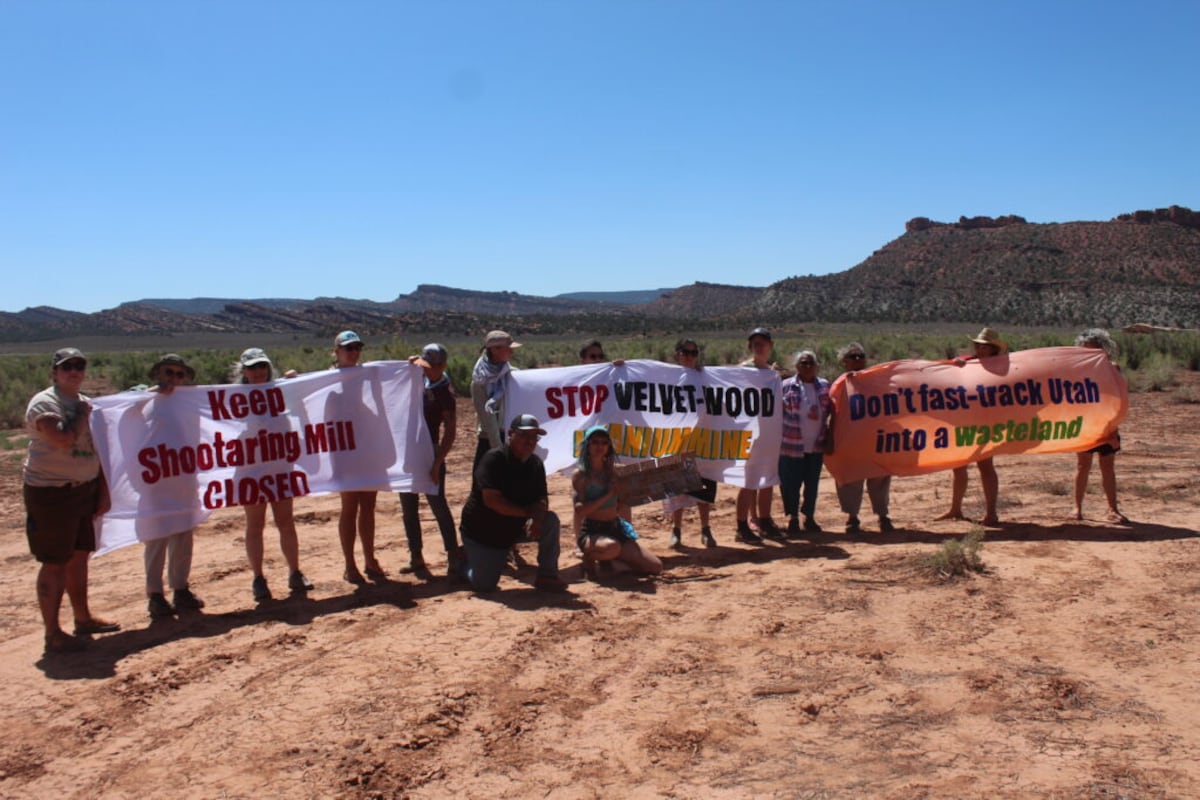
About 20 people gathered in San Juan County on Saturday to protest the planned reopening of the Velvet-Wood uranium mine.
As high-desert winds swept through under a late-morning sun, a small group gathered Saturday on public land east of Lisbon Valley to protest the reopening of the Velvet-Wood uranium mine — Utah’s first project approved under a federal fast-track process tied to a declared national energy emergency.
The protest drew about 20 people to a site just over four miles from the Velvet-Wood mine in San Juan County, which will produce both uranium and vanadium. Uranium can be processed into fuel for nuclear reactors, while vanadium is commonly used in steel alloys.
From that vantage point, attendees could see the rugged hills in the distance, with the mine sites tucked behind them. Wind whipped through handmade banners that read “Don’t fast-track Utah into a wasteland,” “Keep Shootaring Mill closed” and “Stop Velvet-Wood Uranium Mine.”
“This cannot be happening,” said Luis Miranda, one of the organizers. “We are fast-tracking ourselves into creating a wasteland in Utah out of this precious environment. Today, we’re gathered here because we need to do something about this.”
The Velvet‑Wood project, owned by Canadian company Anfield Energy Inc., was approved by the Bureau of Land Management in May — just 11 days after the Interior Department ordered the agency to complete an environmental review within 14 days. That directive came in the wake of a January executive order from President Donald Trump declaring a “national energy emergency,” which allowed federal agencies to shorten certain reviews from months or years to as little as two weeks.
Critics say the accelerated timeline bypasses meaningful environmental analysis and public input.
(Andrew Christiansen | The Times-Independent)
Protest organizer Luis Miranda points toward the Velvet-Wood mine site the group was protesting, located just over four miles beyond the ridgeline behind him near Lisbon Valley.
“This fast-tracked permitting is reckless, unjust and dangerous,” said Ava Curtis, an environmental justice coordinator with a New Mexico-based coalition focused on uranium mining impacts and one of the protest’s organizers. “There’s just no way to ensure safety in such a short amount of time.”
The protest was the first of two being held Saturday. After the Velvet-Wood gathering, some participants planned to caravan 180 miles along the proposed ore transport route to the dormant Shootaring Canyon Mill near Ticaboo, which Anfield also plans to reopen. The route crosses tribal lands, Bears Ears National Monument and the Colorado River — raising concerns about potential contamination from uranium-laden trucks.
“These projects enrich foreign investors while endangering U.S. communities and sacred lands,” the press release about the event stated. “Permitting uranium operations that impact sovereign tribal lands, water systems and national monuments without public or tribal consent is a violation of trust.”
The Velvet-Wood site, which produced about 400,000 tons of ore between 1979 and 1984 before shutting down, now contains more than 5 million pounds of uranium ore, according to Anfield. The company says reopening the mine will disturb only three additional acres. If the Shootaring Mill does not reopen, the White Mesa Mill near Blanding — owned by Energy Fuels — remains a possible site for processing.
While the Bureau of Land Management has approved the project’s environmental assessment, Anfield still needs multiple state and federal permits before mining can begin. The Utah Division of Oil, Gas and Mining must approve the mine plan; the Division of Water Quality must sign off on a pilot water treatment plan; and the Division of Air Quality must authorize construction and modification of ventilation shafts. The U.S. Mine Safety and Health Administration also must approve mine safety infrastructure, and the project may still require local land-use or utility permits.
Curtis said she’s particularly alarmed by Anfield’s plan to pump and treat more than 50 million gallons of water currently stored in the mine.
“There’s the concern about specific health impacts of this mine — how it affects the community and the water — but also the precedent this sets for future extraction of uranium and other critical minerals,” she said.
State and federal officials have embraced the project as part of Utah’s broader effort to become a leader in the domestic nuclear energy supply chain. The state’s energy strategy includes investments in small modular reactors, uranium enrichment and fuel-processing infrastructure. In May, Gov. Spencer Cox praised the Velvet-Wood mine as an example of “a faster, more efficient permitting process” that supports energy independence.
U.S. Sen. John Curtis called the mine “vital,” citing national security concerns and the need to reduce uranium imports from Russia and China.
Miranda said those arguments overlook the environmental and social costs.
“What I’m seeing is a lot of false solutions,” he said. “Multinational companies get contracts to build these things that come at a constant cost to ratepayers, when we have other forms of energy.”
Jessica Wiarda, a Hopi researcher working in Utah through a fellowship with the Southern Utah Wilderness Alliance, said uranium extraction often parallels colonization.
“It’s like a poison,” she said, describing uranium’s visual similarity to corn pollen, a sacred substance in many Native cultures. “Instead of worshipping the corn, some people are worshipping the yellowcake instead.”
Uranium’s path from mine to reactor begins with ore extraction. The ore is then processed at a mill into a concentrated powder called yellowcake, which is converted into gas and enriched before being turned into fuel pellets used in nuclear reactors.
Several members of the White Mesa Community — a Ute Mountain Ute village south of Blanding — also attended the protest. Residents there have long opposed the nearby White Mesa Mill, the country’s only operational conventional uranium mill.
“Our lands that belong to us … look how beautiful it is out here,” said Yolanda Badback. “Digging holes in the ground and hurting our Mother Earth, it’s like hurting us. She hurts as well.”
Local residents helped coordinate the protest through Moab Mutual Aid.
“The land needs us,” said Rachel Gravens, representing Moab Mutual Aid. “It is not just empty space. It isn’t just used for extraction. It is sacred and we need to be here to speak up for it and protect it.”
For Miranda, Saturday’s gathering was one step in a larger campaign against the extractive industry on the Colorado Plateau.
“This fight did not begin last month or with the Trump administration,” he said. “This land was stolen centuries ago and continues to be colonized. We continue to destroy the only possibility of a future beyond climate catastrophe.”
Wide receiver Perrion Williams pledged his commitment to the University of Utah during his official visit to Salt Lake City.
There’s never a dull moment in college football recruiting.
That was the case on Saturday night, as three-star wide receiver Perrion Williams pledged his commitment to the University of Utah during his official visit to Salt Lake City.
Utah was one of two Power Four teams to extend an offer offer to the 6-foot, 163-pound wide receiver from Archbishop Riordan High in San Francisco — with the other offer being from Minnesota.
Advertisement
Advertisement
Advertisement
Last season at Saint Francis High, Williams tallied 757 yards and nine touchdowns on 52 receptions.
The beloved 1993 classic — filmed almost entirely in Utah — is the perfect reason to bring a night of big league baseball to the Beehive State.
Major League Baseball should be in Utah. I’ll never stop saying it.
But while league expansion isn’t coming anytime soon, and the odds of another abrupt Arizona Coyotes-style relocation falling into Utah’s lap are low, that doesn’t mean the Beehive State can’t still host big league ball in the near future.
Advertisement
Advertisement
Advertisement
As baseball’s widespread popularity has declined in recent years, MLB has been forced to get creative and try new things as a means to drum up more interest in the sport.
One such innovation has been the addition of “specialty games” to the league’s calendar each summer. These neutral site contests are played in unique locations and carry a specific theme that MLB can market like crazy during the July/August sports lull that precedes football season.
There have been 12 specialty games since 2016, with two more coming up in 2025. The most famous came in the form of the “Field of Dreams” game in 2021, when the Yankees and White Sox faced off in the famed Iowa cornfield from Kevin Costner’s 1989 tearjerker.
The event was such a smash hit that MLB brought it back the following year. The “Field of Dreams” game worked for three major reasons:
Advertisement
Advertisement
Advertisement
Solid, beloved source material to theme everything around.
Cranking up the nostalgia factor to the max.
A memorable, scenic location.
There’s a Utah version of the “Field of Dreams” game that could follow the exact same formula. It’s such a no-brainer that I can’t believe it hasn’t happened already.
Two words: “The Sandlot.”
‘You’re killing me, Smalls!’
If you’ve never seen “The Sandlot,” my condolences. You were either robbed of an important adolescent experience or didn’t provide it to your own children.
The film follows a young boy named Scotty Smalls who moves to a new town and is welcomed into a group of neighborhood boys who play baseball together every day in the summer of 1962.
Actors Marty York, Patrick Renna, Shane Obedzinski, Grant Gelt, Mike Vitar, Chauncey Leopardi, Brandon Adams, Victor DiMattia and Tom Guiry appear in a promotional photo for “The Sandlot.” | Twentieth Century Fox
“The Sandlot” isn’t the best baseball movie ever made — truthfully, it probably doesn’t even crack the top five — but it very well may be the genre’s most iconic entry. It’s the seminal childhood flick, perfectly depicting the magic, terror and wonder of growing up and the bond shared with your closest friends.
Plus, it’s endlessly quotable, visually appealing, has a terrific musical score and introduced the world to the legends of Benny “The Jet” Rodriguez and “The Great Hambino” Ham Porter.
Seriously, Ham Porter puts up a Hall of Fame performance in this film. His actor, Patrick Renna — who looks the exact same today as he did in 1993 — really should have gotten some Oscar buzz for his work as Ham. As Babe Ruth says in the movie, “Heroes get remembered, but legends never die.”
Patrick Renna portrays Ham Porter in “The Sandlot.” | Deseret News Archives
So yes, “The Sandlot” definitely fits the bill as beloved source material to base an entire specialty game upon.
Advertisement
Advertisement
Advertisement
Aside from the “Field of Dreams” game, MLB has done specialty games at the College World Series, Little League World Series, at a U.S. military base and a historic Negro Leagues stadium in Alabama.
This year, the Little League World Series game will return, along with a meeting between the Braves and Mets at … Tennessee’s Bristol Motor Speedway.
That’s right. MLB is playing a specialty game at a NASCAR racetrack. If that’s the best idea the league could come up with for this year, clearly the need for a “Sandlot” game is greater than I originally thought. Let’s make this happen.
Features for the game
The “Field of Dreams” game began with Costner leading the Yankees and White Sox out of the cornfield, then giving a heartfelt pregame speech to help set the stage for the rest of the evening.
Advertisement
Advertisement
Advertisement
You can watch the sequence below. It’s pretty remarkable — Costner is Costner, after all — and perfectly matches the tone of the film.
The “Sandlot” game will need its own captivating introduction, although less dramatic than that of “Field of Dreams.” It’s a funny kids movie, so let’s keep things light and not overthink it.
All of the actors who portrayed the “Sandlot” kids need to be part of this. Let’s have them all take the field one by one as Booker T. & The MGs’ “Green Onions” (that bouncy organ song from the movie) plays in the background, and have Benny “The Jet” Rodriguez come out last to receive the biggest ovation of all.
Advertisement
Advertisement
Advertisement
Not only should Scotty Smalls throw out the ceremonial first pitch to Ham Porter at catcher, but Benny should steal home during the pitch. It’s the perfect way to kick off the action, along with Ham shouting his signature “Play Ball!” afterward.
Patrick Renna, who played Ham in The Sandlot, warms up before cast members throw the first pitch to celebrate the movie’s 25th anniversary at Smith’s Ballpark in Salt Lake City, on Thursday, Aug. 9, 2018. | Kristin Murphy, Deseret News
As for other movie-specific details, there needs to be an English mastiff on hand as a homage to “The Beast,” a Babe Ruth impersonator wandering around and s’mores sold at every concession stand.
The participating teams should wear 1960s throwback uniforms and the in-stadium soundtrack must stick to songs from that era, along with David Newman’s outstanding film score.
Advertisement
Advertisement
Advertisement
If we really wanted to go overboard with this, we could put a swimming pool on one side of the outfield and a couple of carnival rides on the other to pay tribute to each of the related, iconic scenes from the movie. That may be too much for just one game, but it’s fun to dream big.
Logistically, the two participating teams should each come from the West Coast to help make travel easier. The most obvious choice for the home squad would be the Los Angeles Dodgers, considering that the film takes place in Southern California and ends with Benny playing for the club.
Advertisement
Advertisement
Advertisement
Plus, the idea of superstars such as Shohei Ohtani, Mookie Betts and Freddie Freeman coming to play in Utah would be an absolute thrill. If this is Utah’s one chance to host MLB action, we might as well be treated to the best of the best, and the Dodgers can deliver the goods.
Los Angeles Dodgers’ Shohei Ohtani, of Japan, celebrates after a two-run home run by teammate Freddie Freeman against the Arizona Diamondbacks during the first inning of a baseball game Friday, Aug. 30, 2024, in Phoenix. | Ross D. Franklin, Associated Press
The Dodgers’ opponent should probably come from the American League to avoid them having to play a critical division matchup in a neutral site. Of the AL West teams, the Rangers and Astros are both too far away from Utah, and the Angels likely won’t travel the nearly 700-mile journey just to play someone who is typically just 30 miles away — although former Salt Lake Bee Mike Trout playing in Utah again would be quite the storyline.
Thus, the Mariners and Athletics would be most convenient, with the M’s being preferable, considering they’re a better and more marketable team.
Advertisement
Advertisement
Advertisement
However, the Mariners were established in 1977 and therefore did not exist in the movie’s 1962 setting, making the A’s — who previously flirted with playing in Utah — the only remaining option.
So there’s our matchup: Dodgers vs. Athletics, live in Utah and wearing 1960s throwback uniforms. It should be a heck of a ballgame, especially if the A’s break out these incredible era-appropriate threads.
Jim Hunter, right-handed pitcher for the Kansas City Athletics, is shown in 1967. Should the Athletics participate in a specialty game themed around “The Sandlot,” these would be the uniforms they would wear. | AP
Which Utah ballpark should become the new sandlot?
The site of the actual playing field from the movie is in Salt Lake City’s Glendale neighborhood, but it’s much too small to adequately allow for MLB competition and crowds.
Advertisement
Advertisement
Advertisement
Luckily for us, Utah has multiple existing ballparks that could easily host the “Sandlot” classic.
For starters, there’s the new Ballpark at America First Square in Daybreak where the Bees currently play. It’s an awesome place to watch a game, but it might be just a bit too new and nice to stand in for the rough and tumble 1960s sandlot.
There’s also Lindquist Field in Ogden, where the Pioneer League’s Ogden Raptors play. Ogden is a rather appropriate choice, as the movie’s infamous pool scene was filmed there.
Ogden’s Lindquist Field. | Scott G. Winterton
The ballpark itself is wonderful, intimate and captures the small-town feeling prevalent in “The Sandlot.” The outfield fence could easily be altered to appear more similar to that of the movie’s dusty old sandlot, and the view is majestic. Lindquist would be an excellent choice.
Advertisement
Advertisement
Advertisement
But Smith’s Ballpark in Salt Lake City would be the perfect choice.
Smith’s is only 2 miles away from the actual sandlot site. Its 1300 South and West Temple location has been home to a number of different baseball teams for nearly a century. It’s one of the top sports landmarks Utah has to offer.
And it’s in its final days.
With the Bees’ move to Daybreak and the University of Utah opening its own on-campus baseball venue soon, Smith’s sits vacant, still in good shape but without a tenant to enjoy it.
Salt Lake City has plans to redevelop the 13.5-acre site in the near future, but if there’s any chance of being able to host this “Sandlot” game, the ballpark should remain intact just a bit longer for such an opportunity.
Salt Lake Bees fans watch as the Bees play in one of their last games at Smith’s Ballpark against Oklahoma City on Saturday, Sept. 21, 2024. | Scott G Winterton, Deseret News
The most fitting end to a century of baseball on that site would be to allow the historic, beloved ballpark to host the first regular season Major League game ever played in the state of Utah. It’s only right.
Advertisement
Advertisement
Advertisement
There’s a real appetite for an MLB team in Utah, and filling Smith’s Ballpark with 15,000 fans for a “Sandlot” game would help make that abundantly clear. If “Field of Dreams” was worthy of two specialty games, clearly “The Sandlot” deserves at least one of its own.
Baltimore Orioles legend Cal Ripken Jr. said it best: “You could be a kid for as long as you want when you play baseball.” At its best, this sport can bring out a magical, youthful glee in all of us. That’s ultimately what “The Sandlot” is all about, and that’s what a specialty game based on the film would honor, celebrate and hopefully capture anew.
A man accused of brandishing a rifle at a “No Kings” rally in Utah — prompting an armed safety volunteer to open fire and accidentally kill a protester — has been released from jail while the …
A man accused of brandishing a rifle at a “No Kings” rally in Utah — prompting an armed safety volunteer to open fire and accidentally kill a protester — has been released from jail while the investigation continues.
Salt Lake District Attorney Sim Gill’s office said Friday that it was unable to make a decision on charges against Arturo Gamboa, who had been jailed on suspicion of murder following the June 14 shooting.
Salt Lake City police had said Gamboa brought an assault-style rifle to the rally and was allegedly moving toward the crowd with the weapon raised when a safety volunteer for the event fired three shots, wounding Gamboa and killing a nearby demonstrator, Arthur Folasa Ah Loo.
Gamboa did not fire his rifle and it is unclear what he intended to do with it. His father Albert Gamboa, told The Associated Press earlier this week that his son was “an innocent guy” who was “in the wrong place at the wrong time.”
Utah is an open-carry state, meaning people who can legally own a firearm are generally allowed to carry it on a public street. The volunteer has not been publicly identified as investigators have worked to determine who was at fault.
Judge James Blanch said in the release order that Gamboa must live with his father and is forbidden from possessing firearms. The conditions terminate after two months or if criminal charges against him are pursued, Blanch wrote.
Gamboa’s attorney, Greg Skordas, did not immediately respond to a telephone message left for him seeking comment.
Police said the day after the shooting that witnesses reported seeing Gamboa lift the rifle when he was ordered to drop it and that instead he began running toward the crowd. He fled but was arrested nearby, accused of creating the dangerous situation that led to Ah Loo’s death.
Salt Lake City police said in a statement the next day that Gamboa “knowingly engaged in conduct … that ultimately caused the death of an innocent community member.”
But three days after Gamboa was booked into jail, with no formal charges filed, police acknowledged that the circumstances surrounding the shooting remained uncertain. They issued a public appeal for any video footage related to the shooting or Gamboa, and said detectives were still trying “to piece together exactly what happened.”
The volunteer who confronted Gamboa was described by event organizers as a military veteran whose role as a safety volunteer was to maintain order.
Experts say it’s extremely rare for such individuals, often called safety marshals, to be armed. They typically rely on calm demeanor, communication and relationships with police and protesters to help keep order, said Edward Maguire, an Arizona State University criminology and criminal justice professor.
Police said the permit for the protest did not specify that there would be armed security.
Protest organizers have not said whether or how the safety volunteer who shot Ah Loo was trained or explained why he was armed. All attendees, including those in safety roles, were asked not to bring weapons, according to Sarah Parker, a national coordinator for the 50501 Movement. Parker’s organization on Thursday said it was disassociating from a local chapter of the group that helped organize the Utah protest.
The demonstration involving some 18,000 people was otherwise peaceful. It was one of hundreds nationwide against President Donald Trump’s military parade in Washington, which marked the Army’s 250th anniversary and coincided with Trump’s birthday.