Here’s where things stand with abortion in Utah

Utah’s abortion trigger law remains blocked by court injunctions until at least 2026, while legality has been decided in most other states.

KEY POINTS

  • After Roe v. Wade was overturned in 2022, 12 states banned abortion access, 10 imposed stricter limits, 19 maintained similar restrictions and 9 expanded to include full-term abortions.
  • Utah’s abortion trigger law, which would allow abortions only in limited cases, has been blocked by court injunctions since 2022 with the first procedural hearing scheduled for April 2026.
  • Unlike Roe v. Wade which had an individual plaintiff, current lawsuits against state abortion laws often feature organizations like Planned Parenthood claiming third-party standing, a controversial legal approach.

In 2020, Sen. Daniel McCay, R-Riverton, sponsored Utah‘s abortion trigger bill, which would allow abortions only in the case of rape, incest, substantial impairment of the mother’s health, or if the baby had a lethal birth defect or severe brain abnormality, as the Deseret News previously reported.

While the bill made its way through the state Legislature, “there was a lot of pushback from those who advocate for abortion,” McCay told the Deseret News.

However, “for the most part, it passed through the House and the Senate without much delay,” he said.

The bill was signed into law by former Gov. Gary Herbert, and it sat there, unused until June 24, 2022, when the U.S. Supreme Court overturned Roe v. Wade with the Dobbs v. Jackson Women’s Health Organization decision.

Before Roe was overturned, Utah was one of 18 states that had passed trigger bills limiting abortion access, which were set to go into effect if the federal decision from 1973 was ever overturned.

As of today, 12 states have banned abortion access, 10 states have imposed stricter gestational limits, 19 states have kept their laws at viability, similar to what was in place under Roe, and 9 states have expanded their laws to include some full-term abortions, per the Kaiser Family Foundation.

McCay was surprised to see Roe v. Wade overturned as soon as it was, just two years after Utah passed its trigger law.

“If anybody thought that Roe v. Wade was going to be overturned as quickly as it was after the bill, I would argue they had a sharper crystal ball than I had,” McCay said.

The trigger law went into effect early on Friday, June 24, the day Roe was overturned. The next day, on Saturday, the Planned Parenthood Association of Utah, along with the American Civil Liberties Union of Utah (ACLU), filed a lawsuit against the bill, claiming it violated the Utah Constitution.

On Monday, June 27, 2022, District Court Judge Andrew Stone granted a temporary restraining order to block the law for 14 days.

Next, Stone issued a preliminary injunction, extending the block until Planned Parenthood‘s lawsuit came to a resolution. Then on August 1, the Utah Supreme Court upheld Stone’s injunction 4-1, which allowed Stone’s lower court block to remain while the case moves forward.

That means abortion in Utah is still legal up until 18 weeks of pregnancy.

Chief Justice Matthew Durrant, the sole dissenter, has held that the preliminary injunction blocking the law should be overturned, and Planned Parenthood should be denied third-party standing, per previous Deseret News reporting.

McCay agrees with Justice Durrant: “The Planned Parenthood case should have failed for lack of standing.”

Of the four justices who voted to uphold the injunction, McCay said, “I think the hard part for them is they’re trying to figure out a way to come up with a Solomon solution that is a compromise between what the law says and what they want to be the outcome, and I think that gets increasingly harder for them to do.”

The case’s first procedural hearing is scheduled for April 2026, Pro-life Utah President Mary Taylor told the Deseret News.

Of the abortion trigger bills passed, a vast majority have been contested in courts

The only states with abortion trigger bills that have made it to 2025 relatively injunction-free include laws in Arkansas, Alabama, Oklahoma and South Dakota. All four of these states have total abortion bans.

However, as the dust has mostly settled post-Roe, these states’ abortion laws are outliers in how similar legislation has gone into effect elsewhere across the nation.

More commonly, abortion-related trigger bills faced legal battles, with Planned Parenthood acting as the plaintiff, claiming the legislation violates state constitutions.

In South Carolina, for example, the state passed a 6-week “fetal heartbeat” abortion trigger bill in 2021. The next year, the law went into effect after the Supreme Court overturned Roe, but it was quickly met by a lawsuit by Planned Parenthood in July.

The South Carolina Supreme Court ruled that the trigger law did indeed violate the state’s constitution, and the state’s legislature proceeded to pass a new version of the law. Gov. Henry McMaster signed the bill into law on May 25, 2023, and later that day, Planned Parenthood filed a lawsuit, claiming the new law was unconstitutional, per The State.

On May 26, South Carolina Circuit Court Judge Clifton Newman blocked the ban from taking effect and ordered the state’s Supreme Court to look at it again.

In August, the Supreme Court declared the 2023 Act constitutional and allowed it to go into effect, per U.S. Law.

On the other hand, several abortion trigger laws have been overridden by states amending their constitutions after the issue was put on the ballot.

In the cases of Arizona, Ohio and Missouri, their more restrictive abortion laws were overturned by a vote among state citizens, and the right to abortion was added into the states’ constitutions.

Three years after Roe was overturned, abortion laws are undecided in only a few states — and one of them is Utah.

Recent lawsuits against state abortion laws differ fundamentally from Roe v. Wade

Roe v. Wade was a civil lawsuit pressed by Norma McCorvey (under the pseudonym, Jane Roe) against Henry Wade, then-Dallas County District Attorney in Texas.

Author of “The Family Roe” Joshua Prager described how McCorvey became the Roe plaintiff to NPR.

Before 1973 in Texas, abortion was criminalized in the state for over 100 years. McCorvey was “a prostitute at this time,” Prager said, adding that by her third pregnancy, she wanted an abortion. She had given up her previous two children for adoption.

Lawyers Linda Coffee and Sarah Weddington filed a lawsuit on McCorvey’s behalf when she was six months pregnant with the Roe baby, per the Brennan Center. They challenged whether Texas’ abortion laws were constitutional.

The case was heard before the U.S. Supreme Court in December, 1971, and in 1973, 7 of the 9 justices agreed that the Due Process Clause implies a right to privacy, and the post-Roe federal legal climate governing abortion was born.

The Planned Parenthood lawsuit against Utah’s abortion law, meanwhile, has a non-person plaintiff.

“Planned Parenthood didn’t have a woman that had been injured. Planned Parenthood is claiming a woman could be injured, and that’s highly unusual for the courts to accept that as what they call ‘standing,’” Taylor said.

In Chief Justice Durrant’s dissent, he explained how plaintiffs must show “distinct and palpable injury that gives (them) a personal stake in the outcome of the legal dispute.”

McCay added, “It has to be a person, having that standing or the potential for injury to bring those claims, and we’ve always kind of followed that process.”

“This is a major departure from third party standing over the last 20+ years,” he said.

However, a large majority of the lawsuits resulting in enjoined abortion laws have been pressed by Planned Parenthood, ACLU and other organizations.

Utah’s Supreme Court held in 2024 that providers, including Planned Parenthood, “had third-party standing to challenge the constitutionality of the state’s ban on behalf of their patients,” a decision which Justice Durrant disagreed with.

“Appellate litigation is undoubtedly too expensive, inconvenient and time-consuming. But if these factors alone are enough to justify the exercise of third-party standing, then we risk a dangerous expansion of that doctrine,” he said in his dissent.

Utah lawmakers feel as though their hands are tied

In a conversation with the Deseret News, McCay said he’s heard talk from fellow lawmakers of following suit from other states and passing a 4-week or an 8-week ban, “but we’re just so afraid of the courts enjoining it and restarting it, so it’s really frustrating.”

He explained that while his constituents want more restrictive laws against abortion in the state, lawmakers are “afraid” that new legislation could cause them to restart in the courts.

“It pains me that we are just kind of sitting on our hands, worried that the court will restart litigation and the litigation process just because they’ve gone one way or the other,” McCay said.

Are the widespread injunctions a sign of judicial overreach?

“It is healthy for the legislature, the judiciary and governors to have tension between them,” McCay said. “And I think that tension, while at times I can find it frustrating, I worry about the day when there isn’t tension between those organizations.”

The system is designed to have tension, he explained. “Sometimes it works in my favor, and sometimes it doesn’t.”

However, while every state started its own individual abortion battle on the same day, nearly all have reached legal conclusions, one way or another, and Utah has largely been left behind in its slow trudge toward the case’s procedural hearing.

“A lot of time is ticking away,” McCay said. “To the advocates against abortion, to their point, a lot of children are dying. And the courts, it seems like, aren’t really concerned about that outcome.”

Source: Utah News

Oregon baseball’s NCAA tournament journey begins Friday with Utah Valley in Eugene

Oregon baseball learned its NCAA tournament fate Monday morning and the Ducks are all smiles. They will host Utah Valley (32-27) from the WAC at PK Park in the Eugene Regional starting Friday. It’s …

Oregon baseball learned its NCAA tournament fate Monday morning and the Ducks are all smiles.

They will host Utah Valley (32-27) from the WAC at PK Park in the Eugene Regional starting Friday. It’s the fifth straight time the Ducks have been in the NCAA tournament, and their first time hosting a regional since 2021.

Advertisement

Joining the Ducks and Wolverines in the regional will be Cal Poly out of the Big West and former Pac-12 foe Arizona, winners of the Big XII tournament. Cal Poly (41-17) upset UC-Irvine in their conference tournament. As for the Wildcats (39-18), they defeated TCU to earn that league’s automatic berth.

Oregon (42-14) enters the NCAA tourney as one of the hottest teams in the country, as the Ducks have won 11 of their last 12 games. The lone loss came in the Big Ten tournament to the eventual champions, the Nebraska Cornhuskers.

As the 12-seed, Oregon’s Eugene Regional is matched up with the Chapel Hill Regional, where the 5-seed North Carolina team is favored to win.

Oregon and Utah Valley will play Friday night at PK Park after the Cal Poly-Arizona game earlier in the day.

This article originally appeared on Ducks Wire: Ducks host regional as 12 seed and face Utah Valley at PK Park Friday

Source: Utah News

From radio waves to temple domes: The unexpected journey of a Krishna couple in Utah

A couple who moved from Los Angeles to Utah about 45 years ago to run a radio station are now operating the only Hindu temple in a predominantly Mormon town.

SPANISH FORK, Utah (AP) — Charu Das was in Los Angeles in 1980 when a for-sale ad for a small radio station in rural Utah County — about 50 miles south of Salt Lake City — caught his eye.

Das and his wife, Vaibhavi Devi, have been longtime members of the International Society for Krishna Consciousness (ISKCON) also known as the Hare Krishna movement, a Hindu sect that worships Krishna as the supreme being. At $225,000, ownership of the radio station plus the parcel of land around it, seemed like a bargain to Das, whose dream at the time was to broadcast Krishna radio.

The Spanish Fork property in Utah County was not far from the state’s largest freshwater lake, tucked away amid rolling hills with the snow-capped Wasatch mountain range providing a majestic backdrop. Most county residents were — and still are — members of The Church of Jesus Christ of Latter-day Saints, widely known as the Mormon Church.

“We came here not knowing what Krishna had in store for us,” Das said.

Today, the little radio station is just a dot on their lush 15-acre (6-hectare) campus. At the property’s center sits the Shri Shri Radha Krishna Temple, a 10,000-square-foot (930-square-meter) house of worship. Its architecture is unique to temples in northern India with ornate facades, domes, a large covered pavilion, overhanging windows and archways.

Llamas and cows graze on the property’s pastures. Peacocks crow as they strut around, suddenly fanning out their iridescent blue and green plumage. A lake provides water to cultivate flowers for worship and organic vegetables and fruits, much of which are used for a donation-based vegetarian buffet open to visitors.

“This place is like Vrindavan in Mormon country,” Das said, evoking the historical city in northern India, where Hindus believe Krishna spent much of his childhood. The city has thousands of temples dedicated to the worship of Krishna and his chief consort Radha — also one of the main deities at the temple in Spanish Fork.

Das and his wife said they hadn’t planned to build a temple. Initially, they added a log house where they held Sunday services and began breeding and selling llamas to support themselves.

In the early 1990s, Vaibhavi Devi floated the idea of adding a temple, and they eventually built two: one on their property and the other in Salt Lake City. They were completed thanks in part to support and seed money from devotees, the local Hindu community and Latter-day Saints.

The radio station took a backseat amid construction and management of two temples, he said.

Devi, an artist, supervised the project, channeling her creativity throughout the process, her husband said. She hired an aerospace professional to design the smaller temple domes, and an Idaho company that fashioned potato storage structures to build the large, main temple dome. She also spent six months on scaffolding decorating the vaulted ceiling inside the main sanctuary, painting dancing demigods, lotus flower motifs and masterfully crafting foam to look like marble.

The temple now conducts school tours as one way to support itself; about 4,000 students from area schools visit the temple each year, Das said.

Monica Ringger Bambrough, a volunteer interfaith liaison for the Latter-day Saints church in the region, helps coordinate days of service for youth groups at the Krishna temple.

“Our kids don’t get to see how others live out their faith,” she said, adding that the only two non-Mormon houses of worship in town are the Krishna temple and the Jehovah’s Witnesses Kingdom Hall across the street.

The Krishna temple’s biggest annual event is the Hindu Festival of Colors marking the start of spring, which draws thousands to Spanish Fork. It features color throws, mantra music, devotional dances and yoga. Das often takes the stage as master of ceremonies and “senior rapper.” He’s been writing rap songs, including one that captures a profound verse in the Gita about devotion and spirituality.

“The Bhagavad Gita is 700 verses divided into 18 chapters, which takes about 45 minutes to read,” he said. “But I have a three-minute rap version for you.”

Connecting with an audience through modern music has inspired him to spend more time in the radio station, which originally brought him to Utah. He’s experimenting with AI-generated music, including a country-western jingle advertising their vegetarian buffet.

“This is it,” Das said. “This is how we’re connecting with people. This is what Krishna brought us here for.”

___

Associated Press religion coverage receives support through the AP’s collaboration with The Conversation US, with funding from Lilly Endowment Inc. The AP is solely responsible for this content.

Source: Utah News

How far away is Utah State football from being one of the 10 best Group of Five teams?

Ahead of the 2025 season, Utah State football comes in at No. 119 overall in the SP+ rankings, third-worst among MW teams and ahead of just 17 other teams (all of whom are in the G5). In the MW, only …

It has been three seasons now since Utah State football was numbered among the best teams in the Group of Five.

In 2021, the Aggies caught lightning in a bottle and pulled off one of the most impressive season-to-season turnarounds in recent memory, capping it off with the program’s first Mountain West Conference title.

Advertisement

Since then, though, USU has been nothing if not mediocre. Sometimes worse than that.

Last year, albeit amid considerable turmoil, the Aggies were one of the worst Group of Five programs in the country — and programs in general — with just four total wins. Only one of those wins came against a team that finished the year with a winning record (Robert Morris, which finished 7-5 at the FCS level).

The Aggies were competitive for a good portion of conference play in 2024, but competitive didn’t lead to many wins.

Given that, it isn’t a surprise that Utah State isn’t considered by many to be one of the better teams at the Group of Five level ahead of the 2025 season — or even a Group of Five program worth being mentioned.

Advertisement

Earlier this month, ESPN ranked the top 10 G5 programs. The ones that are believed will be at the top of the proverbial heap in 2025.

Listed in order from the least likely to earn a College Football Playoff berth to the most likely, those 10 teams are:

  • UTSA (American Athletic Conference).

  • Army (AAC).

  • Louisiana (Sun Belt).

  • Liberty (Conference USA).

  • Memphis (AAC).

  • James Madison (Sun Belt).

  • Navy (AAC).

  • Tulane (AAC).

  • Boise State (MW).

Noticeably and quite understandably absent was Utah State.

Few expect much of anything out of the Aggies next year, who are certainly not positioned among the best teams at the Group of Five level.

Which begs the question, just how far away are the Aggies?

How Utah State football compares

By the end of the 2024 season, by almost every metric, Utah State was in the bottom third of the MW.

Advertisement

ESPN’s final FPI for 2024 had the Aggies as the fourth-worst team in the MW — which was also where the Aggies finished record-wise.

A cursory glance at most statistical categories in 2024 found USU near the bottom of the league, save for on offense.

In three games played against MW teams that finished with a winning record last season, Utah State was competitive only once, against Colorado State. Both Boise State and UNLV handled the Aggies. When it came to competing at the level of the best MW teams, USU was far off the pace.

Expand things to the entire Group of Five and things look even worse for Utah State. The top 10 G5 teams last year all finished ranked in the top 67 in FPI. The Aggies finished No. 112. When looking at strength of schedule, game control and average win probability, USU ranked No. 93 or worse in every category, far off the pace of the best teams at the G5 level.

Advertisement

Last year was last year, though. There’s not a lot of reason to rehash it too much, not with a new coaching staff in place in Logan and 50-plus new players on the roster. So how does USU measure up in 2025?

The most notable preseason predictor is ESPN’s SP+ metric, created by Bill Connelly. SP+ takes into account 1) Returning production; 2) Recent recruiting; 3) Recent history.

As Connelly notes, SP+ “is a predictive measure of the most sustainable and predictable aspects of football, not a résumé ranking, and along those lines, these projections aren’t intended to be a guess at what the AP Top 25 will look like at the end of the season. These are simply early offseason power rankings based on the information we have been able to gather.”

Ahead of the 2025 season, Utah State football comes in at No. 119 overall in the SP+ rankings, third-worst among MW teams and ahead of just 17 other teams (all of whom are in the G5). In the MW, only Nevada and New Mexico are rate worse.

Advertisement

Everything about the SP+ metric hurts the Aggies.

When it comes to returning production, USU brings back just 31% of its total production from last season, the fourth lowest by any team at the FBS level. On offense, USU’s strong suit last year, the Aggies bring back just 19% of the production from last season. Only one team brings back less (Miami-Ohio). On defense, USU brings back 43% of its production, but that isn’t especially encouraging given the team’s defensive struggles last season. And the year before that. And the year before that.

Recruiting rankings don’t do any favors for USU either.

While 247 Sports’ Composite rankings has USU with the third-best 2025 class in the MW that is mostly due to sheer numbers. On a quality basis (average ranking of recruits) the Aggies rank in the middle of the league at No. 6. When it comes to incoming transfers, USU’s incoming class ranks second to last in the MW.

Advertisement

Throw in the rough 2024 season, which featured the team’s lowest win total in a 12-game season since 2016, and it isn’t hard to see why SP+ does not look favorably on Utah State ahead of the 2025 season.

Could the Aggies proved the predictors wrong? It has happened before. Utah State wasn’t expected to do much of anything in 2021, but a veteran-laden roster — featuring the right mix of returners and instant impact transfers — exceeded all expectations in dramatic fashion.

The Aggies have been remade under new head coach Bronco Mendenhall, in a way not too dissimilar to what Blake Anderson did in his first offseason leading the program, though there are still a lot of unknowns about that rebuild.

Here’s what we know. Many — though not all — of the transfers USU has landed in the winter and spring are players who were at the Power 4 level but didn’t play much, if at all. There is considerable potential there, but not much proven at this point.

Advertisement

Many of the incoming freshmen won’t be ready to contribute right away either, if they are even on the roster (some of the more notable signees will serving missions for The Church of Jesus Christ of Latter-day Saints).

Of the Aggies’ returners, meanwhile — as noted by Connelly — there aren’t a lot of proven contributors.

Everything points to a long term rebuild being needed in Logan. A one season turnaround is highly unlikely, and the Aggies are not currently among the best the Group of Five have to offer. Not yet at least.

Utah State linebacker John Miller (26) and safety Ike Larsen (6) celebrate with safety Jordan Vincent (24) after he intercepted a pass against Hawaii in the first half of an NCAA college football game Saturday, Nov. 16, 2024, in Logan, Utah. | Eli Lucero

Utah State linebacker John Miller (26) and safety Ike Larsen (6) celebrate with safety Jordan Vincent (24) after he intercepted a pass against Hawaii in the first half of an NCAA college football game Saturday, Nov. 16, 2024, in Logan, Utah. | Eli Lucero

Source: Utah News

These four Utah Mammoth players just won a gold medal

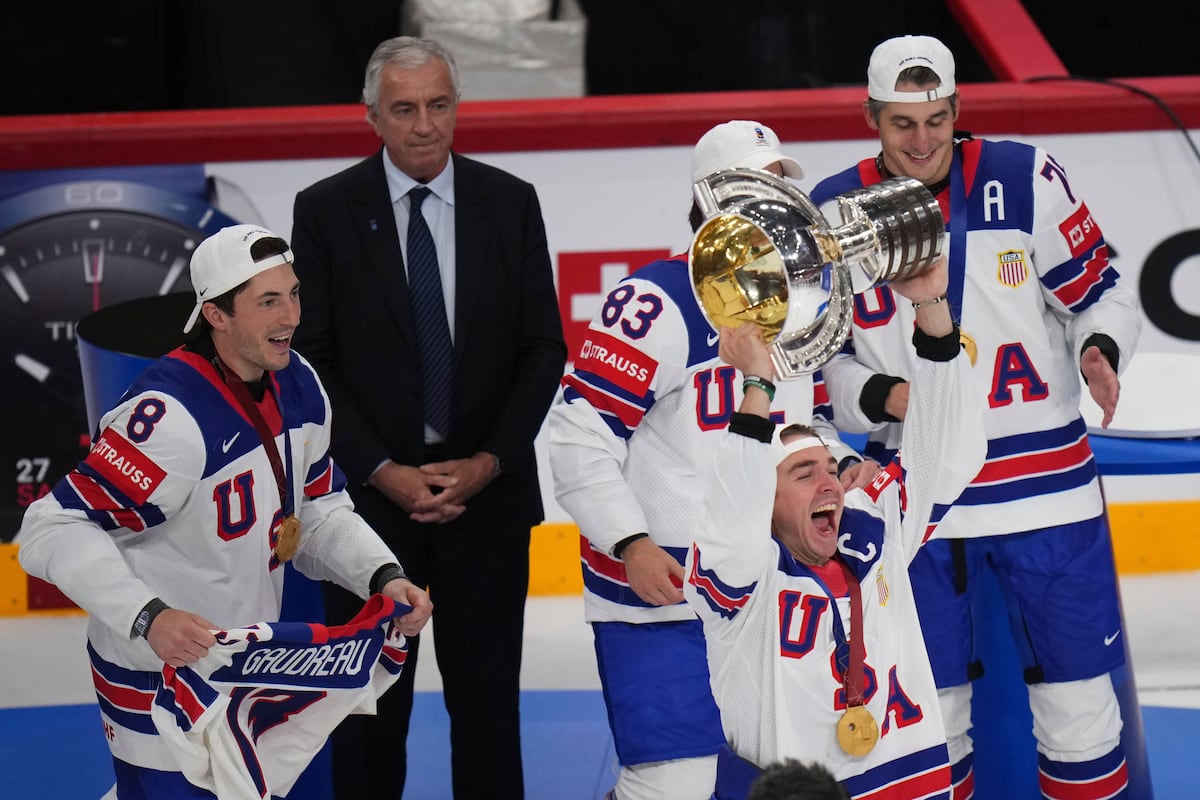
Clayton Keller, Logan Cooley, Michael Kesselring and Josh Doan skated over to get a gold medal placed around their necks.

It was a mammoth moment.

Clayton Keller, Logan Cooley, Michael Kesselring and Josh Doan skated over to get a gold medal placed around their necks.

The four Utah Mammoth players suited up for the U.S. Men’s National Team at the 2025 IIHF Men’s World Championship and beat Switzerland 1-0 in overtime on Sunday at Avicii Arena in Stockholm. It marked the first time in 92 years (since 1933) that Team USA won gold at the Worlds.

The World Championship is an annual international men’s hockey tournament put together by the International Ice Hockey Federation. NHL players can opt to participate if their respective teams missed the playoffs or were ousted in the first two rounds. This year’s World Championship was in Stockholm and Herning, Denmark, from May 9-25.

Switzerland’s Leonardo Genoni catches the puck and the stick of United States’ Logan Cooley during the final match between United States and Switzerland at the ice hockey world championships in Stockholm, Sweden, Sunday, May 25, 2025. (AP Photo/Petr David Josek)

After 60 minutes of scoreless play in the final, USA and Switzerland headed to a 20-minute, 3-on-3 overtime period. The Americans quickly ended the tournament on top.

Cooley corralled the puck out of the defensive zone and pushed it up to Tage Thompson who proceeded to rip it from the right circle for the game-winning tally at 2:02. Cooley’s primary assist on the play marked his 12th point in 10 games. The center had a cumulative four goals and eight assists which tied Frank Nazar (Chicago Blackhawks) for most on the team.

Cooley and Keller — who was named captain for Team USA — were atop the squad’s scoring production. The Mammoth duo was on the first line and played with both Thompson (Buffalo Sabres) and Conor Garland (Vancouver Canucks).

Garland and Keller had familiarity skating with each other; Garland was a fifth-round pick of the Arizona Coyotes in 2015. The forwards had three seasons on the same NHL team before Garland was traded to Vancouver in July 2021.

Following a career-high 90-point season with Utah, Keller posted 10 points (three goals, seven assists) in 10 games in the tournament. The 26-year-old was left off of the Team USA roster for February’s 4 Nations Face-Off and has his eyes on a spot in the 2026 Milan Olympic lineup. It is likely a reason Keller attended the World Championship for the first time since 2019. And his performance — both on the ice and leadership-wise — could bode well for him.

Cooley might be an under-the-radar pick for the Olympics, too. While he was not in the prominent conversation for 4 Nations, Cooley was a consistent difference-maker for Team USA this time around. The 21-year-old anchored the top line and showed the two-way, defensively detailed game that benefited the Mammoth. Cooley finished his sophomore NHL season with 65 points (25 goals, 40 assists) in 75 matchups.

Switzerland’s Sven Andrighetto, left, and United States’ Michael Kesselring fight for the puck during the final match between United States and Switzerland at the ice hockey world championships in Stockholm, Sweden, Sunday, May 25, 2025. (AP Photo/Petr David Josek)

Doan was the 13th forward for Team USA through most of the Worlds. The forward provided a depth role — somewhat similar to his bottom-six minutes in Utah — and had one goal.

Kesselring played on the third pair with the Chicago Blackhawks’ Alex Vlasic. The defensemen have seen each other throughout their hockey careers — they played against each other in Hockey East, for Northeastern and Boston University, respectively, from 2019-21.

Kesselring has joined Team USA at the World Championship the past two years and said it gave him more confidence going into this season with the Mammoth during which he took on a greater role. Kesselring had four points (one goal, three assists) at Worlds and 29 points (seven goals, 22 assists) in 82 games in Utah.

Barrett Hayton and Karel Vejmelka participated in the World Championship, too. Hayton had two points (one goal, one assist) for Canada while Vejmelka logged a .902 save percentage and 2.98 goals against average with Czechia. Both teams were eliminated in the tournament‘s quarterfinal round.

Sunday’s victory was not just historic for Team USA but gave Keller, Cooley, Kesselring and Doan winning experience on a major stage ahead of their second season with the Mammoth — during which they’re aiming to make the playoffs.

Note to readers • This story is available to Salt Lake Tribune subscribers only. Thank you for supporting local journalism.

Source: Utah News

Voices: To keep Utah ‘the best,’ we must ensure every community has fast and reliable internet

As major innovations in security, connectivity and AI rapidly evolve and mature, we must help keep Utah competitive by treating broadband as part of Utah’s critical infrastructure: essential, …

For the third time in a row, U.S. News and World Report has named Utah the “Best State” in the nation, and our high ranking for internet connectivity moved to top place this year. This recognition is an achievement to celebrate — and so is how we got here.

The internet has come a long way since 1969, when the University of Utah first linked with three other universities by phone lines. Known as ARPANET, this U.S. Department of Defense project was the world’s initial step toward critical infrastructure that more than 5.6 billion people worldwide now live by.

Today, the internet is a lifeline for education, healthcare, commerce and more. Internet access is no longer just about streaming or browsing — it’s about job creation, small business growth and attracting top-tier industries to every corner of our state. Reliable internet provides rural students access to the same educational resources as their urban peers, and it’s essential for patients consulting with specialists hundreds of miles away. It’s a gateway to opportunity for businesses large and small, and it supports family connections, public safety and groundbreaking research.

Utah’s enviable connectivity owes thanks to decades of building toward a long-range vision and collaboration that is Utah’s “secret sauce.” In 1996, the Utah Legislature provided substantial funding for the Utah Education Network — later expanded to include healthcare as the Utah Education and Telehealth Network (UETN) — to connect K-12 schools, higher education, public libraries, government and healthcare sites across Utah. UETN now connects more than 2,000 community anchor locations throughout Utah. In partnership with Utah’s broadband providers, the Utah Department of Transportation and key agencies such as UETN and the Utah Broadband Center within the Governor’s Office of Economic Opportunity, Utahns throughout the state enjoy some of the best broadband internet access in the U.S.

By leveraging the state and federal Universal Service Funds — and developing strong partnerships between UETN and many of Utah’s broadband internet access providers — we’ve helped bring high-speed internet to some of the state’s most rural areas. These connections have benefits beyond faster internet for schools and healthcare clinics. Our collaborative projects have improved mobile coverage, traffic and weather monitoring, and enhanced broadband solutions for residential and business customers.

Access to high-speed internet has contributed to business growth in Utah, including increasing opportunities for remote work in rural counties.

The conscientious use of state and federal universal service funding and the development of thriving private-public partnerships have created and sustained this burgeoning internet infrastructure for almost 30 years and serve as a model other states should follow.

Notwithstanding, many Utahns still face barriers to reliable, affordable internet, keeping them from the necessary opportunities to thrive in today’s economy.

Rural internet service providers offered free internet connections during the pandemic. A few years later, when national pandemic-level support for broadband ended, a survey found that 13 percent said they would disconnect due to affordability. The Utah Broadband Center’s Broadband Access Grant (BAG) and Broadband Infrastructure Grant (BIG), totaling over $330M, plans to connect the remaining approximately 45,000 unserved or underserved locations in the state with broadband by 2030. However, ensuring affordable connectivity, devices and digital skills training is an ongoing pursuit.

To unlock our full economic potential, we must connect not just people to the internet, but entire communities to the future. Together we keep working to connect rural areas, tribal communities and outlying urban communities to reduce these barriers that ultimately hamper workers’ access to digital tools and can endanger the public’s ability to access vital health and safety resources in an emergency.

Similarly, Utah is poised to remain at the forefront of technological innovation and all the opportunity it may bring to our great state. As major innovations in security, connectivity and AI rapidly evolve and mature, we must help keep Utah competitive by treating broadband as part of Utah’s critical infrastructure: essential, universal and future-proof.

We’ll get there if we continue to work together — keeping the people of Utah at the heart of every decision.

(Spencer Jenkins) Spencer Jenkins is the CEO and Executive Director of the Utah Education and Telehealth Network (UETN).

Spencer Jenkins is the CEO and executive director of the Utah Education and Telehealth Network (UETN), where he leads efforts to expand educational and telehealth access across Utah through innovative technology and statewide collaboration.

(Rebecca Dilg) Rebecca Dilg is Director of the Utah Broadband Center.

Rebecca Dilg, director of the state’s Utah Broadband Center, has convened stakeholders since 2018 to facilitate the state’s broadband internet expansion to households and businesses, most recently through the state’s two broadband grant programs — Broadband Access Grant (BAG) and Broadband Infrastructure Grant (BIG) — totaling over $330 million.

(Bruce H. Todd) Bruce H. Todd is the President of the Utah Rural Telecom Association and CEO of STRATA Networks.

Bruce H. Todd is the president of the Utah Rural Telecom Association and CEO of STRATA Networks, a cooperative delivering broadband and wireless services across Utah’s Uintah Basin. With over 39 years in telecommunications, he is a leading advocate for rural connectivity and serves on multiple regional and national telecom boards.

The Salt Lake Tribune is committed to creating a space where Utahns can share ideas, perspectives and solutions that move our state forward. We rely on your insight to do this. Find out how to share your opinion here, and email us at voices@sltrib.com.

Source: Utah News

In Utah, tribal co-stewardship shows benefits for public lands and Native communities

Tribal people, long before the concept of public lands and forced colonization, interacted with the landscape traditionally, ceremonially as well as domestically,” says Paiute Indian Tribe of Utah’s …

This article is published through the Utah News Collaborative, a partnership of news organizations in Utah that aim to inform readers across the state.

On Jan. 11, 2025, hundreds of people gathered on the steps of Utah’s Capitol Building for the Rally for Public Lands—a show of support for preserving Utah’s national monuments, national forests and national park lands.

A light flurry of snow chilled the crowd as author Terry Tempest Williams, Utah Senate Minority Leader Luz Escamilla, Regina Lopez-Whiteskunk of the Ute Mountain Ute Tribe and Latiné university student Louise Fernanadez spoke to the value of keeping public lands free of development, while underscoring what polling in Utah consistently states—that dismantling public land protections is overwhelmingly unpopular.

Among those speaking that day was Autumn Gillard, cultural resource manager for the Paiute Indian Tribe of Utah, who emphasized the very specific value of public lands to her people. Gillard addressed how her cultural identity and physical health are intertwined with her ability to steward the landscape, to actively be a part of it. “Today I would like to express the importance of ancestral connection to public land,” Gillard said. “Tribal people, long before the concept of public lands and forced colonization, interacted with the landscape traditionally, ceremonially as well as domestically.”

“Yanawant,” the Paiute word for what is now known as the Grand Staircase region, is her ancestral land and the land her people have stewarded for centuries. According to archeologists, the Paiute Tribes have lived in the region for at least 13,000 years, along with the ancestors of many other tribes, until they were removed by the U.S. government and placed on reservations throughout the 19th and 20th centuries.

The trauma caused by this forced relocation has left intergenerational traces which have been observed in the growing field of epigenetics—how genes are expressed in the body. In 2023, a study was published in the International Journal for Equity in Health titled, “Association Between Gene Methylation and Experiences of Historical Trauma in Alaska Native Peoples,” showing how environmental factors can impact how a person’s DNA is represented. The genetic effects of historical trauma have been linked to elevated rates of depression, anxiety, cardiac disease, diabetes and substance abuse in affected communities. The Alaska study focused on the impact of colonization to Indigenous people’s health and how reconnection to traditional landscapes, food ways and practices can improve overall wellbeing.

“I’ve witnessed it within myself, healing from generational trauma by going out into the landscape and reconnecting,” said Gillard. “But also by being able to provide that to a peer of mine and hearing from them when we’re coming home that they feel so much better.”

To read the full story, visit CornerPost.org.

Source: Utah News

These 5 NFL rookies with Utah ties ended up in ideal spots

From first-rounder Jaxson Dart to undrafted free agents Junior Tafuna and Jakob Robinson, several players with Utah connections have chances to make an impression early in their careers.

There are 30 players with Utah ties who have earned opportunities this offseason to try to make an impression as NFL rookies.

For five of them, it’s as a draft pick. For others, it’s as an undrafted free agent. Still more earned invites to try out at rookie minicamps.

Advertisement

The situation they each find themselves in can be as important as a player’s talent, especially earlier in their pro careers as they try to gain a foothold in the NFL.

Here’s a look at five who, on the surface, have circumstances that could work in their favor.

Giants Rookie Camp Football

New York Giants quarterback Jaxson Dart (6) looks on after the NFL football team’s rookie minicamp, Friday, May 9, 2025, in East Rutherford, N.J. | Angelina Katsanis

The first-rounder: Jaxson Dart

  • Former Corner Canyon High/Roy High quarterback

  • Drafted first round, 25th overall by New York Giants

Dart, a Kaysville native, may have found himself thrust into an ideal situation when the Giants traded back into the end of the first round to snag him.

There are a pair of veterans the Giants brought in this offseason whom Dart, who excelled for three years under Lane Kiffin at Ole Miss, can learn behind while he gets acclimated to the pro game.

Advertisement

Russell Wilson is in New York on a one-year deal worth $10.5 million, according to Spotrac, while Jameis Winston is on a two-year, $8 million contract.

Unlike when Zach Wilson, another Corner Canyon product, entered the NFL as a first-round pick (albeit as the No. 2 overall selection), Dart looks to be more in a situation where he will have time to work on his progression before being thrown into the fire as a starter.

Zach Wilson is heading into his fifth NFL season, and after falling out of favor with the New York Jets after three seasons, he’s on his third pro team now, signing this offseason with the Miami Dolphins (he spent last season with the Denver Broncos).

Perhaps Dart can avoid a similar fate with the chance to grow outside of the bright spotlight early on in his career, with Russell Wilson and Winston able to handle the early pressure of being the starter and the primary backup.

Advertisement

Dart already made a solid impression during rookie minicamp, and he will have the chance to do so again when the Giants start offseason voluntary OTAs next week.

“I’m a competitor, so I’m going to come to work every day and do my best to make everybody around me better,” Dart said at rookie minicamp, according to The Athletic. “I understand what the situation is, but for me, I care about winning.

“There’s nothing fun about losing, so it doesn’t matter where you’re at on the depth chart; if you’re playing this much or not playing this much, if you’re losing, it sucks. So, I just want to make the team better. That’s my focus.”

Chiefs Rookie Camp Football

Kansas City Chiefs wide receiver Jalen Royals takes part in a drill during the NFL football team’s rookie minicamp in Kansas City, Mo., Saturday, May 3, 2025. | Colin E. Braley

The fourth-rounder: Jalen Royals

  • Former Utah State wide receiver

  • Drafted fourth round, 133rd overall by Kansas City Chiefs

Advertisement

During the middle of the draft, Royals spent a decent amount of time listed as one of the “best available” prospects, waiting as he slid a bit more than some draft experts had predicted — there were those who believed he might be a Day 2 selection, likely in the third round.

All the waiting, though, paid off with getting selected by the Chiefs.

Not only is Royals going to Kansas City, one of the most consistently successful franchises in the game right now, but it appears he’ll have an opportunity to contribute early in his career.

The Chiefs have a mix of veteran and young receivers on their roster, with older guys such as JuJu Smith-Schuster and Marquise Brown mixed in with young ones such as Rashee Rice and Xavier Worthy.

Advertisement

Royals could be someone who helps stretch the field for Kansas City, a need for the Chiefs in the passing game. There have been some who pointed out similarities between Royals and Rice, the third-year wideout who had 937 receiving yards and seven touchdowns as a rookie in 2023 before missing most of last season due to an injury incurred in Week 4.

“His game is very similar to Rashee’s,” director of player personnel Ryne Nutt said of Royals, according to ESPN. “He’s got big hands, strong hands, and he’s very good after the catch.

“[Run after the catch] is a big part of our offense. That’s something we look for in receivers. We look for speed. The kid had that 4.40 [40-yard dash at the scouting combine]. We look for strength, and he has that. Then we look for route running and that’s probably an area where Rashee had to kind of develop a little bit, so we kind of thought they were similar in that respect.’’

Big 12 Pro Day Football

Utah’s Caleb Lohner lifts weights during the Big 12 Conference’s NFL football pro day Thursday, March 20, 2025, in Frisco, Texas. | Jessica Tobias

The seventh-rounder: Caleb Lohner

  • Former Utah tight end (also Utah, BYU and Wasatch Academy basketball forward)

  • Drafted seventh round, 241st overall by Denver Broncos

Advertisement

Lohner is one of the more intriguing Day 3 selections from this year’s draft after he pursued football during his final collegiate season while also hooping it up for the Utes following two years each at BYU and Baylor.

Lohner’s matchup with Broncos coach Sean Payton makes the Denver selection especially interesting.

Payton helped turn former NFL tight end Jimmy Graham into a five-time Pro Bowler. Graham played basketball at Miami before joining football during a grad season in 2009, then he was drafted by the New Orleans Saints and shined under Payton.

Now, the 6-foot-7 Lohner has the chance to be the next one to go from college basketball to a pro football career — a path that’s rare but has been successfully traversed most successfully by guys like Antonio Gates and Graham.

Advertisement

Lohner only caught four passes last year for Utah, though all of them went for touchdowns.

Even in limited action in football, which included working out at the Big 12 Pro Day, Payton saw enough in Lohner to want to bring him on board.

“You can see the basketball skill set, that’s easy, at a high level. Then you’re looking at a small amount of playing time and yet enough to where you’re watching them,” Payton said of Lohner, per NFL.com.

“I think the other thing that helped was watching him at the Big 12 Pro Day. There were just a few plays that you see movement skills and it’s a lot to work with. If it turns out like the last one did (Graham), then we’d be really excited.”

NCAA FB: Utah Utes Spring Practice 1

Utah Utes Spring Practice Day 1 in Salt Lake City, UT on Tuesday, March 21, 2023. Hunter Dyke/Utah Athletics | Hunter Dyke/Utah Athletics

Undrafted free agent: Junior Tafuna

  • Former Utah and Bingham High defensive tackle

  • Signed as undrafted free agent by Houston Texans

Advertisement

There were several prognosticators who believed Tafuna could be a Day 3 selection, but he never heard his name called during the draft.

That might be a blessing in disguise, as he heads to a Houston team looking to build some younger depth at defensive tackle behind veteran Mario Edwards Jr. and Sheldon Rankins.

“The Texans signed Rankins in free agency, and re-signed Mario Edwards, so the need isn’t immediate. But Houston has wanted to get younger at defensive tackle for the past two years, and finding one in the draft will help,” the Houston Chronicle’s Jonathan M. Alexander wrote before the draft.

Houston used a seventh-round selection on former Rutgers defensive tackle Kyonte Hamilton, but Tafuna was the team’s only UDFA addition at the position.

Advertisement

That should give Tafuna chances to stand out, and head coach DeMeco Ryans already commented on what he’s seen from the Utah talent after the team’s rookie minicamp.

“Yeah, the thing I saw with Tafuna is a really big, strong guy,” Ryans said, according to KPRC 2’s Aaron Wilson. “He’s very versatile. I like him in the run game and in the pass game. I think he does both. Young guy who can come in and add some depth to our interior defensive line.”

Jakob Robinson

BYU Cougars defensive back Jakob Robinson (0) in a defensive stance during an NCAA football game on Saturday, Oct. 8, 2022 in Las Vegas. (AP Photo/Tyler Tate) | Tyler Tate, Associated Press

Undrafted free agent: Jakob Robinson

  • Former BYU, Utah State and Orem High defensive back

  • Signed as undrafted free agent by San Francisco 49ers

The 5-foot-11 Robinson wasn’t expected to be a draft pick, but he did agree to terms with the 49ers soon after the draft, per reports.

Advertisement

San Francisco used a third-round pick on another cornerback, Western Kentucky’s Upton Stout, but Robinson is the only other rookie corner the 49ers brought in during draft weekend.

One of San Francisco’s needs this offseason has been to add cornerback depth, while many are penciling in Stout as the team’s starting nickelback.

Pro Football Focus highlighted Robinson as the 49ers’ undrafted free agent “to watch” this offseason.

“Robinson earned a 65.0-plus PFF coverage grade in all but one of his four seasons at BYU, and he didn’t allow a passer rating above 100.0 in coverage in any of those campaigns,” PFF’s Ben Cooper wrote.

Advertisement

“In the Cougars’ bowl-game win over Colorado, he limited LaJohntay Wester and Jimmy Horn Jr. to two catches for 3 yards. And Arizona’s Tetairoa McMillan, the No. 8 pick in the 2025 NFL Draft, didn’t secure a catch when matched up with Robinson in BYU’s Week 7 win.”

Robinson will also share the field and be able to learn from another BYU legend, Fred Warner, who recently again became the highest paid linebacker in the NFL with a reported three-year, $63 million contract extension.

Source: Utah News

On set of ‘The Chosen’ in Utah, fans become co-creators

Now, more than 280 million viewers in 175 countries have seen “The Chosen” and more than $43.3 million has been fundraised to put the sixth season of the series in front of audiences, per the official …

There’s a quiet reverence on set of “The Chosen.” Soft whispers and the smack of strappy sandals against the ground are the only noises that come from the 600 background actors filming in Goshen, Utah, in mid-May.

The silence is broken by an assistant director who calls, “Background rolling!” through a megaphone. Hundreds of background actors shuffle back into place, and the sound of chirping birds still rings through.

The scene being shot — which will appear in Season 6 of “The Chosen” — depicts a confrontation between Roman soldier Atticus (Elijah Alexander) and the Pharisee Yanni (Wasim No’mani).

It needs to be reshot. Fluctuating weather and lighting are to blame this time, but it typically takes between one and seven takes to get a scene right.

Adjustments are made for lighting control and the show goes on. Lead actors play their parts while hundreds of extras, the bulk of whom are unpaid fans of “The Chosen,” fill the background with choreographed chaos.

After a couple more shoots, the scene is successfully completed. Hundreds of background actors erupt in applause.

“We’re not used to finishing a shot and having applause,” Dallas Jenkins told the Deseret News while filming on set in Goshen.

For three weeks, a rotation of 600 unpaid extras were on set of “The Chosen,” filming scenes for Season 6. All of these extras are fans of the show and enjoy the opportunity to be part of its creation in exchange for making a donation — after all, “The Chosen” is a crowd-funded series.

When these fan extras are on set, “there’s a ton more joy,” Jenkins said. “Every time they’re here, it gives everybody, the cast and crew, a little bit of a better recharge.

“It‘s very authentic that people are so excited to be here and so excited to be part of it,” he continued. “The scenes, I think, take on a life of their own.”

Extras leave for a break after acting in the background on the set of “The Chosen” in Goshen, Utah County, on Tuesday, May 14, 2025. | Tess Crowley, Deseret News

Filming ‘The Chosen’ in Utah

Filming for “The Chosen” Season 6 is split mostly between a set in Midlothian, Texas and the set in Goshen, Utah — a small town on the southwest edge of Utah County.

Construction on the Utah replica of Jerusalem began in 2010. The set, which is officially called the Motion Picture Studio South Campus, is owned by The Church of Jesus Christ of Latter-day Saints.

“The Chosen” has used the set for filming since Season 2.

“You can tell that the people who built this set cared about every detail, and so do we,” Jenkins said. “When you’re working on a set that‘s this rich and clearly built with honor and respect for the story and authenticity, it inspires me to do the same.”

Cast and crew from “The Chosen” spent three weeks filming scenes for Season 6 in Goshen in May. They’ll soon head to Italy to shoot the final scenes.

While still in Utah, a few scenes will be shot on off-set locations such as at the Little Sahara Sand Dunes in Juab County and the Bonneville Salt Flats in Tooele County.

“The first time I saw (the Goshen set), I couldn’t believe the scope and the scale of it. … It‘s just extraordinary,” Karla Cameron, a paid background actor for “The Chosen” told the Deseret News.

“I‘ve actually visited Israel and been to Jerusalem and seen the sites. They’ve done an excellent job of recreating this in the middle of beautiful Utah.”

Paid background actor Karla Cameron, from Atlanta, poses on the set of “The Chosen” in Goshen, Utah County, on Tuesday, May 14, 2025. | Tess Crowley, Deseret News

‘The Chosen’ fans are co-creators

When Jenkins released Season 1 of “The Chosen,” he didn’t anticipate how large the biblical drama’s fan base would be.

“I didn’t know that there would be any fans,” he said.

Now, more than 280 million viewers in 175 countries have seen “The Chosen” and more than $43.3 million has been fundraised to put the sixth season of the series in front of audiences, per the official “Chosen” site. The bulk of that money comes from fans.

Ahead of filming the Sermon on the Mount scene in Season 2, Jenkins found a way to involve fans who’d made donations to funding the series, while simultaneously benefiting its creation.

“The Chosen” didn’t have the “ability to bring in thousands of people” to form the massive audience gathered around Jesus during the Sermon on the Mount.

Extras laugh in between takes in the background on the set of “The Chosen” in Goshen, Utah County, on Tuesday, May 14, 2025. | Tess Crowley, Deseret News

So Jenkins came up with a solution. “We thought, ‘Well, the fans would love to be here. They’re willing to support the show. Maybe in exchange for their donation, we could give them an opportunity to be here.’”

Fans of the series travelled great distances — some from foreign countries — and bought their own costumes so they could be part of “The Chosen” experience.

Now nearly six seasons into the series, fans of “The Chosen” continue to show up.

“The fans have always been co-creators of the show. We’re a free show. The majority of our income is generated by donations, by fans choosing to give in some way to the show,” Jenkins said. “I’ve always considered it to be a partnership. When they’re here on set, it‘s even more so because they’re literally part of the scene.”

He continued, “That‘s deepened my relationship with the fans. And I think them being here and seeing how hard everyone works to justify their faith in the project deepens their passion as well.”

Wasim No’mani, center, acts as Yanni, a Pharisee in Jerusalem, in the Court of Gentiles on the set of “The Chosen” in Goshen, Utah County, on Tuesday, May 14, 2025. | Tess Crowley, Deseret News

Why extras make the trek to Goshen, Utah

The bulk of background actors won’t receive even a modest bit of screen time. They will blur and blend into the backdrop of the show.

But for these 600 extras, it‘s all about getting a taste of “The Chosen” experience and helping put it in front of a global audience.

Simona Pester travelled from Belfast, Northern Ireland, to blend into the background of “The Chosen” for the fifth consecutive time.

“I’m here … because I love the show. I think it‘s very well done, very well written,” Pester told the Deseret News while on set in Goshen. “I just love to be a part of it. It‘s great opportunity.”

She continued, “‘The Chosen’ is a way of people hearing the gospel across borders … and I want to support that. It‘s worth more to me than any possession or any riches. … I’m willing to give my treasures and possessions to support the show so that other people (can) have the real treasure.”

Karla Cameron, from Atlanta, shared similar motives for making the trek to Utah to be in “The Chosen.”

For Cameron, it‘s about supporting cast and crew of the series to bring the “story about Jesus Christ‘s life” to audiences.

“(’The Chosen’) is a way to access the information, because perhaps you’re not going to read the Bible, but you can see the story, and it will incentivize you to then maybe get a little deeper into the story by opening the Bible and reading it,” Cameron said. “I love it. I think it‘s amazing.”

She concluded, “I am definitely here for the word and for God’s word. … I love it so much.”

Extras act in the background on the set of “The Chosen” in Goshen, Utah County, on Tuesday, May 14, 2025. | Tess Crowley, Deseret News

Source: Utah News