An entertaining weekend of divisional round play leaves Kansas City and Buffalo playing for the AFC championship and Philadelphia and Washington for the NFC championship.
The 265th edition of the BYU-Utah basketball rivalry had its share of heroes from the team wearing red. Thanks to the efforts of Ezra Ausar, Lawson Lovering and Hunter Erickson — and key contributions …
The 265th edition of the BYU-Utah basketball rivalry had its share of heroes from the team wearing red.
Thanks to the efforts of Ezra Ausar, Lawson Lovering and Hunter Erickson — and key contributions from other Runnin’ Utes — Utah was able to win a 73-72 thriller in overtime on Saturday night at the Huntsman Center.
It was a game where free-throw shooting ended up being a primary factor, and one where Utah’s identity it has forged during a three-game winning streak — attacking the paint — played out in its favor.
While the Utes went 17 of 32 from the free-throw line, far from the type of efficiency Utah would like to see from the line, that was much better than BYU’s 4 of 10 shooting from the charity stripe.
In a way, Ausar, Lovering and Erickson all had their own free-throw stories to tell from the Utah victory, and it was spurred by their ability to help the Utes win the battle in the paint against the Cougars.
“That’s the glass half empty,” Utah coach Craig Smith said, of the high number of free throws the team missed. “The glass half full is at least we got to the free throw line 32 times, and we made 17.
“Two weeks ago, there was no chance we’re going to make 17 free throws in a game because we wouldn’t get fouled. But we’re playing a different brand now. We’re getting to the line more, we’re attacking more. We’re just playing with way more force, and it’s big boy basketball. And that was a big boy basketball win.”
Ausar, Lovering and Erickson led that “big boy basketball” mentality against BYU.
Ezra Ausar
Ausar had easily his most impactful game as a Ute, scoring a season-high 26 points, just two of his career-high of 28 last season when he was at East Carolina.
The 6-foot-8 junior forward shot 11 of 15 from the floor, as well as 4 of 8 from the free-throw line.
He also had six rebounds, two assists and two steals.
After scoring two points in the first half, Ausar had 21 in the second half and three more in overtime.
He scored 12 of those points alone during a 16-4 run where Utah turned a 35-27 deficit into a 43-39 lead.
Ausar scored on a wide-open dunk in the final minute of regulation when Gabe Madsen drove then kicked to Ausar for the slam. That play gave Utah a 63-62 lead.
He rebounded a BYU miss on the next possession and was fouled, then hit 1 of 2 free throws to make it a two-point game.
The Cougars responded with a short jumper from Fousseyni Traore, forcing overtime.
Ausar then scored Utah’s first three points of the extra session.
In the final minute of overtime, with Utah trailing by one, he poked the ball away from Richie Saunders, and that led to a possession where Hunter Erickson was fouled, then hit two free throws to give the Utes the lead back.
It’s also an encouraging sign given the context of Utah’s two wins last week. In the Utes’ 73-65 victory over TCU on Wednesday, fellow forward Keanu Dawes scored 16 points and had two critical defensive plays in the final minute — one a block, and another a steal — as Utah held off a TCU comeback.
Utah Utes center Lawson Lovering (34) and Brigham Young Cougars center Fousseyni Traore (45) both battle for rebound during a basketball game at the Jon M. Huntsman Center on the campus of the University of Utah in Salt Lake City on Saturday, Jan. 18, 2025. | Brice Tucker, Deseret News
Lawson Lovering
The 7-foot Lovering was a physical force for Utah in the paint, setting the tone inside from the get-go.
When Utah went on a 16-4 run early in the second half, he had four points in that stretch and also proved to be a menace on the defensive end.
Lovering ended the night with 13 points, seven rebounds, four assists and three blocks.
It’s the latest in an impressive run of games for the senior big man, who’s been integral in each of Utah’s games during its three-game win streak.
The only negative in his game Saturday night was his free-throw shooting — Lovering was 5 of 11 as BYU employed a Hack-a-Shaq philosophy, daring him to make the Cougars pay from the free-throw line.
The idea worked more than it didn’t — that included Lovering missing two free throws in overtime, and on the year, he’s shooting 42.6% from the line.
Lovering, though, was still a handful for BYU to deal with, and he played much of the second half and overtime with four fouls without fouling out — a sign of learning from the center.
Utah Utes guard Hunter Erickson (0) drives the ball to the hoop during a basketball game between the Utah Utes and the Brigham Young Cougars at the Jon M. Huntsman Center on the campus of the University of Utah in Salt Lake City on Saturday, Jan. 18, 2025. | Brice Tucker, Deseret News
Hunter Erickson
Erickson, the former BYU guard whose college career has taken him from Provo to a year at Salt Lake Community College to now two seasons at Utah, came up in several clutch moments for the Utes against his former team.
His first points of the game came on a 3-pointer with 9:39 left in regulation, and was a direct response to a BYU 3-pointer moments earlier. That play gave Utah a 53-48 lead.
Then in overtime, Erickson was as assertive as he’s been all year.
When Utah was struggling to score in overtime as it clanked several free throws, Erickson drilled a 3-pointer with 2:08 on the clock that made it a 70-70 game. He confidently stepped back and made the shot with BYU’s Dallin Hall on defense.
Then in the final minute, Erickson again was assertive, scoring the Utes’ final three points, all from the free-throw line.
First, he was fouled with 47 seconds left and Utah trailing by two.
Erickson made the first shot from the charity stripe, but with the chance to tie the game, he airballed the second attempt.
That was his first free-throw miss since mid-November — Erickson is an 87.5% free throw shooter this year, on 16 attempts.
Erickson, though, got the chance for redemption.
After Ausar forced a turnover, Utah again had possession and the chance to take the lead. Erickson again drove into the lane and was fouled.
This time, he nailed both free throws.
Erickson finished the night with nine points, two assists, one steal and a rebound while playing 23 minutes.
What’s next
Utah will be tested again this week with a trip to No. 10 Houston on Tuesday, followed by a home matchup against No. 25 Baylor.
The Cougars narrowly avoided an upset against UCF on Saturday, while the Bears were knocked off at home by TCU on Sunday.
A side note from Baylor’s loss: TCU, which Utah beat on the road last Wednesday, rose to No. 73 in the NET NCAA rankings by beating the Bears.
The Utes’ win on the road over the Horned Frogs now qualifies, at least for the moment, now qualifies as a Quad 1 win.
I don’t know what got into him,” Utah coach Craig Smith said of his leading scorer, “but it needs to happen all the time,” …
Ezra Ausar jumped into Craig Smith’s arms.
The Utes’ hero and head coach held onto each other for just a moment after the buzzer sounded and thousands of Utah fans cheered around them.
Ausar, the junior forward, showcased his joy with a bright smile. And Smith finally exhaled, as the Runnin’ Utes captured their third-straight victory in Big 12 conference play with an overtime 73-72 win over in-state rival BYU.
Ausar led all scorers with a career-high 26 points against the Cougars on Saturday night, with 24 of them coming in the second half and overtime. The Atlanta, Georgia, native bullied his way to basket after basket, bumping and bruising BYU’s bigs in the paint to lead Utah to the win.
He finished 11 of 15 from the field and grabbed six rebounds, too.
But Ausar’s performance meant something beyond the stat sheet. He recently went home to mourn the death of a family member. And, naturally, he’s dealt with the emotions of grieving.
“It was just really counting on myself,” Ausar said. “To me, it was just confidence. I’ve just been kind of fighting my own emotions and feelings, and the best just came out. And I feel like I’ve still got more to go, so I’m just proud of the performance, and I’m going to take it in and let it marinate.”
Ausar let it all out in the locker room. Tears welled in his eyes, as he embraced his jovial teammates and coaches. Even if he wanted to hide it, he couldn’t.
Neither could his head coach at the podium. When asked to reflect on his and Ausar’s embrace at the end of Utah’s win, Smith let out a deep breath and rubbed his hands together for a few seconds. His voice trembled once he spoke into the microphone.
(Rick Egan | The Salt Lake Tribune) The Muss reacts as Utah takes the lead in the final minutes of the game , in Big 12 basketball action between the Utah Utes and the Brigham Young Cougars, at the Jon M. Huntsman Center, on Saturday, Jan 18, 2025.
“I love that man,” Smith said, as he kept himself from crying.
“I don’t know what got into him, but it needs to happen all the time,” the coach continued. “He’s just a really amazing person. I’ve met a lot of people in my life. I’m not sure I met anybody exactly like Ezra, and that’s a real compliment. Amazing family. You know, he’s been kind of in and out of some things. … He went home for a death in the family and since then he’s had a different look to him. I think he had a lot more purpose.”
Hours before Utah’s pivotal game against the Cougars, Ausar’s mother, Kimya, texted Smith “good luck” before the rivalry contest in Salt Lake City. She doesn’t usually do that, but it was a special occasion.
She also gave Utah’s head coach some advice to pass along to her son.
“Ausar was a beast in there,” Young said. “We had a hard time with him.”
Smith added: “He had a great look to him tonight, and I think he’s learning how to really compete. He’s got to keep doing this.”
Where Ausar has shined on the court, he’s made even more of an impact off of it.
Smith describes the junior forward as a “connector,” a player who builds his teammates up and wants to improve each day.
Someone who wants to learn how to win.
(Rick Egan | The Salt Lake Tribune) The Utes celebrate their overtime win over BYU, in Big 12 basketball action between the Utah Utes and the Brigham Young Cougars, at the Jon M. Huntsman Center, on Saturday, Jan 18, 2025.
Utah’s head coach knew he’d have that impact when he started recruiting Ausar in the transfer portal.
“We have a special connection, and it really started in the recruiting process,” Smith said. “We were talking essentially every day [on FaceTime]. Like, I don’t even FaceTime my family. I didn’t even know what it was, but now with Ezra, it’s like every time it’s a FaceTime call. So he taught me a lesson on that. I started FaceTiming my kids.”
Ausar’s role as a connector could be seen as he approached the podium to speak with reporters after the game. He wore a whiteTt-shirt displaying a picture of teammates Gabe and Mason Madsen tucked into his light-blue jeans.
He said his career-high performance was for former BYU players Hunter Erickson and Caleb Lohner.
“My teammates always count on me,” Ausar said. “They get on me all practice and all week long to stay dominant. … I know that is Hunter and Caleb’s old school, so that was a big win to me. I know that’s their beef.”
While Utah enjoys its win over its biggest rival, Ausar’s production will be needed moving forward.
The Big 12 is one of the best conferences in the country, and the Utes have tough matchups against No. 10 Houston and No. 25 Baylor on the horizon.
There will likely be more highs and lows in 2025. That’s just the reality of Utah’s new conference.
But, at this moment, Ausar is responsible for helping turn Utah’s season around. The Runnin’ Utes are .500 in the conference, and they now have a fighter’s chance to make the NCAA Tournament if they continue their momentum.
That wouldn’t be possible without Ausar’s presence.
“It’s a raw emotion,” Smith said. “It’s hard to replicate it. You can’t explain it. I’m just so happy for him and so happy for these guys for how they’ve responded the last 10 days and two weeks, really.
“Ezra’s best basketball is yet to come. … He’s a special young man.”
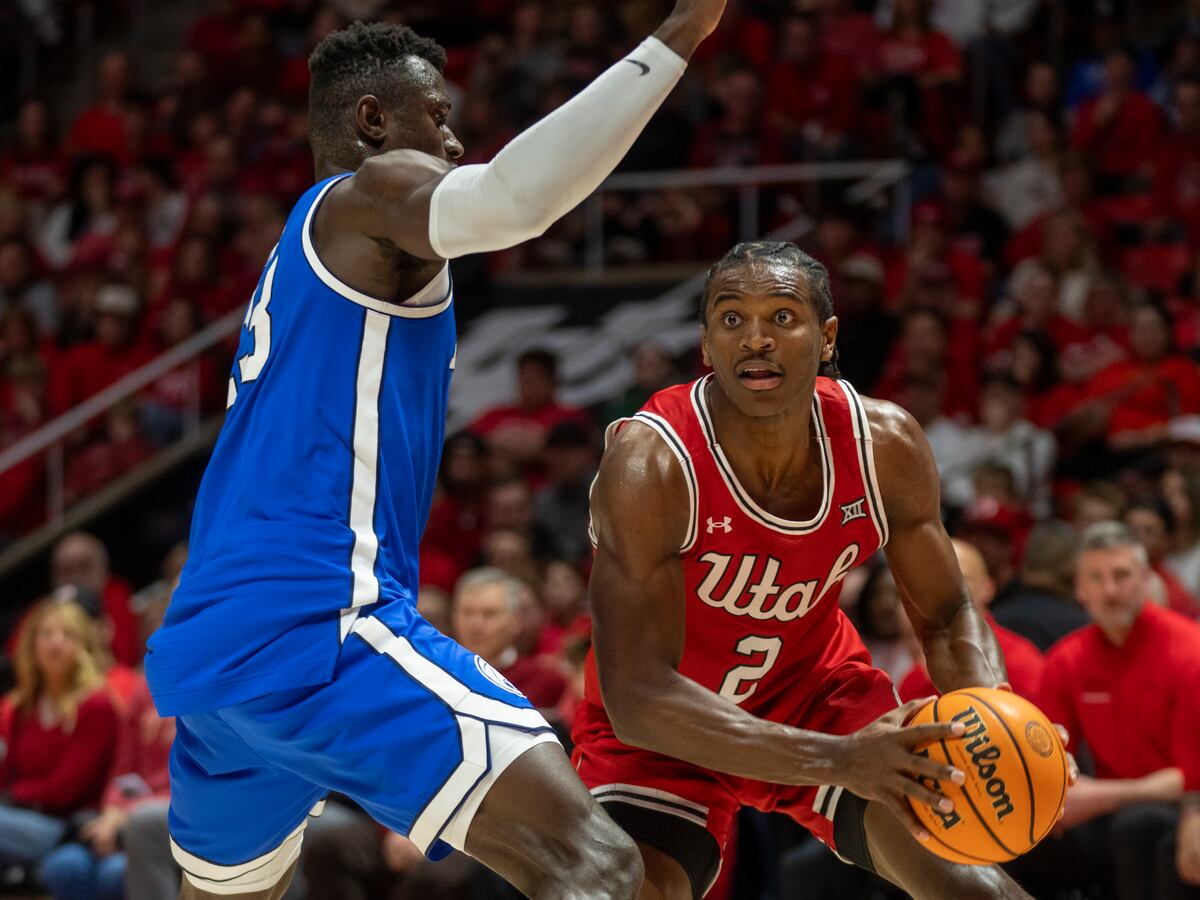
(Rick Egan | The Salt Lake Tribune) Utah Utes forward Ezra Ausar (2) shoots as Brigham Young Cougars center Keba Keita (13) defends, in Big 12 basketball action between the Utah Utes and the Brigham Young Cougars, at the Jon M. Huntsman Center, on Saturday, Jan 18, 2025.
Genesis data is now producing high impact science in cosmochemistry, solar physics, coronal mass ejections, and space weathering.
In the beginning … there was a thud. It was an unwanted sound, and one that resonated around the world.
Think back over 20 years ago to Sept. 8, 2004. That’s when NASA’s Genesis sample return capsule slammed into an isolated part of the U.S. Army’s Dugway Proving Ground in Utah. It was an unintended, full-stop, smashing occasion. Held tight within that canister were delicate wafers that were prized samples of atoms and ions, gathered up from wisps of solar wind accumulated over hundreds of days by the Genesis spacecraft as it loitered at Lagrange Point 1, a select spot in space between Earth and the sun. The capsule met the Utah desert at an estimated speed of 193 miles per hour (311 kilometers per hour). On impact, those wafers were shattered to bits.
The Lockheed Martin-built Genesis spacecraft failed to deploy a set of parachutes that were designed to slow it down, a glitch later attributed to improper installation of gravity-switch sensor hardware. A planned and well-rehearsed mid-air retrieval via helicopter of the returning capsule was for not. But now, over two decades later, call it “late breaking” news as scientists studying Genesis samples recovered from the crash continue to make new discoveries.
Contingency plan
This March, a special Genesis sample return 20th anniversary event is being held at the Lunar and Planetary Science Conference in Texas, a look at what scientists have uncovered from the Genesis samples, while casting an eye toward the future.
You may like
As for the capsule crash, “as you might guess, everybody was shocked and alarmed,” recalled Caltech’s Don Burnett, the mission’s principal investigator and lead scientist. “When 2,700 feet was called out, and no parachute, I knew we were in trouble,” he told Space.com.
Burnett said that there was a contingency plan for a hard landing. It was activated in as-soon-as-possible fashion. That plan had all been previously reported to Jet Propulsion Laboratory (JPL) that managed the Genesis mission for NASA management, “but they didn’t remember,” he said.
On crash day, NASA management wanted to call an urgent meeting about what to do, with Burnett advising that upper management should be told “go to hell.”
Breaking space news, the latest updates on rocket launches, skywatching events and more!
“We needed to go out to pick up the pieces,” Burnett said. The Genesis science team at the crash site swung into action. “The important point was that the crash would not destroy solar wind atoms … all we had to do was find them,” he said.
A historical “uh-oh” space exploration moment in 2004 as the Genesis return capsule suddenly met Utah desert at nearly 200 miles per hour. (Image credit: NASA/JPL-Caltech)
Sample returns are forever
The banged up Genesis sample capsule was transported to NASA’s Johnson Space Center in Houston, Texas. Once in curatorial hands, the painstaking work to reclaim science from collector fragments earnestly began.
The solar wind atoms were there, Burnett said, “but all but one of our 200-plus beautiful 4-inch hexagons were broken into small pieces.”
As luck would have it, Burnett added, the one complete hexagon was the least important scientifically. The pieces, down to one-quarter inch, were picked from the mangled capsule one by one with tweezers. There were nine different materials in the hexagons, he said, and with the help of supervision team members the researchers learned to recognize the different types.
A Genesis collector array as displayed in this pre-launch image at NASA’s Johnson Space Center. The hexagons consisted of a variety of ultra-pure, semiconductor-grade wafers. (Image credit: NASA/JPL-Caltech)
As clearly indicated by the Apollo lunar samples, pointed out Burnett, “sample returns are forever,” with science gained as new ideas and analytical techniques become available.
“With a bit of luck here and there, we were able to deliver our required science results for official mission success, but it took until 2010,” Burnett said.
“Genesis analyses were always going to be hard,” Burnett said, “but they were much harder because of the loss of material in the crash and contamination from sample return capsule materials and Utah dirt.”
Rescue science
Amy Jurewicz, project scientist for Genesis, is now an assistant research professor at Arizona State University’s Center for Meteorite Studies in Tempe, Arizona.
When the Genesis capsule was finally wheeled into the high bay for inspection at the Utah Test and Training Range, “the sight was a shock,” said Jurewicz. “But, we could see that pieces of collectors were still there so we knew that we could rescue at least some of the science.”
As both project scientist and the only materials engineer on the science team, Jurewicz knew her expertise would be greatly needed. The work on Genesis demanded a pace to enable the retrieval of the science she knew was there. “And, I have stayed focused on Genesis to this day.”
Fragments of the Genesis collector arrays. (Image credit: NASA/JSC)
Cosmochemistry
Genesis data is now producing high impact science in cosmochemistry, solar physics, coronal mass ejections, and space weathering, said Jurewicz, sharing recent work in Japan that uses Genesis data to identify the magnitude of massive solar storms.
“There are opportunities for more Genesis sample science in all these areas and more, and techniques developed will support other research in planetary materials,” Jurewicz reports.
Kevin McKeegan of the University of California Los Angeles is a Genesis mission science team member.
Like other Genesis researchers, McKeegan underscores that, unfortunately, what many people remember about Genesis is the crash.
“What they should know, however, is that the Genesis mission was very successful, achieving all of its major scientific objectives,” McKeegan told Space.com. “This is an excellent demonstration of the resilience of sample-return, and is due to the diligence and creative efforts of a large team of curators and scientists led by our indefatigable principal investigator, Don Burnett,” he said.
Logo of NASA’s Genesis spacecraft mission. (Image credit: NASA)
Genesis-provided output
In terms of isotopic compositions of the most important volatile elements, oxygen and nitrogen isotopes in chondrite meteorites and inner solar system planetary materials, “we now know that the standard model is grossly wrong,” McKeegan reported late last year at the annual gathering of the American Geophysical Union.
Genesis showed that the Earth and all (rocky) planetary materials are not made out of the average matter of the solar nebula, especially with respect to the abundant volatile elements, McKeegan said. An output from Genesis-provided data, he said, is yielding constraints on fundamental chemical and isotopic fractionation processes occurring in the early solar system.
Steady and creative
RELATED STORIES:
Caltech’s Burnett concludes that while success seemed remote, he salutes the 20 years of steady and creative processing and cleaning along with analytical improvements that have led to clutching scientific success from the jaws of defeat.
“The cosmochemistry community has risen to the challenge with a continuous stream of important papers,” he said, with Genesis results raising new questions and sparking new ideas for further scrutiny.
“There is still much important science feasible from Genesis sample analysis,” Burnett concluded.
He outscored his season average of 4.4 points solely in overtime, posting six points from a clutch game-tying 3-pointer and three made free throws — all the more valuable in a game where Utah missed …
It was another heartbreaker for Kevin Young’s Cougars.
In the program’s first conference clash against Utah since 2011, BYU suffered a 73-72 overtime loss to the Runnin’ Utes Saturday night in Salt Lake City.
3 takeaways
Once again, BYU fell short both on the road and late in the second half. The Cougars have yet to win in a true road setting this season, and if they can’t do it 45 miles away from the Marriott Center and with a few thousand of their own fans in the building, it’s hard to imagine when they’ll finally find success as a visitor in the Big 12.
Special Collector’s Issue: “1984: The Year BYU was Second to None”
Get an inclusive look inside BYU Football’s 1984 National Championship season.
BYU has now led at halftime in each of the past four contests, yet the Cougars are just 1-3 over the same stretch.
Even after the Utes missed 15 free throws on the night, and with their best player, Gabe Madsen, managing just eight points on 2-12 shooting, they still won.
BYU struggled to execute in overtime, and a number of self-inflicted wounds — namely, a Trevin Knell missed free throw with six seconds remaining that would have tied the score — ultimately buried the Cougars.
Hunter Erickson played hero. Losing to your rival is hard enough. For BYU, letting a former Cougar come alive late and make a big difference in the game has to sting much more.
Erickson played two years at BYU before eventually winding up in Salt Lake City, where he’ll now forever be remembered for his efforts in vanquishing his former teammates.
He outscored his season average of 4.4 points solely in overtime, posting six points from a clutch game-tying 3-pointer and three made free throws — all the more valuable in a game where Utah missed 15 shots from the charity stripe — which ended up being the winning difference.
Additionally, Ezra Ausar exploded for a season-high 26 points, while Lawson Lovering added 13 points, seven boards and four assists.
On the flip side, BYU didn’t get much aside from a combined 32 points from Richie Saunders and Fousseyni Traore, shooting 38.5% from the field, 26.7% from deep and 40% from the free throw line.
It’s great to have this rivalry back in the same conference. Neither BYU nor Utah will compete for the Big 12 crown this year, but Saturday’s matchup had all the feel of a high-stakes March affair.
The contest was tight, tense and dramatic from start to finish. The Huntsman Center was electric. No matter what side you rooted for, what more could you want in a basketball game?
The Cougars and Runnin’ Utes are always juiced up when they meet on the hardwood, but competing in the same league — and matching up twice per season — adds even more to the rivalry.
What a treat to get a rematch between these two squads seven weeks from now in Provo.
During Saturday’s highly anticipated rivalry matchup between the Utah Utes and the BYU Cougars at the Jon M. Huntsman Center, a special ‘Moment of Loudness’ will be held to honor the memory of Cleadus …
The Utah Jazz pulled out all the stops to get closer to their ultimate goal of a high lottery pick during Friday night’s game against the New Orleans Pelicans– and it turned out working in their …
Nucor Corp.’s Towers & Structures business unit on Jan. 9, 2025, said it will build a $200 million utility structures production facility in Brigham City, Utah. The new facility will be located on …
Nucor Corp.’s Towers & Structures business unit on Jan. 9 said it will build a $200 million utility structures production facility in Brigham City, Utah. The new facility will be located on Nucor’s existing Brigham City campus and create 200 full-time jobs.
Nucor is currently completing construction on two utility structures production facilities in Decatur, Alabama, and Crawfordsville, Indiana.