The Oregon Ducks women’s basketball team looked to remain undefeated with the Utah State Aggies coming to town for a non-conference match-up. Here is how it went down. The Ducks got off to a hot start …
The Oregon Ducks women’s basketball team looked to remain undefeated with the Utah State Aggies coming to town for a non-conference match-up. Here is how it went down.
The Ducks got off to a hot start starting the game on an 8-0 run to set the tone early.
The Aggies would push back though as they finished the 1st quarter on a 9-6 run to keep themselves into the game.
Advertisement
Advertisement
Advertisement
The 2nd quarter would be back and forth with neither team going on a substantial run but Janiyah Williams would hit a pull up jumper in transition to start to extend the Ducks lead.
The Ducks would finish the 2nd half strong and take a 12 point lead into half-time.
After the break the Ducks came out on fire. Hitting their first 6 shots of the 2nd half and going on a 16-2 run, highlighted with this steal by Ari Long which lead to a Katie Fiso lay-in.
The Ducks would take a very comfortable 55-26 lead into the 4th quarter where from there it was elementary. The final score would finish at 70-34.
SALT LAKE CITY – The Utah Mammoth got back in the win column with a 3-2 victory over the New York Rangers. Captain Clayton Keller, JJ Peterka, and Nick DeSimone scored for the Mammoth in the win. A …
There were plenty of momentum swings in tonight’s game, especially as the Mammoth and Rangers traded goals in the first and second period.
Peterka’s ninth of the season that opened the scoring. A key to the goal was a strong net front presence by Associate Captain Lawson Crouse and Peterka. After Nate Schmidt’s shot hit New York’s netminder Jonathan Quick and went behind him, both forwards pounced towards the loose puck. Peterka pushed the puck past the goal line and scored. Peterka has scored three of the last four Mammoth goals. Five of his nine goals have been in the last six games.
“Tonight, he was the player he can be,” Tourigny said of Peterka’s game. “He was really good. JJ’s skill is there. The battle level he had tonight, the desire to do those things was really good.”
The momentum shifted when the Rangers scored the next two goals. Vladislav Gavirkov tipped-in Adam Fox’s shot in the final five minutes of the first period to tie the game 1-1. Artemi Panarin gave the visitors a 2-1 lead eight minutes into the second period when his shot snuck past Utah’s Karel Vejmelka. However, as they had before, the Mammoth controlled what they could and stuck with their game.
Three minutes after the Rangers’ second goal, the Mammoth responded. After Kailer Yamamoto’s shot off a broken play was stopped, Keller scored on the rebound by lifting the puck over Quick on the doorstep. Keller’s eighth of the season tied the game 2-2.
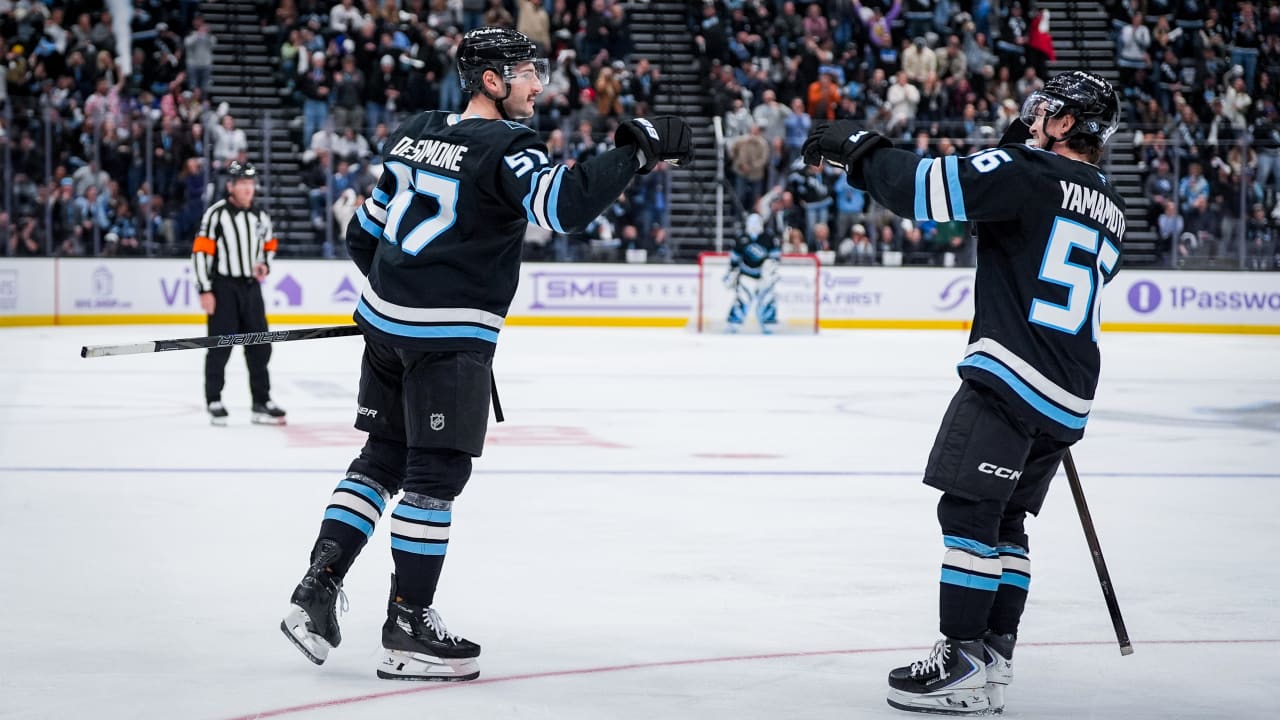
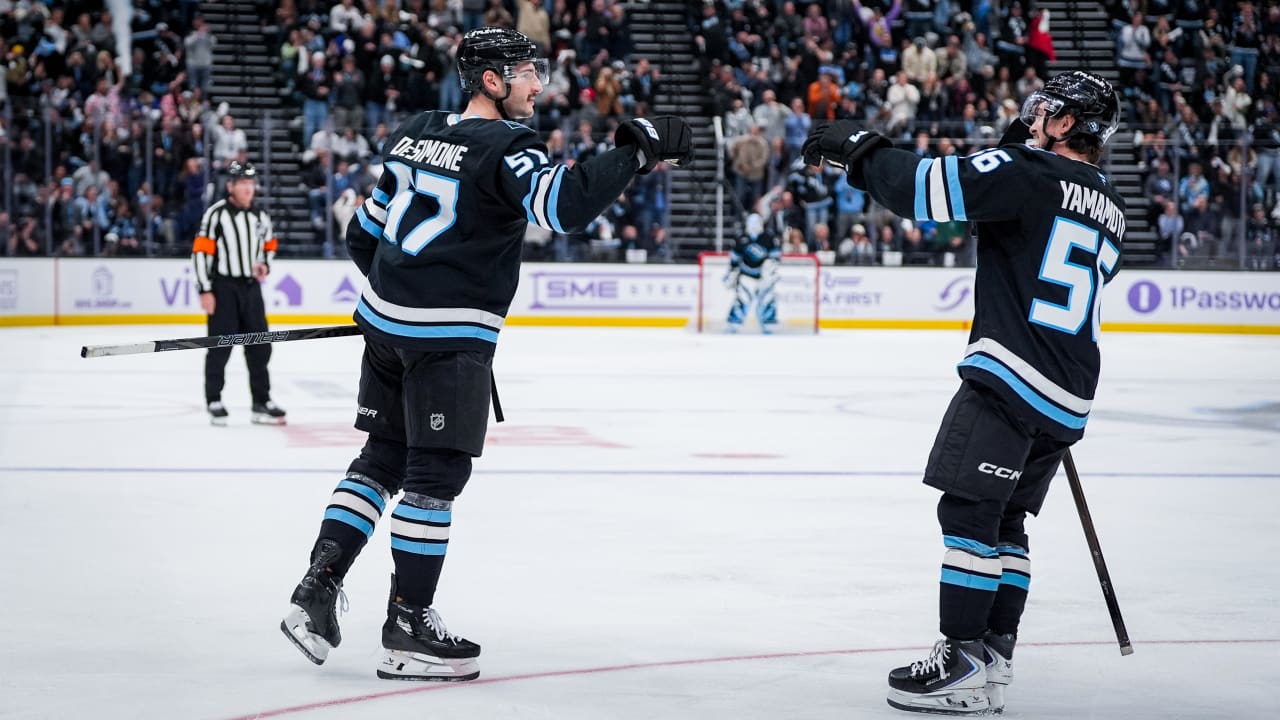
Seven and a half minutes into the third period Nick DeSimone’s shot from the top of the right circle sailed past Quick and gave Utah a 3-2 lead. The tally would be the eventual game-winner and is the defenseman’s second career game-winning goal. DeSimone played on the top d-pair with Mikhail Sergachev and set a new season-high in ice time as the defenseman played 20:13 against the Rangers.
Karel Vejmelka made timely saves and stood strong throughout tonight’s game and was key when the Mammoth defended a one-goal lead for 12 and a half minutes. Utah’s netminder remained strong in net in the final minutes as the team defended a one-goal lead. Vejmelka finished the night with 20 saves on 22 shots.
“Super consistent game,” Peterka said of Vejmelka’s performance. “Huge saves. In the third, with four or five rebounds, it kept us in the game the whole game, and we did our job on the other side.”
Tonight’s result shows the team’s dedication to the game plan, controlling what they could, and staying calm through the momentum swings. Both Peterka and DeSimone reflected on the team’s strong effort following the win.
“Competing harder, that was the message over the last couple of days,” Peterka reflected. “We got a little away from that over the last couple of games, and I think today we did a much better job of getting to the shooting line and getting second chances. That gave us a win.”
“I think we built momentum with each shift,” DeSimone explained of the team handling momentum swings. “We (were) setting everybody up the next shift whether it’s setting them up for a forecheck or a good puck and we kind of set each other up all night, which gave us momentum.”
Yes, they can, but Kenny Dillingham’s team needs help in the final week of the regular season.
Here’s a look at the Big 12 standings, odds, projections, scenarios and tiebreakers for the conference entering college football Week 14, which is a big one for the Big 12, with four teams still in the conference title race.
Those four teams? Texas Tech, BYU, Utah and Arizona State.
What to know about the Big 12 conference championship race now:
Big 12 football standings
Texas Tech and BYU both lead the conference at 7-1 in Big 12 play.
Utah and Arizona State are now each 6-2, tied for third in the conference.
Every other team in the conference has at least three conference losses and is out of the running for the conference title game.
BYU is given a 28.9% shot and Utah is at 1.6%. Arizona State is at 0.5% to win the conference.
Big 12 football championship scenarios
Clinching scenarios for Big 12 teams:
Texas Tech and BYU control their own destiny in the conference. Win and they are in the conference championship game. They would also both be in with an Arizona State loss to Arizona on Friday, Nov. 28.
Texas Tech plays at West Virginia on Saturday, Nov. 29.
BYU hosts UCF that same day.
But what happens if Texas Tech or BYU lose their final game? Here are some other scenarios:
The Red Raiders could also get in the Big 12 title game with a BYU loss and a Utah win over Kansas on Nov. 28. The Cougars could also get in with a Kansas win over Utah and a Texas Tech loss.
Provided it defeats Arizona in the Territorial Cup, Arizona State would get in with a UCF upset of BYU or a West Virginia upset of Texas Tech and a Kansas upset of Utah.
Utah’s Big 12 title scenario? The Utes would be in the Big 12 title game with a win over Kansas, a BYU win over UCF, an Arizona State win over Arizona and a Texas Tech loss against West Virginia.
Elimination scenarios for Big 12 teams:
Texas Tech would be eliminated with a loss, an Arizona State win and a BYU win. A loss with an ASU win and a Kansas win would also eliminate the Red Raiders.
BYU would be out with a loss, an Arizona State win and a Utah win.
Utah would be eliminated with a loss or an Arizona win over Arizona State or a UCF win over BYU or a Texas Tech win over West Virginia.
Arizona State would be out with a loss to Arizona or a BYU win and a Utah win or a BYU win and a Texas Tech win.
Win percentage against all common conference opponents among the tied teams
Win percentage against the next highest placed common opponent in the standings (based on the record in all games played within the conference), proceeding through the standings
Combined win percentage in conference games of conference opponents (strength of conference schedule)
Total number of wins in a 12-game season
Highest ranking by SportSource Analytics (team Rating Score metric), following regular season
Coin toss
For ties between more than two teams:
The records of the three (or more) tied teams based on winning percentage among the tied teams
The records of the three (or more) tied teams compared based on winning percentage against common conference opponents played by all other teams involved in the tie
Record of the three (or more) tied teams against the next highest-placed common opponent in the standings, proceeding through the standings
Record of the three (or more) tied teams based on combined win percentage in conference games of conference opponents (strength of conference schedule)
Total number of wins in a 12-game season
Highest ranking by SportSource Analytics (team Rating Score metric), following regular season
Gambling involves risk. Please only gamble with funds that you can comfortably afford to lose. While we do our utmost to offer good advice and information we cannot be held responsible for any loss that may be incurred as a result of gambling. We do our best to make sure all the information that we provide on this site is correct. However, from time to time mistakes will be made and we will not be held liable. Please check any stats or information if you are unsure how accurate they are. No guarantees are made with regards to results or financial gain. All forms of betting carry financial risk and it is up to the individual to make bets with or without the assistance of information provided on this site and we cannot be held responsible for any loss that may be incurred as a result of following the betting tips provided on this site. Past performances do not guarantee success in the future and betting odds fluctuate from one minute to the next. The material contained on this site is intended to inform, entertain and educate the reader and in no way represents an inducement to gamble legally or illegally or any sort of professional advice.
Gannett may earn revenue from sports betting operators for audience referrals to betting services. Sports betting operators have no influence over nor are any such revenues in any way dependent on or linked to the newsrooms or news coverage. Terms apply, see operator site for Terms and Conditions. If you or someone you know has a gambling problem, help is available. Call the National Council on Problem Gambling 24/7 at 1-800-GAMBLER (NJ, OH), 1-800-522-4700 (CO), 1-800-BETS-OFF (IA), 1-800-9-WITH-IT (IN). Must be 21 or older to gamble. Sports betting and gambling are not legal in all locations. Be sure to comply with laws applicable where you reside. It is your sole responsibility to act in accordance with your local laws.
If you purchase through our links, the USA Today Network may earn a commission. Prices were accurate at the time of publication but may change.
State’s effort vs. Utah the greatest he’s ever been a part of, and referenced calls for his job amid a disappointing season.
Kansas State football coach Chris Klieman choked up multiple times and had to be comforted by athletic director Gene Taylor during his postgame news conference following the Wildcats’ heartbreaking 51-47 loss to No. 12 Utah on Saturday in Salt Lake City.
“I’ve heard it enough that the kids have cashed in and that we need to get new leadership over here and new players, new coaches; I’m tired of it,” Klieman told reporters. “I gotta be honest with you, I’m tired of it. I’ve given my friggin-ass life to this place for seven years; I’ve given everything for seven years, and I think I deserve something, a little respect.”
After three minutes, Klieman sat back in his chair and tried to gather himself. Taylor walked up to Klieman and put his arm around him.
“You ain’t going anywhere, bud,” Taylor said, overheard on the microphone. “Understand that. We’ve got your back. We’ve got your back.”
Kansas State dropped to 5-6 overall and 4-4 in Big 12 play with the defeat, when many expected the Wildcats to compete for a conference title in 2025. The Wildcats have been ravaged by injuries, but they showed in Saturday’s defeat they’re still fighting plenty. They can earn bowl eligibility when they host Colorado on Nov. 29 at Bill Snyder Family Stadium.
The Wildcats gained 574 yards of offense against the Utes, with a program-record 472 coming on the ground. Joe Jackson set the program single-game record with 293 yards and three touchdowns.
Utah erased a 12-point deficit in the final seven minutes, with Devon Dampier running in a 1-yard touchdown with 56 seconds left for the game-winner.
“I’d go to friggin’ battle with these kids any day,” Klieman said. “That was a top-10 team in the country, one of the best offenses and defenses in the country that we just rushed for 472 yards on because we told the guys we were going to commit to running the football, we told the guys to buy into and believe in it.
“Our kids bought into it, and we stuffed it down their throat the entire game, and we lost. I’m crushed because of that, but I’m gonna stand up here with my friggin’ pride and say that we’ve battled our ass off against a really good team and I’m crushed.”
What is Chris Klieman’s buyout?
Klieman has one regular-season game remaining in his seventh season as the Wildcats’ coach. A bowl appearance would be the program’s fifth-straight. Klieman is signed through the 2032 season, and if he were to be bought out after the season, he’d be owed nearly $30 million.
Wyatt D. Wheeler covers Kansas State athletics for the USA TODAY Network and Topeka Capital-Journal. You can follow him on X at @WyattWheeler_, contact him at 417-371-6987 or email him at wwheeler@usatodayco.com
The longer Kansas State football coach Chris Klieman tried to process a gut-wrenching 51-47 loss against Utah on Saturday at Rice-Eccles Stadium, the more emotional he got.
The longer Kansas State football coach Chris Klieman tried to process a gut-wrenching 51-47 loss against Utah on Saturday at Rice-Eccles Stadium, the more emotional he got.
A victory would have clinched bowl eligibility for the Wildcats and given Klieman a signature win to crow about all weekend. Instead, his team suffered its latest painful loss in a season that has been defined by disappointing results.
Advertisement
Advertisement
Advertisement
When he sat down at a table outside the visiting locker room and prepared to make his opening statement, he decided to share his unfiltered feelings on many different topics that have hung over this group all year. He spoke for three minutes, pausing at times to collect himself and even shed a few tears.
“I am heartbroken for the kids and for the loss,” Klieman said. “It’s one of the greatest efforts I’ve been a part of as a coach. It’s hard to say this, because we lost the game, but we’re down so many players. I know a lot of people thought we’d come over here and lay down, and that maybe the kids have cashed it in.”
Then anger took over.
“I’ve heard it enough,” Klieman said. “I’ve heard that I’ve cashed it in. I’ve heard the players have cashed it in and we need to get new leadership here. We need to get new players, new coaches. I’m tired of it. I have got to be honest with you, I’m tired of it. I have given my frigging ass life for this place for seven years. I have given everything for seven years. I think I deserve a little bit of respect.”
Advertisement
Advertisement
Advertisement
It was surprising to hear Klieman acknowledge the fan complaints that have been made about him on message boards and social media this season.
But his popularity is beginning to dip in Manhattan. So much so that unfounded rumors have spread that he may consider retirement at the end of this season.
Klieman led the Wildcats to a Big 12 championship and an appearance in the Sugar Bowl during a dream 2022 season. But since then, K-State hasn’t been able to keep pace with the top of the conference. The Wildcats followed that campaign with consecutive nine-win seasons.
K-State was expected to contend for a Big 12 title again with a No. 17 preseason ranking this year. Now the Wildcats are 5-6 overall and 4-4 in the Big 12. They need to beat Colorado next week to achieve bowl eligibility for the sixth time in Klieman’s seven seasons.
Advertisement
Advertisement
Advertisement
“I’m frustrated like everybody else is,” Klieman said. “But I love those kids. I will go to frigging battle with those kids any day.”
He was particularly proud of the way K-State rushed the ball against No. 13 Utah (9-2, 6-2 Big 12).
The Wildcats rushed for a school record 472 yards. Joe Jackson led the way with his own school record of 293 yards and three touchdowns behind a physical offensive line that opened holes for him all afternoon.
No one else has come close to putting up those numbers against a stingy Utah defense.
K-State played well enough to lead 31-21 at halftime and then 47-35 with 7 minutes remaining in the fourth quarter. But Utah mounted a comeback in the final minutes.
Advertisement
Advertisement
Advertisement
“That’s a top (15) team in the country with one of the best offenses in the country and one of the best defenses in the country,” Klieman said. “We rushed for 472 yards on them, because we told the guys we were going to commit to running the football. We told the guys to buy into it, believe in it. We are running the football against these guys, because nobody’s trying like we’re going to try it.
“And the kids bought into it. Kids don’t buy into it if they’ve given in. Kids don’t buy into it if they’re halfway out the door. Our kids bought into it, and we stuffed it down their throat the entire game running the football, and we lost.
“I’m crushed because of that, but I’m going to stand up here with frigging pride and say we’ve battled our ass off against a really good team. I’m crushed we lost the football game, but I’m more upset with …”
Klieman was unable to finish his train of thought.
Advertisement
Advertisement
Advertisement
After a long stretch of silence in which he fought back tears, K-State athletic director Gene Taylor walked to the table and gave Klieman a hug.
“You ain’t going anywhere, brother,” Taylor told Klieman. “Understand that. I believe in you. We’ve got your back.”
Klieman was later asked if there was a specific reason why he reacted so emotionally after this loss.
“You guys know,” he said. “You guys all know.”
It will be interesting to see how K-State fans react to Klieman’s statement. They did not respond favorably last week when the Wildcats struggled during a 14-6 win over Oklahoma State and Klieman said he wasn’t going to apologize for the victory because “it’s dang hard to win” at Boone Pickens Stadium.
Advertisement
Advertisement
Advertisement
Some were quick to point out that Oklahoma State hasn’t won a conference game in more than two calendar years.
But K-State quarterback Avery Johnson said he likes playing for Klieman.
“You want to be able to win a bunch of games, just because of how good of a person Coach Klieman is,” Johnson said, “and how creative a leader and a coach he is. … We love Coach Klieman to death and we laid out on the line for him tonight. It’s just tough coming up short.”
On Friday, André Tourigny prescribed a particular game plan to cure the Mammoth’s woes. On Saturday, they were cured.
Where one four-game losing streak ends, another is born.
The Utah Mammoth busted their slump with a 3-2 win over the New York Rangers, who are now on a four-game losing skid of their own.
Mammoth head coach André Tourigny laid out a simple game plan at practice on Friday, and it resulted in the win on Saturday.
Advertisement
Advertisement
Advertisement
Here’s the story.
Utah Mammoth center Logan Cooley (92) gains possession of the puck during an NHL game against the New York Rangers at the Delta Center in Salt Lake City on Saturday, Nov. 22, 2025. | Tess Crowley, Deseret News
Utah Mammoth players celebrate after scoring a goal against the New York Rangers during an NHL game at the Delta Center in Salt Lake City on Saturday, Nov. 22, 2025. | Tess Crowley, Deseret News
New York Rangers left wing Conor Sheary (43) skates with the puck during an NHL game against the Utah Mammoth at the Delta Center in Salt Lake City on Saturday, Nov. 22, 2025. | Tess Crowley, Deseret News
Utah Mammoth defenseman Mikhail Sergachev (98) pushes New York Rangers left wing Will Cuylle (50) during an NHL game at the Delta Center in Salt Lake City on Saturday, Nov. 22, 2025. | Tess Crowley, Deseret News
New York Rangers left wing Artemi Panarin (10) celebrates after scoring during an NHL game against the Utah Mammoth at the Delta Center in Salt Lake City on Saturday, Nov. 22, 2025. | Tess Crowley, Deseret News
Utah Mammoth left wing Michael Carcone (53) keeps his eye on the puck during an NHL game against the New York Rangers at the Delta Center in Salt Lake City on Saturday, Nov. 22, 2025. | Tess Crowley, Deseret News
Utah Mammoth right wing Kailer Yamamoto (56), right, celebrates with Utah Mammoth defenseman Nick Desimone (57) after Desimone scored a goal during an NHL game against the New York Rangers at the Delta Center in Salt Lake City on Saturday, Nov. 22, 2025. | Tess Crowley, Deseret News
New York Rangers center Noah Laba (42) attempts a shot at the goal during an NHL game against the Utah Mammoth at the Delta Center in Salt Lake City on Saturday, Nov. 22, 2025. | Tess Crowley, Deseret News
New York Rangers right wing Taylor Raddysh (14) skates toward the puck during an NHL game against the Utah Mammoth at the Delta Center in Salt Lake City on Saturday, Nov. 22, 2025. | Tess Crowley, Deseret News
Teammates celebrate with Utah Mammoth defenseman Nick Desimone (57) after he scored a goal during an NHL game against the New York Rangers at the Delta Center in Salt Lake City on Saturday, Nov. 22, 2025. | Tess Crowley, Deseret News
New York Rangers goaltender Jonathan Quick (32) dives to block a shot at the goal during an NHL game against the Utah Mammoth at the Delta Center in Salt Lake City on Saturday, Nov. 22, 2025. | Tess Crowley, Deseret News
New York Rangers defenseman Adam Fox (23) dives toward the puck during an NHL game against the Utah Mammoth at the Delta Center in Salt Lake City on Saturday, Nov. 22, 2025. | Tess Crowley, Deseret News
Utah Mammoth center Nick Schmaltz (8) maintains control of the puck against the New York Rangers during an NHL game at the Delta Center in Salt Lake City on Saturday, Nov. 22, 2025. | Tess Crowley, Deseret News
New York Rangers goaltender Jonathan Quick (32) receives care on the ice after he was hurt during an NHL game against the Utah Mammoth at the Delta Center in Salt Lake City on Saturday, Nov. 22, 2025. | Tess Crowley, Deseret News
Utah Mammoth fan Nick Allred reacts during an NHL game against the New York Rangers at the Delta Center in Salt Lake City on Saturday, Nov. 22, 2025. | Tess Crowley, Deseret News
Utah Mammoth defenseman Nate Schmidt (88) passes the puck during an NHL game against the New York Rangers at the Delta Center in Salt Lake City on Saturday, Nov. 22, 2025. | Tess Crowley, Deseret News
Utah Mammoth center Barrett Hayton (27) attempts a shot at the goal against New York Rangers goaltender Jonathan Quick (32) during an NHL game at the Delta Center in Salt Lake City on Saturday, Nov. 22, 2025. | Tess Crowley, Deseret News
New York Rangers goaltender Jonathan Quick (32) reacts after the Utah Mammoth score during an NHL game at the Delta Center in Salt Lake City on Saturday, Nov. 22, 2025. | Tess Crowley, Deseret News
Utah Mammoth center Jack McBain (22) gains control of the puck against the New York Rangers during an NHL game at the Delta Center in Salt Lake City on Saturday, Nov. 22, 2025. | Tess Crowley, Deseret News
Utah Mammoth goaltender Karel Vejmelka (70) fails to block New York Rangers left wing Artemi Panarin’s (10) shot at the goal during an NHL game at the Delta Center in Salt Lake City on Saturday, Nov. 22, 2025. | Tess Crowley, Deseret News
Utah Mammoth fans cheer during an NHL game against the New York Rangers at the Delta Center in Salt Lake City on Saturday, Nov. 22, 2025. | Tess Crowley, Deseret News
Quick catchup
Utah Mammoth: 3
New York Rangers: 2
JJ Peterka kicked this one off with a rebound goal halfway through the first period. It was nothing fancy, but that’s exactly the type of goal Utah needs to score right now.
Vladislav Gavrikov tied it up with a perfect deflection from the high slot. It floated past Karel Vejmelka in a way that can only be described as a puck with eyes.
An Artemi Panarin breakaway gave the Rangers the lead in the second period, but Clayton Keller tied it back up with a rather unusual goal (we’ll go over it in a minute).
Nick DeSimone played hero in this one, putting a shot through traffic and past future Hall of Fame goaltender Jonathan Quick. That goal stood as the winner.
Advertisement
Advertisement
Advertisement
“Saturday night, against the Rangers, two points. What a beautiful night in Utah, huh?” Tourigny beamed at the beginning of his postgame interview.
The Mammoth’s win elevated them to the second wild card spot in the Western Conference. They’re also one point short of the third spot in the Central Division standings, having played the same number of games as the Minnesota Wild, who currently own that spot.
Takeaways
The game plan
At practice on Friday, Tourigny told the media that his team’s troubles stemmed from battles in the corners. A large portion of goals in the NHL come from unanticipated bounces.
Advertisement
Advertisement
Advertisement
Hard work in the corners is what makes most of those bounces go your way.
Tourigny agreed, but said it’s not meant to be a broad statement. He mentioned puck battles and how those often result in goals that nobody saw coming.
That’s why they did so many battle drills in practice today.
That was the difference in this game. Hard work in the corner resulted in a failed Rangers clearing attempt, which teed DeSimone up for the game-winning goal.
“Look at all the goals in the NHL tonight,” Tourigny said after the game. “The way we scored, that’s the way the NHL scores. The seam, back-door, this and that, that will be probably 30% of the goals.
“Goals (that) are greasy — driving the net, getting a stick on the rebounds, getting point shots with traffic — those kinds of goals, that’s the way the NHL works.”
That’s an ode to simplicity, too.
Advertisement
Advertisement
Advertisement
‘Put it on net and good things happen’
If you’ve played hockey at any level, you’ve probably heard the phrase a million times. “Put it on net and good things happen,” coaches always say.
That was the case during a series of plays in the third period.
During a scramble in front of the Rangers’ net, the puck popped out to Nate Schmidt at the point. He put everything he had into a slap shot, but he squandered the chance by sending it high and wide. A few moments later, Dmitri Simashev did the same thing in a similar situation.
When DeSimone found himself in the same scenario just after that, he made no mistake, just making sure it went on net. And what do you know? It went in.
Advertisement
Advertisement
Advertisement
That reflects the team as a whole over this recent stretch. In too many instances to count, they’ve tried to do too much, which has often resulted in scoring chances not even yielding shots on net.
Keeping it simple is often the best way to go.
Peterka, whose goal on Saturday was his fifth in the last six games, pointed to that exact thing when asked what’s been contributing to his success.
“I think just keeping it simple. I think that’s been the key,” he said.
By the way, DeSimone has been the perfect depth defenseman for this team. He doesn’t complain when he’s a scratch 15 games in a row, and as soon as his services are needed, he plays like he hasn’t missed a game all season.
Advertisement
Advertisement
Advertisement
That’s his second goal and third point in seven games this season as a defenseman who averages fewer than 16 minutes of playing time per game.
I asked Nick if a game-winning goal is the best birthday present he’s ever had (his birthday was yesterday).
He said he’d have to say the best is something his wife got him, but this is up there too https://t.co/PbXwiPaOow
An air of confusion ran through the Delta Center when the horn sounded mid-play halfway through the second period. If you’re still wondering what happened, here’s an explanation.
The horn sounded because a Keller shot had gone in the net, though the on-ice officials didn’t see it.
The league is equipped to handle situations like these. The situation room, which is located in Toronto, monitors every game. Their replay angles clearly showed the puck enter the net, so they used their powers to call the goal remotely.
Advertisement
Advertisement
Advertisement
It’s an uncommon but not unheard-of scenario. Hockey is a fast game and it’s easy for the officials to miss things in real time.
Goal of the game
Nick DeSimone’s game-winner
None of Utah’s goals were particularly flashy, so don’t expect a highlight-reel goal here. But for reasons already described, this was an important goal for the Mammoth.
The Utah Mammoth got back in the win column with a 3-2 victory over the New York Rangers, Saturday night. Captain Clayton Keller, JJ Peterka, and Nick DeSimone scored for the Mammoth in the win. A pac …
SALT LAKE CITY – The Utah Mammoth got back in the win column with a 3-2 victory over the New York Rangers, Saturday night. Captain Clayton Keller, JJ Peterka, and Nick DeSimone scored for the Mammoth in the win. A packed Delta Center brought energy and cheered on the home team as Utah improved to 6-2-1 at home.
The Mammoth and Rangers traded goals in the first and second period, but it was Peterka’s ninth of the season that opened the scoring. A key to the goal was a strong net front presence by Associate Captain Lawson Crouse and Peterka. After Nate Schmidt’s shot hit New York’s netminder Jonathan Quick and went behind him, both forwards pounced towards the loose puck. Peterka pushed the puck past the goal line and scored.
The Rangers scored the next two goals. Vladislav Gavirkov tipped-in Adam Fox’s shot in the final five minutes of the first period to tie the game 1-1. Artemi Panarin gave the visitors a 2-1 lead eight minutes into the second period when his shot snuck past Utah’s Karel Vejmelka.
However, three minutes later the Mammoth responded. After Kailer Yamamoto’s shot off a broken play was stopped, Keller scored on the rebound by lifting the puck over Quick on the doorstep. Keller’s eighth of the season tied the game 2-2.
Seven and a half minutes into the third period Nick DeSimone’s shot from the top of the right circle sailed past Quick and gave Utah a 3-2 lead. DeSimone played on the top d-pair with Mikhail Sergachev and set a new season-high in ice time as the defenseman played 20:13 against the Rangers.
With the win, the Mammoth are 11-8-3 this season and have snapped a four-game losing skid.
No. 12 Utah charged back from 12 points down with seven minutes remaining to pull off an improbable 51-47 comeback win over Kansas State on Saturday in a game that will go down as one of the most …
An emotional Kyle Whittingham said one word over and over as he embraced a large group of family members on the Rice-Eccles Stadium field.
“Wow, wow, wow.”
Time will tell if that was the final time Whittingham walked off the field that he’s spent 21 years on as a head coach, but if it is, what a game to go out on.
No. 12 Utah charged back from 12 points down with seven minutes remaining to pull off an improbable 51-47 comeback win over Kansas State on Saturday in a game that will go down as one of the most unbelievable wins of the Whittingham era.
Advertisement
Advertisement
Advertisement
The Utes looked dead in the water after quarterback Devon Dampier fumbled the ball with 7:49 remaining in the fourth quarter, giving Kansas State great field position at the Utah 26-yard line.
Two plays later, Wildcat running back Joe Jackson was in the end zone — a scene all too familiar for the Utes this day.
Jackson simply ran up the middle, then broke a tackle to put Kansas State up 47-35 as Whittingham took his headset off in frustration.
With seven minutes remaining, that looked like the end for Utah — especially with the way its defense had been playing. In one of — if not the worst — defensive performances of the Whittingham era, the Utes allowed a school-record 472 rushing yards.
Advertisement
Advertisement
Advertisement
Kansas State ran over the Utes time after time, and Morgan Scalley’s defense couldn’t stop it to save their lives. It wasn’t anything fancy — half the time the Wildcats ran the ball up the gut, only for the Utes to either be completely out of position or miss tackles — oftentimes both.
It was a near-mirror image of Utah’s domination on the ground last week against Baylor, except with the Utes’ defense giving up untouched runs.
“It was a power run game, just a basic power play and it was an ‘A gap’ power play where they started strong side and cut it back and we continually didn’t defend it the right way,” Whittingham said.
“We were out of square, we were losing gaps, and so obviously we didn’t do a good enough job as coaches of getting them ready to play, especially that particular play. But it was that one play that did the majority of the damage. They just ran it over and over and we just didn’t, didn’t do a good enough job as coaches, so that’s on me.”
Utah quarterback Devon Dampier (4) runs the ball as he tries to evade Kansas State Wildcats defensive end Chiddi Obiazor (8) during an NCAA football game held at Rice-Eccles Stadium in Salt Lake City on Saturday, Nov. 22, 2025. | Isaac Hale, Deseret News
Utah quarterback Byrd Ficklin (15) runs the ball against the Kansas State Wildcats during an NCAA football game held at Rice-Eccles Stadium in Salt Lake City on Saturday, Nov. 22, 2025. | Isaac Hale, Deseret News
Utah wide receiver Creed Whitmore (80) celebrates after making a catch against the Kansas State Wildcats during an NCAA football game held at Rice-Eccles Stadium in Salt Lake City on Saturday, Nov. 22, 2025. | Isaac Hale, Deseret News
Utah safety Tao Johnson (5) runs the ball back for a two-point conversion after intercepting it during the Kansas State Wildcats’ two-point conversion attempt at the other end zone in an NCAA football game held at Rice-Eccles Stadium in Salt Lake City on Saturday, Nov. 22, 2025. | Isaac Hale, Deseret News
Utah linebacker Lander Barton (8) calls out to his teammates before a play against the Kansas State Wildcats during an NCAA football game held at Rice-Eccles Stadium in Salt Lake City on Saturday, Nov. 22, 2025. | Isaac Hale, Deseret News
Utah kicker Dillon Curtis (17) slaps hands with Utah punter Orion Phillips (92) after making an extra point against the Kansas State Wildcats during an NCAA football game held at Rice-Eccles Stadium in Salt Lake City on Saturday, Nov. 22, 2025. | Isaac Hale, Deseret News
Utah offensive lineman Jaren Kump (68) and the rest of the offensive line prepare for the snap against the Kansas State Wildcats during an NCAA football game held at Rice-Eccles Stadium in Salt Lake City on Saturday, Nov. 22, 2025. | Isaac Hale, Deseret News
Utah head coach Kyle Whittingham looks to the field during an NCAA football game against the Kansas State Wildcats held at Rice-Eccles Stadium in Salt Lake City on Saturday, Nov. 22, 2025. | Isaac Hale, Deseret News
Utah wide receiver Larry Simmons (12) makes a catch for a touchdown as he’s defended by Kansas State Wildcats cornerback Donovan McIntosh (9) during an NCAA football game held at Rice-Eccles Stadium in Salt Lake City on Saturday, Nov. 22, 2025. | Isaac Hale, Deseret News
Utah fans cheer after a play against the Kansas State Wildcats during an NCAA football game held at Rice-Eccles Stadium in Salt Lake City on Saturday, Nov. 22, 2025. | Isaac Hale, Deseret News
Kansas State Wildcats head coach Chris Klieman talks on his headset during an NCAA football game against Utah held at Rice-Eccles Stadium in Salt Lake City on Saturday, Nov. 22, 2025. | Isaac Hale, Deseret News
Utah wide receiver Larry Simmons (12) celebrates his touchdown against the Kansas State Wildcats with tight end JJ Buchanan (81) during an NCAA football game held at Rice-Eccles Stadium in Salt Lake City on Saturday, Nov. 22, 2025. | Isaac Hale, Deseret News
Utah quarterback Byrd Ficklin (15) celebrates his touchdown against the Kansas State Wildcats during an NCAA football game held at Rice-Eccles Stadium in Salt Lake City on Saturday, Nov. 22, 2025. | Isaac Hale, Deseret News
Utah head coach Kyle Whittingham talks with Kansas State Wildcats head coach Chris Klieman after Utah defeated Kansas State 51-47 in an NCAA football game held at Rice-Eccles Stadium in Salt Lake City on Saturday, Nov. 22, 2025. | Isaac Hale, Deseret News
Utah linebacker Lander Barton (8) celebrates after “lighting the U” after Utah defeated Kansas State 51-47 in an NCAA football game held at Rice-Eccles Stadium in Salt Lake City on Saturday, Nov. 22, 2025. | Isaac Hale, Deseret News
Utah linebacker Lander Barton (8) celebrates after a play against the Kansas State Wildcats during an NCAA football game held at Rice-Eccles Stadium in Salt Lake City on Saturday, Nov. 22, 2025. | Isaac Hale, Deseret News
Utah defensive end John Henry Daley (90) downs Kansas State Wildcats quarterback Avery Johnson (2) during an NCAA football game held at Rice-Eccles Stadium in Salt Lake City on Saturday, Nov. 22, 2025. | Isaac Hale, Deseret News
Utah cheerleaders spell out Utah just before an NCAA football game between Utah and the Kansas State Wildcats held at Rice-Eccles Stadium in Salt Lake City on Saturday, Nov. 22, 2025. | Isaac Hale, Deseret News
Utah players try and block and extra point attempt from the Kansas State Wildcats during an NCAA football game held at Rice-Eccles Stadium in Salt Lake City on Saturday, Nov. 22, 2025. | Isaac Hale, Deseret News
Utah defensive coordinator Morgan Scalley talks with linebacker Lander Barton (8) before a play against the Kansas State Wildcats during an NCAA football game held at Rice-Eccles Stadium in Salt Lake City on Saturday, Nov. 22, 2025. | Isaac Hale, Deseret News
Utah wide receiver Nate Johnson (3) is tackled by Kansas State Wildcats safety Vj Payne (7) during the second half of an NCAA football game held at Rice-Eccles Stadium in Salt Lake City on Saturday, Nov. 22, 2025. | Rio Giancarlo, Deseret News
Utah head coach Kyle Whittingham looks on during the second half of an NCAA football game against the Kansas State Wildcats held at Rice-Eccles Stadium in Salt Lake City on Saturday, Nov. 22, 2025. | Rio Giancarlo, Deseret News
Utah defensive coordinator Morgan Scalley holds up two fingers on each hand for the “Utah 22 Forever” tribute during the third quarter break to honor late Utah players Ty Jordan and Aaron Lowe during an NCAA football game against the Kansas State Wildcats held at Rice-Eccles Stadium in Salt Lake City on Saturday, Nov. 22, 2025. | Rio Giancarlo, Deseret News
Fans hold up two fingers on each hand for the “Utah 22 Forever” tribute during the third quarter break to honor late Utah players Ty Jordan and Aaron Lowe during an NCAA football game against the Kansas State Wildcats held at Rice-Eccles Stadium in Salt Lake City on Saturday, Nov. 22, 2025. | Rio Giancarlo, Deseret News
Utah quarterback Devon Dampier (4) is tackled short of the goal line during the second half of an NCAA football game against the Kansas State Wildcats held at Rice-Eccles Stadium in Salt Lake City on Saturday, Nov. 22, 2025. | Rio Giancarlo, Deseret News
Kansas State Wildcats running back Joe Jackson (4) runs into the end zone for a touchdown after breaking a tackle by Utah safety Tao Johnson (5) during the second half of an NCAA football game held at Rice-Eccles Stadium in Salt Lake City on Saturday, Nov. 22, 2025. | Rio Giancarlo, Deseret News
Utah wide receiver Nate Johnson (3) celebrates after a first down during the second half of an NCAA football game against the Kansas State Wildcats held at Rice-Eccles Stadium in Salt Lake City on Saturday, Nov. 22, 2025. | Rio Giancarlo, Deseret News
Utah linebacker Mateaki Helu (20) reacts during the second half of an NCAA football game against the Kansas State Wildcats held at Rice-Eccles Stadium in Salt Lake City on Saturday, Nov. 22, 2025. | Rio Giancarlo, Deseret News
Utah linebacker Lander Barton (8) celebrates after tackling Kansas State Wildcats quarterback Avery Johnson (2) short of the goal line during the second half of an NCAA football game held at Rice-Eccles Stadium in Salt Lake City on Saturday, Nov. 22, 2025. | Rio Giancarlo, Deseret News
Kansas State Wildcats running back Joe Jackson (4) runs downfield after breaking a tackle by Utah defensive end Logan Fano (0) during the second half an NCAA football game held at Rice-Eccles Stadium in Salt Lake City on Saturday, Nov. 22, 2025. | Rio Giancarlo, Deseret News
Kansas State Wildcats quarterback Avery Johnson (2) is hit by Utah cornerback Smith Snowden (2) as he throws during the second half of an NCAA football game held at Rice-Eccles Stadium in Salt Lake City on Saturday, Nov. 22, 2025. | Rio Giancarlo, Deseret News
Utah defensive coordinator Morgan Scalley gestures to his players during the second half of an NCAA football game against the Kansas State Wildcats held at Rice-Eccles Stadium in Salt Lake City on Saturday, Nov. 22, 2025. | Rio Giancarlo, Deseret News
Utah cornerback Blake Cotton (16) breaks up a pass intended for Kansas State Wildcats wide receiver Jaron Tibbs (12) during the second half of an NCAA football game held at Rice-Eccles Stadium in Salt Lake City on Saturday, Nov. 22, 2025. | Rio Giancarlo, Deseret News
Utah safety Tao Johnson (5) scores a two point conversion after intercepting Kansas State Wildcats quarterback Avery Johnson’s (2) two point conversion attempt during the second half of an NCAA football game held at Rice-Eccles Stadium in Salt Lake City on Saturday, Nov. 22, 2025. | Rio Giancarlo, Deseret News
Utah wide receiver Larry Simmons (12) catches a pass ahead of Kansas State Wildcats cornerback Donovan McIntosh (9) during the second half of an NCAA football game held at Rice-Eccles Stadium in Salt Lake City on Saturday, Nov. 22, 2025. | Rio Giancarlo, Deseret News
Utah wide receiver Larry Simmons (12) celebrates his touchdown against the Kansas State Wildcats with tight end JJ Buchanan (81) during an NCAA football game held at Rice-Eccles Stadium in Salt Lake City on Saturday, Nov. 22, 2025. | Isaac Hale, Deseret News
Utah running back Wayshawn Parker (1) runs through a gap during the second half of an NCAA football game against the Kansas State Wildcats held at Rice-Eccles Stadium in Salt Lake City on Saturday, Nov. 22, 2025. | Rio Giancarlo, Deseret News
Utah quarterback Devon Dampier (4) celebrates with wide receiver Larry Simmons (12) after scoring the go ahead touchdown with 56 seconds left in the fourth quarter of an NCAA football game against the Kansas State Wildcats held at Rice-Eccles Stadium in Salt Lake City on Saturday, Nov. 22, 2025. | Rio Giancarlo, Deseret News
Utah offensive lineman Spencer Fano (55) grimaces as he is helped off the field after getting injured during the second half of an NCAA football game against the Kansas State Wildcats held at Rice-Eccles Stadium in Salt Lake City on Saturday, Nov. 22, 2025. | Rio Giancarlo, Deseret News
Utah wide receivers coach Micah Simon celebrates after Utah took the lead over the Kansas State Wildcats late in the fourth quarter of an NCAA football game held at Rice-Eccles Stadium in Salt Lake City on Saturday, Nov. 22, 2025. | Rio Giancarlo, Deseret News
Utah quarterback Byrd Ficklin (15) reacts after scoring a touchdown during the second half of an NCAA football game against the Kansas State Wildcats held at Rice-Eccles Stadium in Salt Lake City on Saturday, Nov. 22, 2025. | Rio Giancarlo, Deseret News
Kansas State Wildcats cornerback Zashon Rich (25) breaks up a pass intended for Utah wide receiver Larry Simmons (12) during the second half of an NCAA football game held at Rice-Eccles Stadium in Salt Lake City on Saturday, Nov. 22, 2025. | Rio Giancarlo, Deseret News
Kansas State Wildcats running back Joe Jackson (4) celebrates after scoring a touchdown during the second half of an NCAA football game against Utah held at Rice-Eccles Stadium in Salt Lake City on Saturday, Nov. 22, 2025. | Rio Giancarlo, Deseret News
Utah quarterback Devon Dampier (4) greets Kansas State Wildcats quarterback Avery Johnson (2) at midfield after Utah defeated Kansas State 51-47 in an NCAA football game held at Rice-Eccles Stadium in Salt Lake City on Saturday, Nov. 22, 2025. | Rio Giancarlo, Deseret News
Utah defensive end John Henry Daley (90) is tended to after being roughed up on a play against the Kansas State Wildcats during an NCAA football game held at Rice-Eccles Stadium in Salt Lake City on Saturday, Nov. 22, 2025. | Isaac Hale, Deseret News
Utah quarterback Devon Dampier (4) runs the ball against the Kansas State Wildcats during an NCAA football game held at Rice-Eccles Stadium in Salt Lake City on Saturday, Nov. 22, 2025. | Isaac Hale, Deseret News
Utah quarterback Byrd Ficklin (15) celebrates his touchdown against the Kansas State Wildcats during an NCAA football game held at Rice-Eccles Stadium in Salt Lake City on Saturday, Nov. 22, 2025. | Isaac Hale, Deseret News
Utah tight end JJ Buchanan (81) runs the ball as his ankle is wrapped up by Kansas State Wildcats safety Vj Payne (7) during an NCAA football game held at Rice-Eccles Stadium in Salt Lake City on Saturday, Nov. 22, 2025. | Isaac Hale, Deseret News
Utah quarterback Devon Dampier (4) dives into the end zone for a touchdown while guarded by Kansas State Wildcats safety Vj Payne (7) during an NCAA football game held at Rice-Eccles Stadium in Salt Lake City on Saturday, Nov. 22, 2025. | Isaac Hale, Deseret News
Utah tight end Dallen Bentley (88) can’t quite reel in a catch as he’s guarded by Kansas State Wildcats safety Gunner Maldonado (3) during an NCAA football game held at Rice-Eccles Stadium in Salt Lake City on Saturday, Nov. 22, 2025. Pass interference was called on Kansas State on this play. | Isaac Hale, Deseret News
Utah defensive end John Henry Daley (90) sacks Kansas State Wildcats quarterback Avery Johnson (2) while the ball gets loose from his hands during an NCAA football game held at Rice-Eccles Stadium in Salt Lake City on Saturday, Nov. 22, 2025. | Isaac Hale, Deseret News
Utah tight end JJ Buchanan (81) stiff-arms Kansas State Wildcats safety Vj Payne (7) as he runs the ball after making a deep catch during an NCAA football game held at Rice-Eccles Stadium in Salt Lake City on Saturday, Nov. 22, 2025. | Isaac Hale, Deseret News
Utah quarterback Devon Dampier (4) warms up before an NCAA football game against the Kansas State Wildcats held at Rice-Eccles Stadium in Salt Lake City on Saturday, Nov. 22, 2025. | Isaac Hale, Deseret News
Utah quarterback Brendan Zurbrugg (14) greets fans as he makes his way into Rice-Eccles Stadium with the rest of the team before an NCAA football game against Kansas State Wildcats in Salt Lake City on Saturday, Nov. 22, 2025. | Isaac Hale, Deseret News
Kansas State Wildcats head coach Chris Klieman makes his way into Rice-Eccles Stadium before an NCAA football game against Utah in Salt Lake City on Saturday, Nov. 22, 2025. | Isaac Hale, Deseret News
Utah quarterbacks Isaac Wilson (11) and Brendan Zurbrugg (14) warm up before an NCAA football game against the Kansas State Wildcats held at Rice-Eccles Stadium in Salt Lake City on Saturday, Nov. 22, 2025. | Isaac Hale, Deseret News
Utah head coach Kyle Whittingham greets fans as he makes his way into Rice-Eccles Stadium with the rest of the team before an NCAA football game against the Kansas State Wildcats in Salt Lake City on Saturday, Nov. 22, 2025. | Isaac Hale, Deseret News
Utah players stretch before an NCAA football game against the Kansas State Wildcats held at Rice-Eccles Stadium in Salt Lake City on Saturday, Nov. 22, 2025. | Isaac Hale, Deseret News
Utah head coach Kyle Whittingham, left, and Kansas State Wildcats head coach Chris Klieman, right, talk before an NCAA football game held at Rice-Eccles Stadium in Salt Lake City on Saturday, Nov. 22, 2025. | Rio Giancarlo, Deseret News
Utah quarterback Devon Dampier (4) and Utah quarterback Byrd Ficklin (15) look on during warm ups before an NCAA football game against the Kansas State Wildcats held at Rice-Eccles Stadium in Salt Lake City on Saturday, Nov. 22, 2025. | Rio Giancarlo, Deseret News
Kansas State Wildcats quarterback Avery Johnson (2) passes during warm ups before an NCAA football game against Utah held at Rice-Eccles Stadium in Salt Lake City on Saturday, Nov. 22, 2025. | Rio Giancarlo, Deseret News
Utah players greet fans as they arrive at Rice-Eccles Stadium before an NCAA football game against the Kansas State Wildcats in Salt Lake City on Saturday, Nov. 22, 2025. | Rio Giancarlo, Deseret News
Utah head coach Kyle Whittingham, left, and Kansas State Wildcats head coach Chris Klieman, right, talk before an NCAA football game held at Rice-Eccles Stadium in Salt Lake City on Saturday, Nov. 22, 2025. | Rio Giancarlo, Deseret News
Utah safety Tao Johnson (5) tackles Kansas State Wildcats running back Joe Jackson (4) during the first half of an NCAA football game held at Rice-Eccles Stadium in Salt Lake City on Saturday, Nov. 22, 2025. | Rio Giancarlo, Deseret News
Utah quarterback Devon Dampier (4) looks to pass over Kansas State Wildcats linebacker Ralph Ortiz (20) during the first half of an NCAA football game held at Rice-Eccles Stadium in Salt Lake City on Saturday, Nov. 22, 2025. | Rio Giancarlo, Deseret News
Utah quarterback Byrd Ficklin (15) celebrates after scoring a rushing touchdown during the first half of an NCAA football game against the Kansas State Wildcats held at Rice-Eccles Stadium in Salt Lake City on Saturday, Nov. 22, 2025. | Rio Giancarlo, Deseret News
Utah quarterback Devon Dampier (4) runs past Kansas State Wildcats safety Daniel Cobbs (4) during the first half of an NCAA football game held at Rice-Eccles Stadium in Salt Lake City on Saturday, Nov. 22, 2025. | Rio Giancarlo, Deseret News
Utah takes the field before an NCAA football game against the Kansas State Wildcats held at Rice-Eccles Stadium in Salt Lake City on Saturday, Nov. 22, 2025. | Rio Giancarlo, Deseret News
Utah quarterback Devon Dampier (4) dives past Kansas State Wildcats safety Vj Payne (7) to score a touchdown during the first half of an NCAA football game held at Rice-Eccles Stadium in Salt Lake City on Saturday, Nov. 22, 2025. | Rio Giancarlo, Deseret News
Utah quarterback Byrd Ficklin (15) runs into the end zone fore a touchdown during the first half of an NCAA football game against the Kansas State Wildcats held at Rice-Eccles Stadium in Salt Lake City on Saturday, Nov. 22, 2025. | Rio Giancarlo, Deseret News
Utah head coach Kyle Whittingham looks on during the first half of an NCAA football game against the Kansas State Wildcats held at Rice-Eccles Stadium in Salt Lake City on Saturday, Nov. 22, 2025. | Rio Giancarlo, Deseret News
Utah quarterback Devon Dampier (4) and Utah quarterback Byrd Ficklin (15) look on during warm ups before an NCAA football game against the Kansas State Wildcats held at Rice-Eccles Stadium in Salt Lake City on Saturday, Nov. 22, 2025. | Rio Giancarlo, Deseret News
Kansas State ran wild over the Utes’ poor run fits and tackling with seven runs of 30-plus yards, including touchdowns of 80 and 66 yards. Fans booed the Utes at multiple points during the game after they allowed long rushing touchdowns.
Advertisement
Advertisement
Advertisement
Jackson had a career night with 293 yards, while Antonio Martin Jr. added 89 yards and a score and quarterback Avery Johnson added 72 and a touchdown.
As Jackson celebrated his third touchdown of the night in the south end zone, some fans started to stream out of the stadium with seven minutes still on the clock.
“I did see a few fans leaving when I think we got down by 10 with not much time to go and didn’t like to see that, but I guess you can’t blame them,” Whittingham said.
For the vast majority of the 51,444 who stayed, they were treated to one of the more remarkable wins in the Whittingham era.
Advertisement
Advertisement
Advertisement
Utah’s furious comeback began when the Wildcats went for two, up 12, to make it a 14-point game. Ute safety Tao Johnson — who like the rest of the defense, had his struggles in the run game — picked off Johnson in the end zone after cornerback Smith Snowden deflected the pass, and he took it the other way for two points.
“That play, as I mentioned, was instrumental. If that play doesn’t happen, it’s probably a different outcome. In fact, if we didn’t score on it, that would’ve changed the complexion,” Whittingham said.
“If we would’ve just defended it, it still put us in a pretty good deficit, and so like I said, that was a four-point switch and kept our hopes alive, gave us a better chance.”
Utah’s offense had kept the Utes in it all game as the defense was gashed, but the Utes’ previous two drives resulted in a three-and-out and a fumble.
Advertisement
Advertisement
Advertisement
Dampier, who was already playing through an ankle injury, took several blows to the head in Saturday’s game. He was medically cleared to return to the game, but Saturday’s performance — to that point — was decidedly not his best.
The question hung over Rice-Eccles Stadium — would he be able to drive the Utes down the field in the game’s biggest drive?
In a game full of absolutely inconceivable moments, Utah’s drive delivered two of them. The first was a penalty by Kansas State that extended the drive.
With the ball on the Wildcat 37-yard-line, Utah went for it on fourth-and-2 and running back Wayshawn Parker was stopped short, but illegal substitution was called on Kansas State to extend the Ute drive.
Advertisement
Advertisement
Advertisement
After that, Dampier was called for intentional grounding on second-and-10, setting up third and 22.
Dampier completed a 21-yard pass to Larry Simmons, then Parker got the first down, shaking off a tackle to convert. On the next play, it was the Dampier-to-Simmons connection once again for a 20-yard touchdown in the corner of the end zone.
Down three, Utah had life.
Its much-maligned defense had to come up with a stop, though — something that had been very rare on Saturday night.
The Utes forced a three-and-out and Kansas State had to punt the ball away.
This was the moment Dampier came to Utah from New Mexico for. Somehow, some way, Utah had the ball with 2:25 left and a chance to tie or win the game. The season — and the Utes’ slim College Football Playoff and Big 12 title hopes — was on the line.
Advertisement
Advertisement
Advertisement
Dampier, who had persevered through injuries all night and kept the Utes in the game despite a run defense that was as strong as wet paper, had the ball in his hands.
“Not once did I hear Dev say he was going to give up. He kept his head up the whole time, told them, ‘We’re going to go out here and score. Believe it and we’re going to do it,” said quarterback Byrd Ficklin, who spelled Dampier at times and scored three rushing touchdowns.
Like everything else on Saturday, there was adversity to overcome on Utah’s final offensive drive.
After an incomplete pass to start the drive, Dampier found receiver Creed Whittemore — the Mississippi State transfer who has sparingly played this season — for a gain of 6 yards. Utah handed it to Parker on third-and-4, but after he was stopped a yard short of the marker, the Utes were facing fourth and 1.
Advertisement
Advertisement
Advertisement
As they have many times in that situation this season, offensive coordinator Jason Beck decided to keep the ball in his quarterback’s hands.
With Utah’s season on the line, Dampier just needed to gain about 3 feet.
Dampier took the snap, faked the handoff to Parker and charged forward into a perfectly-sealed hole — tight end Dallen Bentley was part of creating that hole for Dampier.
Once Dampier burst through the hole, he had a lot of green turf in front of him, racing 59 yards until he was caught by Kanijal Thomas at the 3-yard line.
That actually ended up being beneficial for the Utes, who were able to burn off more time — not intentionally — as they were stuffed on first and second down.
Advertisement
Advertisement
Advertisement
On third and 1, the ball was back in Dampier’s hands and he barreled his way into the north end zone, sending the crowd to volume levels not heard in this building since Cam Rising’s two-point conversion in the 2022 win over USC.
Dampier’s score gave the Utes a four-point lead with just 54 seconds remaining.
“That last score, it was surreal,” Whittingham said. “It was just a moment that, like I said, you can’t even dream it up.”
Dampier’s signature moment as a Ute had arrived.
Time and time again in those last two drives, the pressure was on Dampier to make a play, and he delivered.
“I told Dev, pressure makes diamonds but also crumbles people. Prove you’re a diamond. Show it out to people, show who you are,” Ficklin said.
Advertisement
Advertisement
Advertisement
After a very rough game, Utah’s defense sealed the game as senior linebacker Lander Barton picked off Johnson, sending Rice-Eccles Stadium into a frenzy.
Barton grew up a Utah fan, then spent time in Rice-Eccles Stadium watching his brothers Cody and Jackson play for Whittingham and the Utes.
His final play in the stadium was one of the most memorable of his career.
“What a fitting way for Lander Barton to finish his career here at Rice-Eccles,” Whittingham said. “… For him to seal the victory with that pick, he’s done so much for this program through the years.”
As Whittingham talked about the senior class in his postgame press conference, he began to choke up.
Advertisement
Advertisement
Advertisement
“Just a great illustration of what determination and guts and a never-say–die attitude can get you,” Whittingham said.
“Just so happy for our seniors to be able to go out with a win in the last opportunity in Rice-Eccles. Excuse me — when I think about our seniors, I get emotional so I apologize — but it’s just so awesome for them to be able to have that experience.”
Was that also Whittingham’s last game in Rice-Eccles? If so, it was an unforgettable sendoff for the greatest coach in Utah history.
“That was one for the ages,” Whittingham said.
Utah linebacker Lander Barton (8) calls out to his teammates before a play against the Kansas State Wildcats during a game held at Rice-Eccles Stadium in Salt Lake City on Saturday, Nov. 22, 2025. | Isaac Hale, Deseret News
The final Utah high school football games have all wrapped up, well, for the most part, Thursday at the University of Utah’s Rice – Eccles Stadium with the UHSAA state championships. Corner Canyon …
The final Utah high school football games have all wrapped up, well, for the most part, Thursday at the University of Utah’s Rice – Eccles Stadium with the UHSAA state championships.
The Massey Ratings, officially used during the BCS era, is a model that ranks sports teams by analyzing game outcomes, strength of schedule, and margin of victory.
Here is the final Utah high school football Top 25 rankings for 2025, according to Massey as of Nov. 22.
1. Corner Canyon Chargers (12-1)
Star senior quarterback and Texas A&M commit Helaman Casuga didn’t have to be the guy in Corner Canyon‘s 35-20 win over Lone Peak for the UHSAA Class 6A state championship. That’s because running back Wyatt Briggs took on the heavy lifting for his quarterback, rushing for a game-high 174 yards and scoring four touchdowns in the win. Now the Chargers will take their act against an out of the state opponent for the third time this Utah high school football season and face St. Frances Academy (Md.) for the first-ever Overtime Nationals high school football championship.
Advertisement
Advertisement
Advertisement
2. Skyridge Falcons (10-3)
Skyridge (10-3) came up just short of facing Corner Canyon for the Class 6A state championship, falling to Lone Peak in the state semifinal round, 13-7. Featuring one of Utah high school football’s top offenses, led by three-star signal caller Kaneal Sweetwyne, the Falcons were a team that looked like they could finish atop of these final Utah high school football rankings for moments throughout the season.
3. Lone Peak Knights (8-5)
For awhile during Thursday’s Utah high school football UHSAA Class 6A state championship game, you felt like Lone Peak had a legitimate shot of walking away with a trophy in hand. If not for the effort via the ground game by Briggs, the Knights might be holding up the title. Lone Peak led for a good portion of the second and third quarters before their defensive front seven gave way to huge chunk plays an route to not being able to beat Corner Canyon for a second time this season.
Advertisement
Advertisement
Advertisement
4. Ridgeline Riverhawks (13-0)
The Ridgeline Riverhawks (13-0) left absolutely no doubt who the best team was of the 2025 Utah high school football season in Class 4A. The Riverhawks cruised to a 56-0 rout of Green Canyon, capping a dominant season. It was a dominating effort on both sides of the ball as Ridgeline’s defense racked up eight sacks in the victory. When it came to consistency this Utah high school football season, no one might have the argument Ridgeline can offer.
5. Orem Tigers (12-2)
Rounding out the top 5 of the final Utah high school football rankings is the Orem Tigers (12-2), which bounced back from a 1-2 start to the season to reel off eleven straight victories en rout to the UHSAA Class 5A state championship. The Tigers were able to sit atop of the classification after a dominating 42-7 win over Springville, with senior defensive end Lopeti Matai’tini Moala Jr. leading the way with a game-high three sacks.
For high school football fans looking to keep up with scores around Utah, staying updated on the action is now easier than ever with the Rivals High School Scoreboard. This comprehensive resource provides real-time updates and final scores from across the state, ensuring you never miss a moment of the Friday night frenzy. From nail-biting finishes to dominant performances, the Rivals High School Scoreboard is your one-stop destination for tracking all the gridiron excitement across Utah high school football.
This article was originally published on www.si.com/nba/jazz/onsi as Utah Jazz’s Confidence Growing in Ace Bailey Selection. The Utah Jazz, through the first month of the NBA regular season, have seen …
This article was originally published on www.si.com/nba/jazz/onsi as Utah Jazz’s Confidence Growing in Ace Bailey Selection. The Utah Jazz, through the first month of the NBA regular season, have seen …