“Should be a great matchup,” Utah head coach Kyle Whittingham said following the Utes win over Arizona State on Saturday. “I would say it’s shaping up to be a biggest event in the state of Utah, …
“Big Noon Kickoff” is coming to Provo this week.
BYU will host FOX’s premier college football pregame show beginning at 8 a.m. MDT Saturday, ahead of the highly anticipated BYU vs. Utah rivalry contest at 6 p.m.
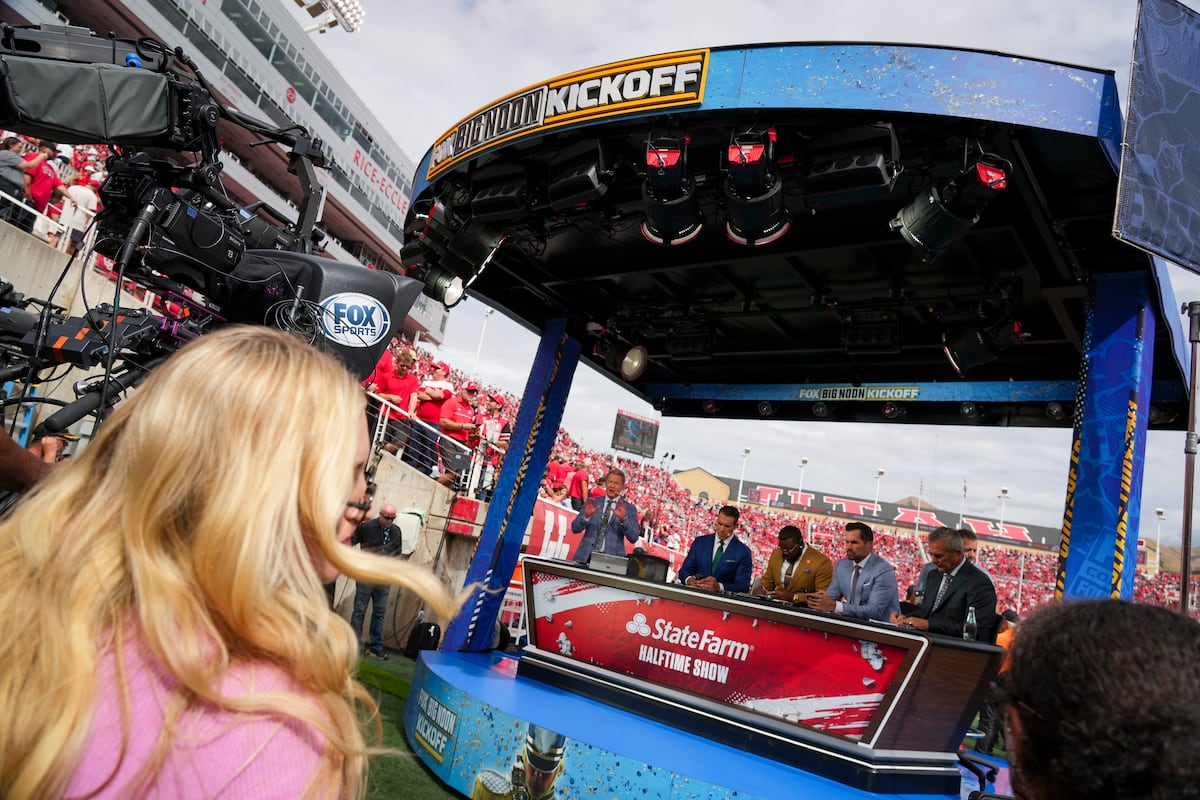
This will be the second time the program has come to Utah this season. Three weeks ago the Utes and Salt Lake City played host to show before the Utes lost 34-10 to No. 7 Texas Tech on Sep. 20 in Rice-Eccles Stadium.
“Should be a great matchup,” Utah head coach Kyle Whittingham said following the Utes win over Arizona State on Saturday. “I would say it’s shaping up to be a biggest event in the state of Utah, sporting event like it is most years.”
The “Big Noon Kickoff” pregame cast includes host Rob Stone, former Heisman Trophy winners Brady Quinn, Mark Ingram II and Matt Leinart.
(Chris Samuels | The Salt Lake Tribune) Fox and Barstool personalities on the set of Fox’s Big Noon Kickoff before Utah plays Texas Tech in Salt Lake City, Saturday, Sept. 20, 2025.
Barstool Sports founder Dave Portnoy and former Utah head coach Urban Meyer are also on the show. The last time Portnoy was in town, he led anti-BYU chants with Ute fans and tried several local pizza joints in downtown Salt Lake City.
Both programs are coming into the matchup ranked inside the AP Top 25 — with BYU at No. 15 and the Utes at No. 23 — after their respective wins this weekend.
Note to readers •This story is available to Salt Lake Tribune subscribers only. Thank you for supporting local journalism.
The next installment of the Holy War rivalry will also be a top-25 matchup between a pair of Big 12 contenders. Utah and BYU will head into next Saturday’s cont …
The next installment of the Holy War rivalry will also be a top-25 matchup between a pair of Big 12 contenders.
Utah and BYU will head into next Saturday’s contest as members of the Associated Press Top 25 poll after both came away victorious in Week 6, setting up a pivotal matchup in Provo, Utah, that’ll feature more than just bragging rights at stake.
Following their dominant win over Arizona State, the Utes earned a spot as the No. 23-ranked team in the country in the latest edition of the media poll that was released Sunday afternoon.
The Cougars, meanwhile, ascended three spots to No. 15 following their come-from-behind win on the road over Arizona, in which they overcame a double-digit deficit for a 33-27 double-overtime win in Tucson, Arizona.
Utah’s Week 7 contest didn’t include nearly as much drama, as the Utes pummeled the Sun Devils in the trenches to pull away for a 42-10 victory at Rice-Eccles Stadium. Devon Dampier had 120 of his team’s 276 rushing yards, gashing the Big 12’s No. 2 run defense all night, while Utah’s defense sacked backup quarterback Jeff Sims five times to hold Arizona State to just 259 total yards of offense.
Oct 11, 2025; Salt Lake City, Utah, USA; Utah Utes quarterback Devon Dampier (4) throws the ball against the Arizona State Sun Devils during the second quarter at Rice-Eccles Stadium. / Rob Gray-Imagn Images
The Sun Devils, who didn’t have Sam Leavitt for that 32-point loss, dropped out of the poll after checking in at No. 21 last week. Iowa State, previously ranked No. 23, also fell out of the top 25 after its 24-17 setback to Colorado.
Texas Tech led the Big 12 pack as the No. 7-ranked team in the land. The Red Raiders improved to 6-0 over the weekend with a 42-17 triumph over Kansas.
The matchup at LaVell Edwards Stadium between Utah and BYU is set to be the only ranked matchup in the Big 12 on Saturday. Kickoff is set for 6 p.m. local time on Fox.
“Should be a great matchup,” Whittingham said of the BYU game. “I would say it’s shaping up to be the biggest event in the state of Utah, sporting event [wise], like it is most years.”
Here’s the rest of the AP Top 25 poll.
Ohio State (6-0, 3-0 Big Ten) [50 first-place votes]
Miami (5-0, 1-0 ACC) [13]
Indiana (6-0, 3-0 Big Ten) [3]
Texas A&M (6-0, 3-0 SEC)
Ole Miss (6-0, 3-0 SEC)
Alabama (5-1, 3-0 SEC)
Texas Tech (6-0, 3-0 Big 12)
Oregon (5-1, 2-1 Big Ten)
Georgia (5-1, 3-1 SEC)
LSU (5-1, 2-1 SEC)
Tennessee (5-1, 2-1 SEC)
Georgia Tech (6-0, 3-0 ACC)
Notre Dame (4-2)
Oklahoma (5-1, 1-1 SEC)
BYU (6-0, 3-0 Big 12)
Missouri (5-1, 1-1 SEC)
Vanderbilt (5-1, 1-1 SEC)
Virginia (5-1, 3-0 ACC)
South Florida (5-1, 2-0 AAC)
USC (5-1, 3-1 Big Ten)
Texas (4-2, 1-1 SEC)
Memphis (6-0, 2-0 AAC)
Utah (5-1, 2-1 Big 12)
Cincinnati (5-1, 3-0 Big 12)
Nebraska (5-1, 2-1 Big Ten)
Dropped out
Florida State (No. 25), Iowa State (No. 22), Arizona State (No. 21), Illinois (No. 17), Michigan (No. 15)
Pregame analysis and predictions of the San José State Spartans vs. Utah State Aggies NCAAF game to be played on October 17, 2025 on ESPN.
San Jose State (2-4) at Utah State (3-3), Oct. 17 at 9 p.m. EDT.
How to watch: CBS Sports Network
Key stats
Utah State Offense
Overall: 423.0 yards per game (42nd in FBS)
Passing: 254.7 yards per game (50th)
Rushing: 168.3 yards per game (53rd)
Scoring: 34.7 points per game (37th)
Utah State Defense
Overall: 435.2 yards per game (123rd in FBS)
Passing: 257.2 yards per game (121st)
Rushing: 178.0 yards per game (112th)
Scoring: 32.7 points per game (125th)
San Jose State Offense
Overall: 411.7 yards per game (53rd in FBS)
Passing: 310.8 yards per game (9th)
Rushing: 100.8 yards per game (122nd)
Scoring: 24.0 points per game (96th)
San Jose State Defense
Overall: 420.2 yards per game (116th in FBS)
Passing: 292.7 yards per game (132nd)
Rushing: 127.5 yards per game (49th)
Scoring: 29.2 points per game (102nd)
Utah State ranks 131st in third down percentage, converting 28.8% of the time. San Jose State ranks 36th on defense, allowing its opponents to convert at 33.3%.
Utah State ranks 132nd in FBS in red zone defense, allowing opponents to score on 96.0% of trips.
Utah State ranks 123rd in the FBS with an average time of possession of 27:01.
Rushing: Jabari Bates, 192 yards on 27 carries, 2 TDs
Receiving: Danny Scudero, 851 yards on 50 catches, 8 TDs
Last game
Utah State lost 44-26 to Hawaii on Sunday, Oct. 12. Barnes led Utah State with 175 yards on 14-of-26 passing (53.8%) for one touchdown and one interception. He also carried the ball 12 times for 64 yards. Davis had 102 rushing yards on 15 carries and one touchdown, adding three receptions for 12 yards. Pegan had three receptions for 84 yards.
San Jose State fell to Wyoming 35-28 on Saturday, Oct. 11. Eget threw for 295 yards on 23-of-37 attempts (62.2%) with four touchdowns and no interceptions. Lamar Radcliffe carried the ball seven times for 29 yards. Scudero recorded 180 yards on 10 catches with four touchdowns.
Next game
Utah State plays at New Mexico on Oct. 25. San Jose State hosts Hawaii on Nov. 1.
That was ugly. There is no other way to put ASU’s 10 to 42 loss to the Utah Utes. Now, credit to Utah, it was a game that they completely dominated from start t …
That was ugly. There is no other way to put ASU’s 10 to 42 loss to the Utah Utes. Now, credit to Utah, it was a game that they completely dominated from start to finish. Utah Head Coach Kyle Whittingham did a great job and his team, but there are reasons why ASU fans should be concerned.
Sep 27, 2025; Morgantown, West Virginia, USA; Utah Utes head coach Kyle Whittingham talks to several officials during the third quarter against the West Virginia Mountaineers at Milan Puskar Stadium. Mandatory Credit: Ben Queen-Imagn Images / Ben Queen-Imagn Images
Brian Ward’s unit had their worst game of the season by far as they allowed over 42 points. It was the first time this season that they allowed 30-plus points in a game. Now, Utah started the game hot as they had 21 points. However, ASU’s bend but don’t break defense that was prevalent in the Big 12 wins they had this season, against Baylor and TCU, was not present as Utah continued to produce points.
Defensive coordinator Brian Ward instructs his players during ASU fall camp practice on Aug. 2, 2024, at Verde Dickey Dome in Tempe. / Cheryl Evans/The Republic / USA TODAY NETWORK
One of the elements that stood out the most was the bad tackling on display. Utah had so many runs that were extended due to ASU’s poor tackling angles and pursuit. This was especially prevalent with Quarterback Devon Dampier, who looked like the Baltimore Ravens‘ Lamar Jackson on the field with how well he was able to run the ball at the quarterback position.
Oct 11, 2025; Salt Lake City, Utah, USA; Utah Utes quarterback Devon Dampier (4) runs the ball against the Arizona State Sun Devils during the first quarter at Rice-Eccles Stadium. Mandatory Credit: Rob Gray-Imagn Images / Rob Gray-Imagn Images
This is especially concerning, especially since ASU is coming off of their bye week, a week of preparation and rest. For the defense to look this sloppy is a huge concern moving forward. Brian Ward’s unit simply did not play well and it is something that they need to fix, especially with a great offense in Texas Tech next week.
Another reason that Dampier was able to run so well was because of ASU’s lack of line play. Going to this game, ASU had a big challenge, to face Utah’s amazing line and they struggled.
Oct 11, 2025; Salt Lake City, Utah, USA; Utah Utes offensive lineman Spencer Fano (55) celebrates a touchdown against the Arizona State Sun Devils during the third quarter at Rice-Eccles Stadium. Mandatory Credit: Rob Gray-Imagn Images / Rob Gray-Imagn Images
Devon Dampier did not get sacked once and he had plenty of time back in the pocket. On the opposite side, ASU’s Jeff Sims was under pressure pretty constantly throughout the game. ASU’s line play has been good so far outside of this game, but the concern starts with the fact that their next opponent, the Texas Tech Red Raiders, is great in the trenches.
When it was known that Jeff Sims was going to start, it was said by ASU’s coaching staff that the game plan was not going to change from what they had with Sam Leavitt. Now, Sims was not bad in this game, but the game plan should have been changed with Sims starting. A lot of the passing plays were longer developing, which is just not Sims’s strength.
Oct 11, 2025; Salt Lake City, Utah, USA; Utah Utes safety Tao Johnson (5) pressures Arizona State Sun Devils quarterback Jeff Sims (2) during the second quarter at Rice-Eccles Stadium. Mandatory Credit: Rob Gray-Imagn Images / Rob Gray-Imagn Images
Sims has talent, and it was good for ASU to go deep on the first play or two to show that Marcus Arroyo had confidence in Sims. However, as the game went on, the team should have focused on the middle and short areas of the field.
If Sam Leavitt were starting, there is a high chance that ASU would not win. However, if Sims is starting next week against Texas Tech, then Arroyo needs to change the playbook.
Arizona State offensive coordinator Marcus Arroyo answers questions during media day for the Chick-fil-A Peach Bowl in Atlanta on Monday, Dec. 30, 2024. / Michael Chow/The Republic / USA TODAY NETWORK via Imagn Images
This game was bad; there are no positives about it. However, this is a big rebounding point for ASU. Coach Dillingham has established a strong culture and it will be up to him and the rest of the team to hopefully get back on track this season. So, even though things look dire, there is hope.
We would highly appreciate it if you would discuss your thoughts on how the biggest issues facing the Sun Devils. Additionally, follow @Kevin Hicks on X to get updates on when new ASU on SI pieces drop!
Please let us know your thoughts on this ASU Week 7 story when you like our Facebook page when you click right here.
Arizona State traveled to Salt Lake City and had to play Utah without starting quarterback Sam Leavitt. It did not go well.
SALT LAKE CITY — The Arizona State Sun Devils returned to Rice-Eccles Stadium, where they have had forgettable games against Utah in recent years. Now another can be added to the list of those, as the No. 21 Sun Devils were manhandled by the Utes 42-10 in Big 12 play on a cold and wet night.
It marks the fifth time in six years ASU has lost to Utah, with three of those coming on the road.
Advertisement
Advertisement
Advertisement
“I feel like this is deja vu.” Arizona State coach Keny Dillingham said, referring to the last time his team was in the same venue and lost 55-3. That was in 2023. This one wasn’t quite that bad, but it was close.
Senior quarterback Jeff Sims got the call for the injured Sam Leavitt, who made the trip but had his right foot in a walking boot. Junior running back Kyson Brown was listed as questionable but did not play. He aggravated the ankle injury suffered at Mississippi State. They were among half a dozen key players who were missing.
What went wrong
Special teams faltered: Jesus Gomez has been solid as a placekicker, but he had a 29-yard field goal attempt in the first half blocked. The snap was well off the mark, which interrupted the timing of the play. That miscue spelled the end of a drive that took 8 minutes. There was also a bad snap on a punt attempt by Matthew McKenzie in the third quarter, although he was able to get the kick off. Kanyon Floyd was unable to punt due to a quad injury, leaving the inexperienced McKenzie to hold down that job.
Advertisement
Advertisement
Advertisement
Run defense was not up to par: ASU entered the game ranked second in the Big 12 and eighth among all FBS teams, allowing just 78.2 yards per game on the ground. The Utes ended up running for 276 yards, with 183 of that in the first half. The Sun Devils had a particularly difficult time containing Utah quarterback Devon Dampier, who had 120 yards and three touchdowns in the game, despite not playing much of the fourth quarter. He is the first Utah quarterback to rush for 100 yards in a game since Travis Wilson did so against Oregon in 2015.
Offensive line struggled: A change was made this week with Wade Helton going in at center and Ben Coleman returning to right guard, the position he played last season. Helton had worked some there late in fall camp, but ASU opted to go with Coleman there to start the season. Coleman was injured with 4:02 left in the first and did not return. He was replaced by Jimeto Obigbo, who was called for holding on his first play in the game. The Sun Devils ended up settling for a field goal on that possession. Obigbo was also called for a false start in the third quarter. LT Josh Atkins was called for a holding in the second quarter, and RT Max Iheanachor was called for another, although Utah took the play rather than having the penalty marched off because it resulted in a fourth down.
A bad start: We have seen this in many games this season: down 17-0 in the first half at Mississippi State, and down 17-0 in their last outing against TCU. The Sun Devils were down early again, trailing Utah 21-3 at the half. It didn’t get any better. Utah got the first score in the third quarter to lead 28-3. There was no coming back from that.
Pass rush nonexistent: The Sun Devils had come in with 11 sacks in the previous two games, with the pass rush one of the more improved areas of the team. The front group was facing a formidable challenge, though, with Utah boasting two of the top offensive linemen in the country, Spencer Fano and Caleb Lomu. ASU did not manage even one sack and was dominated in the trenches. ASU had only one tackle for a loss after managing 13 in its last game.
What went right
Nothing: Rarely is there a game where there isn’t one thing that can be singled out as a bright spot, but that was indeed the case here.
Arizona State Sun Devils running back Raleek Brown (3) runs against Utah Utes cornerback Smith Snowden (2) and linebacker Johnathan Hall (7) during the second quarter at Rice-Eccles Stadium in Salt Lake City, on Oct. 11, 2025.
Personnel
QB Sam Leavitt, RB Kyson Brown, LB Zyrus Fiaseu, and S Xavion Alford were the most notable players who did not see action due to injuries. Sims got his first start of the season in place of Leavitt, while Adrian “Boogie” Wilson continued occupying Alford’s spot . . . True freshman TE A.J. Ia had his first career catch, which went for 10 yards in the second half.
Advertisement
Advertisement
Advertisement
Grades
Offense (F): The Sun Devils managed 259 yards, well under the 423 they had been averaging. Sims was only 18-for-38 for 124 yards, but did run for 52 yards, and that included sack yardage losses. Raleek Brown was held to 67 on 14 carries. The normally dangerous Jordyn Tyson was held to 40 yards on eight catches despite being targeted 16 times and was a non-factor. The offensive line had a lot of issues (see above).
Defense (D): The defense came in, giving up an average of 78.2 on the ground and 248 through the air. In this game, the Sun Devils gave up 276 yards on the ground and 136 passing for a total of 412 yards. Dillingham also noted how poorly his team tackled, something that had not been a problem previously. Wilson and LB Keyshaun Elliott each had seven tackles while Myles Rowser had six. There were no takeaways or sacks, and just one tackle for a loss.
Special teams (D+): Gomez made a field goal from 38 yards and had one from 29 yards out blocked after a bad snap. McKenzie averaged 41 yards on three punts, none downed inside the 20. The Sun Devils allowed a 24-yard kickoff return. Jaren Hamilton had a kick return for 23 yards, which was a positive.
Advertisement
Advertisement
Advertisement
They said it
“We trust those boys up front. That front five, I trust those guys over anybody. We take whatever that defense gives us, and our run game was moving. We were moving the ball efficiently and stuck to it.” — Utah quarterback Devon Dampier on the run game
“They got us physicality-wise. They outphysicaled us. We were thinking too much. Once you start doing that too much, that throws you off your game. They got us tonight. We have to go back to the drawing board and get back to the process.” — Arizona State defensive tackle C.J. Fite
“They beat us as a whole program. They just beat us top to bottom. The best part of football, it’s it’s only worth one. They don’t add up the scores at the end of the year and say, `What was your total score? They just put one L. Now we have to let them beat us twice.” — ASU coach Kenny Dillingham on getting beat and trying to bounce back
Advertisement
Advertisement
Advertisement
Next up
The Sun Devils return home for an Oct. 18 matchup against No. 9 Texas Tech (6-0, 3-0), which defeated Kansas 42-17.
Four teams started the night tied at the top of the Big 12 with 2-0 records, but it is the Red Raiders who have steamrolled the competition. Texas Tech has outscored its six opponents 285-73. Included in that tally was a 34-10 win over Utah.
The music video for his breakthrough hit “ Beautiful Things ‚” which has over 800 million views on YouTube, was filmed in St. George. The singer also filmed the music video for the song “ Mr. Electric …
Update: This story was published earlier in the day, before weather conditions affected Post Malone’s show at RedWest Fest. On Saturday at 9:40 p.m., the festival announced that Post Malone’s show was canceled.
“For the safety of our fans, artists, and staff, we are unable to continue with today’s programming,” the festival shared in a statement on Instagram. “Conditions at the festival site are currently unsafe to proceed. We’re truly sorry and appreciate your patience and understanding. Please stay tuned to our social channels and check your email for further updates and next steps.”
It’s a big night for music in Salt Lake City.
Advertisement
Advertisement
Advertisement
Advertisement
On Saturday, Benson Boone wraps up the North American leg of his “American Heart” tour with his third and final sold-out show at the Delta Center — the only venue on his massive tour where he’s playing three times.
At the same time, a little over a mile to the west at the Utah State Fairpark, another superstar with strong Utah ties is headlining the RedWest country music festival: Post Malone.
Boone and Malone, who both call Utah home at least part-time, are two of the biggest superstars based in the Beehive State.
Here’s a look at their ties to Utah — and what to expect from their Saturday night shows.
Benson Boone’s 3-night stint in Salt Lake City
Boone’s world tour sold out in a staggering nine seconds, but the demand was extra high in Salt Lake City.
Advertisement
Advertisement
Advertisement
Advertisement
The extra love the “Beautiful Things” singer is showing his Utah fans is fitting, as the state has played a meaningful part in his rapid rise to fame.
The music video for his breakthrough hit “Beautiful Things‚” which has over 800 million views on YouTube, was filmed in St. George. The singer also filmed the music video for the song “Mr. Electric Blue,” from his second album, in Utah, as the Deseret News reported.
More in Entertainment
Although he grew up in Washington state, a recent profile in Rolling Stone magazine notes that Boone has a home about 30 minutes south of Salt Lake City, in “a sharp-angled, industrial-gray luxury fortress with towering windows atop a cliff” that overlooks Utah Lake.
The Grammy-nominated artist has attended a few Utah Jazz games, rubbing shoulders with the Jazz Bear at the Delta Center.
Benson Boone performs during the first weekend of the Coachella Valley Music and Arts Festival at the Empire Polo Club on Friday, April 11, 2025, in Indio, Calif. | Amy Harris
Now, he is concluding his North American “American Heart” tour at that same venue.
Advertisement
Advertisement
Advertisement
Advertisement
And the thousands and thousands of fans at the Delta Center are cheering him on — loudly.
“Throughout the show, friends and families — particularly moms and their young daughters — seemed to be serenading each other as they sang along,” as I wrote after attending the first of three shows Wednesday night. “Sometimes, Boone being on the stage felt of secondary importance.
“The show often felt like a massive singalong, and it could sometimes be hard to hear Boone over the crowd. But there were moments when his vocals really cut through.
“While Boone has absolutely nothing to prove, he made a strong case for any of the doubters that his voice can stand on its own and that he’s a lot more than his flips (although there were also plenty of those).”
Benson Boone, top, performs onstage during the 67th Annual GRAMMY Awards at Crypto.com Arena on Feb. 2, 2025, in Los Angeles, Calif. | Kevin Winter
Post Malone headlines RedWest Fest
Post Malone calls Cottonwood Heights home — and has been vocal about his love for living in Utah.
Advertisement
Advertisement
Advertisement
Advertisement
“Moving here to this amazing state was one of the best things I’ve done in my life, besides have a baby girl,” Malone told his cheering fans at Utah First Credit Union Amphitheatre last fall, according to a video shared by Salt Lake-based country radio stationThe Bull on TikTok. “I moved to L.A. when I was a kid, and I was like, ‘Hey this is not kind of where I want to be.’ So I did a show here right on the Salt Flats, and I was like, ‘This place rocks.’ … Like a week later we bought a house here. I gotta say, Utah is one of the most beautiful places on the planet, and I’m so grateful and so honored to be a resident here, ladies and gentlemen.”
Six months ago, Malone kicked off his first stadium tour with a hometown show at Rice-Eccles Stadium in Salt Lake City. While the show covered hits from throughout his career, it was when Malone performed country music from his latest album, “F-1 Trillion,” that the crowd really came to life, as the Deseret News reported.
That country music will be on full display at RedWest.
Post Malone performs “America the Beautiful” during the first half of the NFL Super Bowl 58 football game Sunday, Feb. 11, 2024, in Las Vegas. | Steve Luciano
“Like Beyonce, Malone traded in his beats for boots with the release of his album ‘F-1 Trillion,’ marking his move into country. Onstage, he wove his new twang-heavy tracks into a set list that still honored the hits that built his name,” Madeline Thorpe wrote for Deseret News. “But when he leaned into the country, something shifted. The former SoundCloud artist seemed to come more alive.
“The crowd matched his energy, not just following along, but really leaning in — singing louder, kicking up dust and getting loose,” Thorpe continued. “And though they still cheered for the decade of hip-hop, rock and rap anthems, it was the country songs that drew the loudest response.”
For Guenther, game-winners are a regular occurrence as he managed to score nine game-winning goals last season. On top of that, Guenther’s offense has been very important for Utah as he has scored two …
Oct 11, 2025; Nashville, Tennessee, USA; Utah Mammoth right wing Dylan Guenther (11) scores the game winner past Nashville Predators goaltender Juuse Saros (74) during the overtime period at Bridgestone Arena. Mandatory Credit: Steve Roberts-Imagn Images
Dylan Guenther is as clutch as ever for Utah Mammoth.
Playing in overtime against the Predators, Utah was in full control after securing the puck early. Though Utah was managing to keep the puck away from Nashville, the Mammoth was still looking for an opening in the Predators’ defense.
Advertisement
Advertisement
Advertisement
Suddenly, after a near turnover, Guenther got that opportunity and delivered big time.
Though Nashville defenseman Spencer Stastney certainly put a lot of pressure on Guenther, Guenther stayed strong and controlled the pass from Mikhail Sergachev by deflecting it back off the boards.
But what was even more impressive was Guenther holding off Fedor Svechkov’s best efforts to steal the puck shortly after.
With Svechkov too far behind and the puck under control, all Guenther had to do was get past goalie Juuse Saros. With a quick burst and Saros leaning left, Guenther took his shot and won the game.
Advertisement
Advertisement
Advertisement
“As you get more comfortable playing in close games and [get] in those situations all the time, I mean you get better at it,” said Guenther. “Those are the ones that you want to play in.”
For Guenther, game-winners are a regular occurrence as he managed to score nine game-winning goals last season. On top of that, Guenther’s offense has been very important for Utah as he has scored two of Utah’s four goals this season and even added an assist on a third.
Utah winning its first overtime game is a great sign, especially since it lost 13 overtime games last season.
But not everything went well for the Mammoth in overtime, as it saw defenseman Sean Durzi injured and in pain after a hard collision with Nashville.
Sean Durzi appears to have gotten injured in OT.
He took a hard hit and fell on his right shoulder, which I believe was the one that eliminated him from the first half of last season.#TusksUp
“I don’t have an update,” said coach André Tourigny when asked about Durzi’s injury status.
Advertisement
Advertisement
Advertisement
Utah will have to hope Durzi’s injury isn’t too serious, considering he was a big part of why the Mammoth even got to overtime after assisting on a clutch Jack McBain goal to tie the game 2-2 in the third.
But if not for an earlier Utah challenge that successfully called back Nashville defenseman Roman Josi’s third-period goal due to an offside, the game might have ended differently.
If not for Karel Vejmelka’s impressive play as well in his 200th NHL game, Utah would never have been able to tie the game and force overtime. But in the end, the score was still 2-1 despite the scares, and Utah eventually forced overtime thanks to McBain’s goal.
Advertisement
Advertisement
Advertisement
“We showed a lot of resilience,” said McBain. “There was a lot of penalties and stuff in the second period. Maybe not our best stuff, but we stuck with it really well and got a good team win there.”
Though the Mammoth came out swinging on offense with a great goal from Logan Cooley just 2:21 into the game, Utah still has some work to do if it wants to be a top-10 offense.
Specifically, the Mammoth’s power play wasn’t able to capitalize despite four opportunities. It wasn’t as if Utah didn’t get any shots either — Nick Schmaltz got all four of his shot attempts by simply sitting in the slot on the power play.
Advertisement
Advertisement
Advertisement
The Mammoth will need to find more opportunities to crash the blue paint to help Schmaltz and change up its shot selection a bit more if it wants to capitalize on the man advantage.
But more importantly, Utah will need to clean up its game after it amassed six second-period penalties that nearly put the Mammoth in a big hole. Though Nashville also took penalties of its own, the Mammoth still gave it five power-play opportunities.
On the bright side, the Mammoth has to be happy it was able to be successful with its penalty kill unit, but it certainly made winning tonight’s game even harder by being down a man so often.
But a win is a win, and Utah will take its first one any way it can get it.
Advertisement
Advertisement
Advertisement
With its next game on the road against the Chicago Blackhawks on Oct. 13, Utah could come away from its road trip 2-1 — that is, if it can stay out of the penalty box.
Utah State has played many P4 teams over the years and it has seemed, at times, that the Aggies only play those teams during their best seasons.
When it was announced last week that Utah State football had come to an agreement with Washington to play a game next season in Seattle, questions arose.
To be clear, those questions were not about why Utah State scheduled the football game.
Advertisement
Advertisement
Advertisement
With the move to Pac-12 next summer, Utah State has to find five nonconference opponents, and before the announcement of the game against the Huskies, the Aggies had just two games scheduled — at home against Idaho State and on the road against Utah.
Utah State needs games — it still does — and the game against Washington will pay USU $1.5 million. Add in the fact that Washington is a Western-based Power Four program, exactly the type of program Bronco Mendenhall said he hoped the Aggies would schedule going forward, and it was even better for the Aggies.
The game makes complete sense in almost every way, aside from giving USU two P4 opponents in a single season again.
No, the questions that arose after the announcement of the USU-Washington game were centered on luck and whether or not Utah State has much at all, if any.
Advertisement
Advertisement
Advertisement
For a large subset of Aggie fans, it feels as though USU only plays P4 teams when they are at their best, often during special seasons. This season, Utah State has played both No. 5 Texas A&M and No. 20 Vanderbilt, and there is a real argument that both teams are in the middle of the best seasons in program history, or at least the best starts to a season.
So there were jokes aplenty that Washington can look forward to being a College Football Playoff contender next season — the Huskies are 4-1 this season and ranked No. 27 in ESPN’s latest Football Power Index.
Such is the curse of the Aggies, or something like that.
But is it true? Does Utah State have the misfortune of playing P4 teams when they are on the upswing rather than catching P4 teams when they are down or underachieving?
Advertisement
Advertisement
Advertisement
Or is that just recency bias, with Texas A&M and Vanderbilt especially, but other teams in the recent past as well?
As it turns out, it is a little of both.
What Power Four teams has Utah State played?
LSU running back Clyde Edwards-Helaire (22) carries against Utah State linebacker Kevin Meitzenheimer (33) in the first half of an NCAA college football game in Baton Rouge, La., Saturday, Oct. 5, 2019. (AP Photo/Gerald Herbert) | Gerald Herbert, AP
Over the last 15 years, going back to the 2011 season, the Aggies have played 13 Power Four teams, many of those teams multiple times.
(For the purposes of this exercise, we aren’t counting games against Oregon State and Washington State. Additionally, games against BYU, prior to the Cougars joining the Big 12, weren’t considered, either.)
Those teams have come from across the college football landscape, too, from the SEC (Alabama, Auburn, LSU, Tennessee and Vanderbilt), the Big Ten (Wisconsin, Washington, Michigan State, Iowa and USC), the ACC (Wake Forest) and the Big 12 (Utah).
Advertisement
Advertisement
Advertisement
Some of those indeed were experiencing real highs when they played the Aggies.
Take LSU in 2019.
Before that season, LSU was expected to be improved (the Tigers won 10 games the year before), but few had any idea of just how improved it would be. Led by Joe Burrow, those Tigers rolled in dominant fashion to an undefeated 15-0 record and won the national title running away.
That LSU team might be the best college football team of all time. Bad luck, Aggies. What hurts more? The next year, LSU went 5-5 overall. Yes, it was the pandemic-marred 2020 season, but it wasn’t a one-off. The year after that, LSU went 6-7 and Ed Orgeron was fired.
Advertisement
Advertisement
Advertisement
It isn’t just LSU either.
In 2017, Utah State played the best Wisconsin team (by final record) ever. That year, the Badgers finished 13-1 and won the Orange Bowl. Led by star tailback Jonathan Taylor, the Badgers handled anyone and everyone they faced off against that year, save for only Ohio State.
The average margin of victory for Wisconsin in 2017 was nearly 20 points per game (19.85).
Similar to LSU, the year after the Aggies faced off against an elite Wisconsin team, Wisconsin was vulnerable, winning just eight games in 2018.
You can’t talk about programs peaking when they play Utah State without mentioning both Texas A&M and Vanderbilt this season.
Advertisement
Advertisement
Advertisement
The other Aggies are 5-0 right now, ranked No. 5 overall, and are on pace for the best season by the program since 2012, the last time Texas A&M won double-digit games.
Vanderbilt, meanwhile, at 5-1, is trending toward the best season in program history. The most wins the Commodores have racked up in a single season is nine, most recently accomplished in 2012 and 2013 under James Franklin. Vanderbilt is on pace — right now — for the first double-digit win season in program history.
The Aggies have also benefitted from playing teams at opportune times as well, though.
In 2012 and 2013, Utah was in its early days in the Pac-12 and won just five games in back-to-back seasons. The Utes had talent, sure, but not the depth to compete at the Power conference level, and it took time for them to get there.
Advertisement
Advertisement
Advertisement
In 2014, USU faced off against a bad Wake Forest team that won only three games. That is notable because the Demon Deacons went on — a couple of seasons later — to win seven or more games in six of seven seasons, including an 11-win campaign in 2021. Utah State did catch two of those teams, in 2017 and 2019, barely missing out on an upset in 2019.
Utah State also played a pretty mediocre Tennessee team in 2014. The Volunteers won seven games that season, but went on to win nine games in back-to-back years the next two years.
In 2015, Washington was mediocre, a seven-win team. And in 2018, Utah State played a mediocre Michigan State team that won seven games.
Last year, the Aggies caught both Utah (five wins) and USC (seven wins) in down years. It didn’t matter, as the Aggies themselves were struggling, but the Utes and Trojans were far from their best selves when they played USU.
Advertisement
Advertisement
Advertisement
More than anything else, though, Utah State has played good P4 schools when they are good. A challenge, sure, but not an unsurprising one.
In 2011, Auburn won eight games, a fall off from the national title run the season prior, but still, a solid season, even one of the better ones for the Tigers in the last 15 years.
Wisconsin in 2012 was an eight-win team. A good team, though not as good as the ones that preceded or followed.
USC won 10 games in both 2013 and 2016.
Wake Forest, as previously mentioned, won eight games in 2017 and 2019.
Alabama won 11 games in 2022, not the Crimson Tide at their greatest (they missed the College Football Playoff) but still a great team.
Advertisement
Advertisement
Advertisement
Iowa won 10 games in 2013, and Utah State was in their game against the Hawkeyes throughout, with a chance to win it in the fourth quarter.
Next season, Utah State is slated to play both Utah and Washington on the road.
It is certainly possible that both teams could be great when the Aggies play them. Right now, the Utes and Huskies are a combined 8-2 and are in the hunt in their respective conferences (Big 12 and Big Ten).
Will Utah and Washington be among the best teams in their respective histories?
Even though it might feel like it when they play the Aggies, probably not. Unless Utah State is really that unlucky.
The team from Utah separated itself on Friday in the second round of the International Senior Invitational. Call it a full-team effort.
The team from Utah separated itself on Friday in the second round of the International Senior Invitational. Call it a full-team effort.
Utah’s rise to the top of the leaderboard during Thursday’s opening round of the elite senior event at Cartersville (Georgia) Country Club could largely be attributed to Shane McMillan. Two eagles and six birdies went a long way in helping McMillan secure the top spot on the individual leaderboard as well as the team leaderboard, but on Friday, that hot play cooled slightly.
Advertisement
Advertisement
Advertisement
After an opening 65, McMillan returned a 74 on Friday with only two birdies canceled out by four bogeys. His teammates, however, stepped up in the play-three-count-two format. Brigham Gibbs posted 71 while Jon Wright had 74. Utah is now 4 under and one shot ahead of South Carolina.
McMillan is still in a tie for first place on the individual leaderboard after being caught by Irishman Joe Lyons, who backed up an opening 71 with a 68 to reach 5 under. No surprise there: Lyons is among his country’s most notable senior amateurs. He has won multiple Irish Senior Men’s Amateur Close Championships as well as the Spanish, Portuguese, and Irish senior amateur championships.
Stan Payne.
Lyons won the individual title in this event in 2023. He is co-founder of Lyons Links, which operates luxury golf and sightseeing tours in Ireland and the United Kingdom, and lives a life that revolves around the game.
Advertisement
Advertisement
Advertisement
Lyons’ strong play led his Irish team five spots up the leaderboard to a tie for eighth with Kentucky and Florida. The biggest mover of the day, however, was team Arkansas. Led by Stan Payne’s 66, that threesome climbed 15 spots into a tie for third. At 1 under as a team, Arkansas is now only three off Utah’s pace and in real contention for the title.
Iowa also climbed the team leaderboard on Friday, jumping five spots into a tie for third along with Arkansas and Scotland.
Mike McCoy, the reigning U.S. Senior Amateur champion, largely led that Iowan effort with his second-round 71. He is 4 under for the tournament and in solo third.
With one round left, a local team lurks, too. Cartersville member Chad Branton continues to lead the charge for a Georgia team that includes past U.S. Senior Am champs Bob Royak and Rusty Strawn. Branton posted a second-round 70 that moved him into the top 5 individually as his Georgia team sits in sixth on the team leaderboard.
TEMPE — The 21st-ranked Arizona State Sun Devils (4-1, 2-0 Big 12) are seeking a spotless start to conference play as they hit the road against the Utah Utes (4-1, 1-1) in what is a major battle …
TEMPE — The 21st-ranked Arizona State Sun Devils (4-1, 2-0 Big 12) are seeking a spotless start to conference play as they hit the road against the Utah Utes (4-1, 1-1) in what is a major battle …