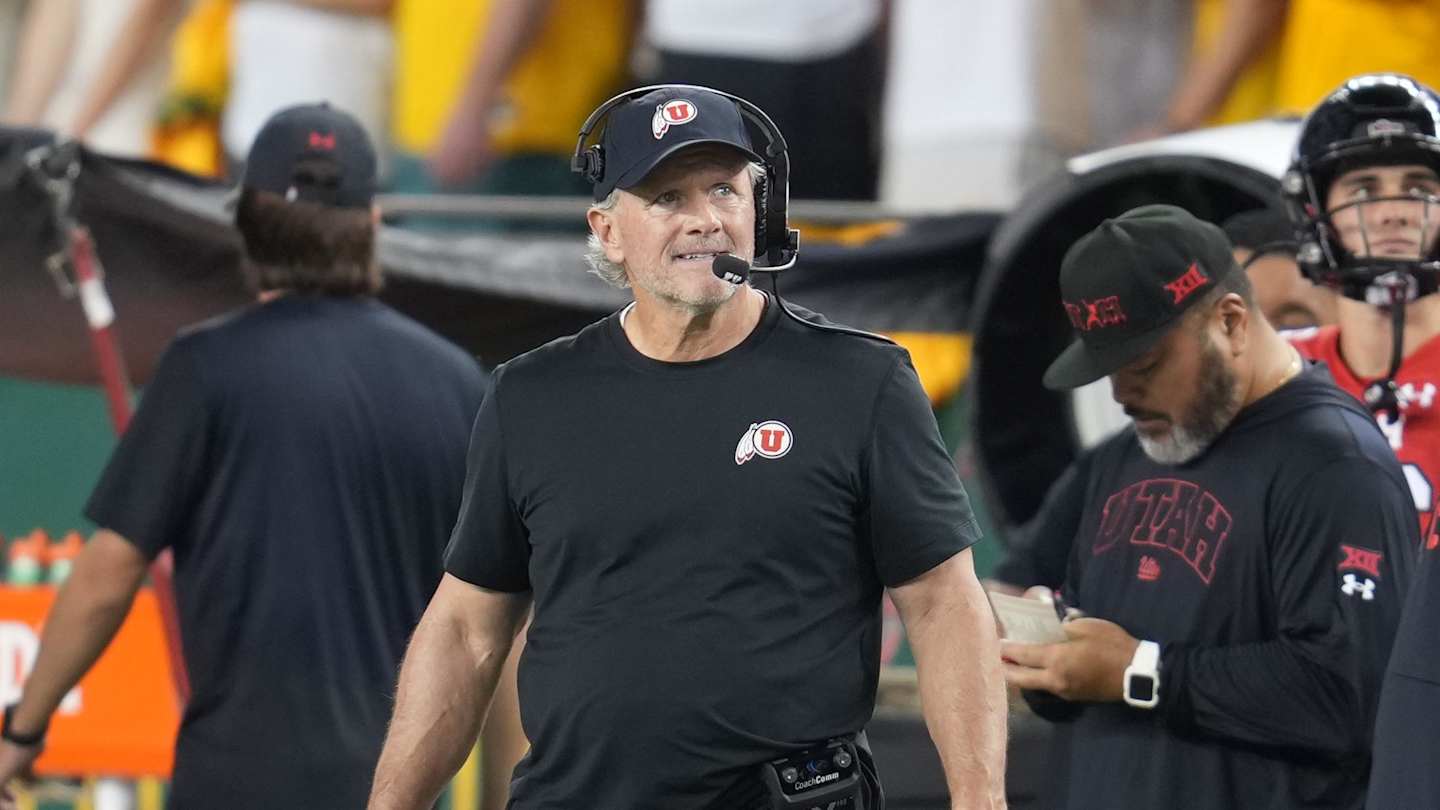
Utah’s come-from-behind win over a .500 team in Week 13 put into question the Utes’ College Football Playoff at-large bid hopes going into the final week of the …
Utah’s come-from-behind win over a .500 team in Week 13 put into question the Utes’ College Football Playoff at-large bid hopes going into the final week of the regular season.
Tuesday’s CFP rankings reveal confirmed Utah would need quite a bit of help if it was going to earn a spot on the 12-team bracket without winning the Big 12.
The Utes (9-2, 6-2 Big 12) dropped from No. 12 to No. 13 following their come-from-behind victory over Kansas State, which rushed for 472 yards and led by as many as 12 in the fourth quarter of Saturday’s 51-47 final from Rice-Eccles Stadium.
Miami leapfrogged its way to the No. 12 spot heading into a pivotal ACC clash with No. 22 Pitt (10 a.m. MT, ABC). The Hurricanes (9-2, 5-2 ACC) needed a win to have a chance at playing for the conference championship. Utes fans, meanwhile, would prefer a Panthers victory with the hope that a third loss would knock Miami out of at-large contention.
Utah would probably like as much chaos as possible to ensue over the Thanksgiving weekend, especially if it involves other at-large contenders (any team around the No. 12 spot) losing.
An appearance in Arlington, Texas, for the Big 12 title game would give the Utes their best hope at punching a ticket to the playoff.
For that to happen, four scenarios would need to play out over the weekend: Utah would need to beat Kansas (Friday 10 a.m. MT, ESPN); Arizona State has to defeat Arizona (Friday 7 p.m. MT, Fox); BYU must take care of business against UCF (Saturday 11 a.m. MT, ESPN2); and (probably the least likely outcome of the bunch) West Virginia has to upset Texas Tech (Saturday 10 a.m. MT, ESPN).
That would set up a rematch between Utah and BYU for the right to be called Big 12 champions and earn an automatic bid into the College Football Playoff.
Nike founder Phil Knight is known for being heavily involved in Oregon athletics. The billionaire sports brand founder has given a ton of money to Oregon football, track, basketball and other sports.
Donald Trump is struggling to stay on message after accidentally boosting a call to impeach himself. The president, 79, went on a social media posting spree attacking a group of Democrats who last week released a video urging U.S. service members and the intelligence community to refuse illegal orders. But while doing so, he posted a screenshot of Sen. Mark Kelly, a retired naval officer and one of six Democratic lawmakers featured in the video, from an anti-Trump account named “Impeach Trump a
Around three dozen Republican lawmakers gathered at the Utah Capitol Tuesday to outline their next steps two weeks after 3rd District Judge Dianna Gibson rocked Utah politics by selecting her own …
This is a breaking news story and will be updated.
Utah legislative leadership announced Tuesday they will take immediate action to end the latest round of litigation in the state’s multiyear redistricting legal battle so they can appeal the entire case to the Utah Supreme Court.
Around three dozen Republican lawmakers gathered at the Utah Capitol Tuesday to outline their next steps two weeks after 3rd District Judge Dianna Gibson rocked Utah politics by selecting a congressional district map put forward by special interest groups for the 2026 midterm elections, while rejecting one put forward by the Legislature.
In an effort to reverse Gibson’s Nov. 10 decision, Senate President Stuart Adams and Speaker Mike Schultz said they are asking for a permanent injunction to rapidly secure a final ruling from Gibson so that they are able to file a full appeal to the state’s highest court.
The Legislature decided on this course of action in consultation with Utah Gov. Spencer Cox, who they said will call lawmakers into special session on Dec. 9 where they may postpone candidate filing deadlines to make time to adjust the state’s electoral boundaries yet again.
“This is a defining moment for Utah’s governance,” said Schultz, R-Hooper. “Two branches of government, those branches chosen by Utah voters, are standing together to correct this wrong, to restore order and ensure our system works the way our constitution was intended.”
How did we get here?
Over the past 18 months, Utah courts have ruled that the state’s GOP majority violated the Utah Constitution by amending the Better Boundaries initiative known as Proposition 4 in 2020 and by skirting the law’s anti-gerrymandering requirements in 2021.
While legislators begrudgingly complied with Gibson’s orders to redraw the state’s congressional seat boundaries, they argued that courts should not have any role in the redistricting process, which the state constitution places under legislative authority.
GOP lawmakers erupted when Gibson ultimately rejected their remedial map, which made two more competitive districts, in favor of one submitted by plaintiffs in the case, creating four uncompetitive districts, including a +20 Democratic seat in northern Salt Lake County.
“By design or by default, Judge Gibson has authorized the most partisan, and thus the most gerrymandered map in the history of the state of Utah,” said Adams, R-Layton. “I assume she didn’t intend or set out to gerrymander herself, but anyone who looks at the donut hole map sees very clearly it’s gerrymandered.”
State election officials have already begun adjusting the state’s election process to accommodate the new map. But legislative leaders said they still believe there is a possibility they can succeed in court to throw out the so-called “Map 1″ before next November.
In the long-term, legislators committed to resolve the disagreement over separation of powers in the state by placing a constitutional amendment on the ballot that clarifies their ability to amend or repeal ballot initiatives, including those that alter the structure of government.
This would be similar to the Amendment D option lawmakers planned to include on the 2024 ballot which was voided by Gibson because she said it did not meet thresholds for ballot language clarity and for adequate advertising.
The College Football Playoff bubble is looking crowded. How much movement will there be in Tuesday’s selection committee Top 25?
Today’s the final Tuesday of the college football regular season, which means the College Football Playoff selection committee will be releasing another Top 25 — and we’re one step closer to the rankings that matter most on Dec. 7. So what will the rankings look like Tuesday night (7 ET, ESPN)?
I’m here again to do my best at projecting what the committee is going to do, using my Playoff projections model, after a chalky weekend across college football.
Advertisement
Last week, the committee went against my formula and gave edges to Notre Dame over Alabama and Texas over Michigan. After drubbing Syracuse, Notre Dame moved ahead of Alabama in my projections, so I assume they’ll be in agreement with the committee this week. Michigan, however, stays ahead of Texas in my model before its showdown with top-ranked Ohio State.
Overall, I had my worst week when it comes to projecting the committee’s rankings, especially because I missed the top Group of 5 pick (I had North Texas; the committee had Tulane). Back to the drawing board this week.
Here’s what my model thinks will happen in the Nov. 25 rankings:
Projected CFP Top 25 after Week 13
Rank
Team
Record
SOR
SOS
1
11-0
3
75
2
11-0
2
45
3
11-0
1
16
4
10-1
4
22
5
10-1
8
48
6
10-1
7
49
7
10-1
6
27
8
9-2
10
12
9
9-2
11
35
10
9-2
9
14
11
10-1
5
29
12
9-2
12
21
13
9-2
15
51
14
9-2
13
40
15
9-2
14
50
16
8-3
22
5
17
8-3
20
24
18
9-2
18
77
19
8-3
21
28
20
10-1
30
119
21
9-2
17
78
22
10-1
32
120
23
9-2
16
72
24
8-3
26
66
25
8-3
25
62
Next five: Arizona State, Arizona, Washington, Navy, Missouri
Strength of record and strength of schedule rankings are based on The Athletic’s model
Biggest questions: Will Miami or Vanderbilt move up? What about Texas and Michigan?
The bubble is crowded, and some teams likely will feel snubbed come selection day
My projections have Vanderbilt (ranked 14th last week) with a better resume than Miami (13th), and both were behind Utah (12th) last week. Miami took care of Virginia Tech on the road 34-17 and Vanderbilt comfortably disposed of Kentucky 45-17. Meanwhile, Utah gave up 472 rushing yards and needed a dramatic comeback to beat Kansas State as a big favorite in the final minute on Saturday.
Will that be enough for the committee to make a move here? Vanderbilt can’t win the SEC championship, so beating Tennessee on Saturday and moving up to get an at-large bid is its only path to the Playoff. Miami still has an outside chance (merely 4 percent in my model) to win the ACC title, but it likely needs an at-large bid as well.
Again, a lot of things can happen on the final weekend of the regular season, and Miami beating Pitt and Vanderbilt beating Tennessee on the road Saturday may not be enough. If they want more comfort heading into the final weekend, they’d like the committee to give them a boost after this week’s performances.
Advertisement
Personally, I think a win at Tennessee gives Vanderbilt the best resume of all three, but the committee has been lower on the Commodores than me.
Bubble
`:E:”—”)(d.bracket_seed),one_week_change:g,colors:{…d.colors,one_week_change:k},colors_dark:{…d.colors_dark,one_week_change:y},display:{…d.display,one_week_change:v},is_elim:!1}});const u=[o,{col:”bracket_seed”,th_content:”PROJ. SEED”,td_class:”center”},…Io([{col:”make_playoffs”,th_content:”MAKE PLAYOFF”}]),{col:”one_week_change”,th_content:”1-WEEK CHANGE”,td_class:”center bold”,td_component_name:”Circle”}];return e.$$set=d=>{“confForecast”in d&&n(3,r=d.confForecast),”confLastForecast”in d&&n(4,i=d.confLastForecast)},[s,f,u,r,i]}class xf extends Re{constructor(t){super(),Se(this,t,Ef,Tf,Ie,{confForecast:3,confLastForecast:4})}}function Mf(e){let t,n;return t=new xf({props:{confForecast:e[2],confLastForecast:e[3]}}),{c(){yt(t.$$.fragment)},m(r,i){at(t,r,i),n=!0},p:ee,i(r){n||(ae(t.$$.fragment,r),n=!0)},o(r){be(t.$$.fragment,r),n=!1},d(r){lt(t,r)}}}function Cf(e){let t,n;return t=new wf({props:{confForecast:e[2],confLastForecast:e[3],conference:Ve(e[1])}}),{c(){yt(t.$$.fragment)},m(r,i){at(t,r,i),n=!0},p(r,i){const o={};i&2&&(o.conference=Ve(r[1])),t.$set(o)},i(r){n||(ae(t.$$.fragment,r),n=!0)},o(r){be(t.$$.fragment,r),n=!1},d(r){lt(t,r)}}}function Nf(e){let t,n,r,i=e[6][e[7]]+””,o,s,a,l,f,u,d,p,g,k;const y=[Cf,Mf],v=[];function b(E,R){return E[0]===”confOdds”?0:E[0]===”playoffOdds”?1:-1}return~(a=b(e))&&(l=v[a]=y[a](e)),{c(){t=U(“main”),n=U(“div”),r=U(“h2”),o=ue(),s=U(“div”),l&&l.c(),f=ue(),u=U(“div”),d=U(“p”),d.textContent=`As of ${e[4].toLocaleDateString(“en-us”,e[5])}`,p=ue(),g=U(“a”),g.innerHTML=’See the full CFP projections ‘,A(r,”class”,”svelte-5l5omq”),A(s,”class”,”table-container center-content svelte-5l5omq”),A(d,”class”,”last-updated svelte-5l5omq”),A(g,”href”,”https://www.nytimes.com/athletic/article/6560541/”),A(g,”class”,”svelte-5l5omq”),A(u,”class”,”recirc-button svelte-5l5omq”),A(n,”class”,”recirc-container center-content graphics-container-impressions svelte-5l5omq”),A(n,”data-module-label”,”ncaaf_forecast”),A(n,”data-module-type”,”conference”),A(n,”data-module-id”,e[1]),A(n,”data-module-context”,e[0]),A(t,”class”,”app-wrapper center-content svelte-5l5omq”)},m(E,R){J(E,t,R),q(t,n),q(n,r),r.innerHTML=i,q(n,o),q(n,s),~a&&v[a].m(s,null),q(n,f),q(n,u),q(u,d),q(u,p),q(u,g),k=!0},p(E,[R]){let j=a;a=b(E),a===j?~a&&v[a].p(E,R):(l&&(En(),be(v[j],1,1,()=>{v[j]=null}),xn()),~a?(l=v[a],l?l.p(E,R):(l=v[a]=y[a](E),l.c()),ae(l,1),l.m(s,null)):l=null),(!k||R&2)&&A(n,”data-module-id”,E[1]),(!k||R&1)&&A(n,”data-module-context”,E[0])},i(E){k||(ae(l),k=!0)},o(E){be(l),k=!1},d(E){E&&Z(t),~a&&v[a].d()}}}function Af(e,t,n){var v,b;let{data:r}=t,{teamsData:i}=t,{recircType:o}=t,{conference:s}=t,a=Xc(r,i.teamsv2),l=(v=a[0])==null?void 0:v.forecast,f=(b=a[1])==null?void 0:b.forecast;const u=l.filter(E=>E.conference===Ve(s)),d=f==null?void 0:f.filter(E=>E.conference===Ve(s));let p=new Date(u[0].last_updated);const g={year:”numeric”,month:”short”,day:”numeric”},k={confOdds:`Austin Mock’s favorites to win the ${Ve(s)}`,playoffOdds:`Austin Mock’s CFP favorites from the ${Ve(s)}`},y=o;return e.$$set=E=>{“data”in E&&n(8,r=E.data),”teamsData”in E&&n(9,i=E.teamsData),”recircType”in E&&n(0,o=E.recircType),”conference”in E&&n(1,s=E.conference)},[o,s,u,d,p,g,k,y,r,i]}class Of extends Re{constructor(t){super(),Se(this,t,Af,Nf,Ie,{data:8,teamsData:9,recircType:0,conference:1})}}new Of({target:document.getElementById(“graphics-app-playoffOdds-SEC”),props:{data:JSON.parse(document.getElementById(“graphics-data-playoffOdds-SEC”).textContent),teamsData:JSON.parse(document.getElementById(“graphics-teamsData-playoffOdds-SEC”).textContent),recircType:JSON.parse(document.getElementById(“graphics-recircType-playoffOdds-SEC”).textContent),conference:JSON.parse(document.getElementById(“graphics-conference-playoffOdds-SEC”).textContent)}});
Beyond that trio, Texas and Michigan are lurking ahead of huge Rivalry Week games. Texas (17th) got the nod over Michigan (18th) last week, and both could move up a couple of spots on Tuesday after USC and Georgia Tech lost in Week 13.
Texas hosts No. 3 Texas A&M on Friday night, and Michigan hosts No. 1 Ohio State on Saturday. A win for either could be resume-changing. Could they make the jump above those three aforementioned teams? I’m not sure — Texas has three losses but did beat Vanderbilt — but the margins are going to be razor thin. Of course, there is a world where Michigan can still win the Big Ten if it beats Ohio State, but if it’s in need of an at-large bid, how these five teams are ranked this week will be important to watch.
After right-wing activist Charlie Kirk was assassinated, Utah Gov. Spencer Cox called for civility. NPR’s Steve Inskeep spoke with him at a meeting of the Western Governors’ Association.
After right-wing activist Charlie Kirk was assassinated, Utah Gov. Spencer Cox called for civility. NPR’s Steve Inskeep spoke with him at a meeting of the Western Governors’ Association.
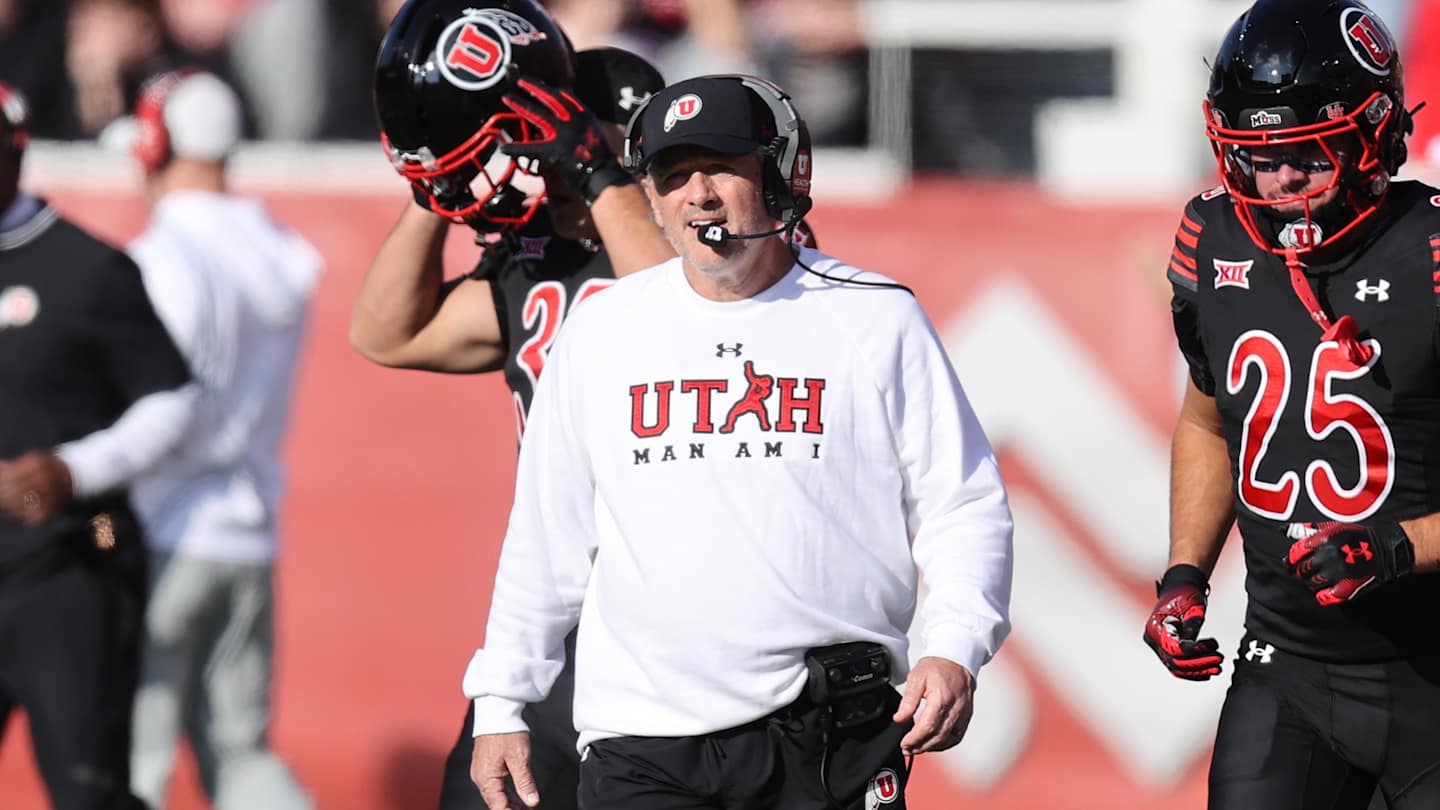
The 2025 regular season for Utah concludes with a pivotal Big 12 matchup with Kansas at David Booth Kansas Memorial Stadium. Looking to keep their conference ti …
The 2025 regular season for Utah concludes with a pivotal Big 12 matchup with Kansas at David Booth Kansas Memorial Stadium.
Looking to keep their conference title and College Football Playoff aspirations alive, the Utes (9-2, 6-2 Big 12) face off against a Jayhawks (5-6, 3-5 Big 12) squad that’s striving to become bowl eligible for the third time in the last four seasons.
Here’s some important numbers to know ahead of Friday’s 10 a.m. MT kickoff (ESPN) from Lawrence, Kansas.
Sitting at 3,076 rushing yards on the season, Utah needs 188 more to break the program’s single-season record of 3,263, set in 1984. The Utes are also two rushing touchdowns away from setting a new single-season benchmark and surpassing the 37 rushing touchdowns the 2022 squad recorded.
Utah ranks No. 2 in the Football Bowl Subdivision with 279.6 yards per game — trailing only Navy (308.2) in that category — while averaging 6.2 yards per carry.
“The offensive line is really the driving impetus behind that,” said Utes head coach Kyle Whittingham regarding his team’s potent ground game. “I mean, we got a really good, athletic quarterback that runs the ball well, Wayshawn Parker’s coming into his own. But without an offensive line that can do the things that our guys have done all year, that stuff doesn’t happen.
Parker, a sophomore transfer from Washington State, has made the most of his recent opportunities with four consecutive 100-plus yard games on the ground. One more from the 5-foot-10 back would be the most since Tavion Thomas’ five 100-yard games during the 2021 campaign.
Parker’s 836 rushing yards paces the Utes’ ground attack, which has also been supplemented by productive seasons from Utah’s dual-threat quarterback tandem in Devon Dampier (637) and Byrd Ficklin (496).
Even with a win Friday, Utah would likely need some outside help in order to make the 12-team playoff. ESPN’s playoff predictor grants the Utes a 17% chance of making the playoff going into their Week 14 game.
Those odds increase with a win over the Jayhawks, though an appearance in Arlington, Texas, for the Big 12 title game would give Utah its best hope at punching a ticket to the playoff.
For that to happen, four scenarios would need to play out over the weekend: the Utes need to beat the Jayhawks; Arizona State has to defeat Arizona; BYU must take care of business against UCF; and (probably the least likely outcome of the bunch) West Virginia has to upset Texas Tech.
Those outcomes would set up a rematch between Utah and BYU in the Big 12 championship game.
Only Oregon and NC State have gotten more receiving touchdowns by tight ends than Kansas, which has 8 touchdowns combined between tight ends Boden Groen and DeShawn Hanika.
Utah gave up a touchdown to Kansas State tight end Garrett Oakley during its porous defensive outing last Saturday, a week after allowing NFL draft prospect Michael Trigg to catch 3 passes for 42 yards in the Utes’ 55-28 win over Baylor.
Here’s a look at where Utah and Kansas rank nationally in other key stats heading into Saturday:
Golden State used all 11 of its active players by the early second quarter in a matchup that was truly a game of runs. Utah began the game up 11-0, and then the Warriors embarked on a 15-3 jolt to …
SAN FRANCISCO – The Warriors had every reason to toss Monday night’s home game against the young, tall and spry Jazz into a growing pile of “scheduled losses.”
After losing three straight, Golden State was without several key members of its frontcourt. Jonathan Kuminga was out with knee soreness for the sixth game in a row. Al Horford (sciatica) will be reevaluated at the end of the week.
Draymond Green was held out with a foot injury sustained during Friday’s loss to the Blazers.
But after going down big early, an energized lineup rallied for a much-needed 134-117 victory thanks to a relentless 21-0 run to begin the second quarter.
Steph Curry scored 29, while Jimmy Butler put in 18 and dished out seven assists. Gary Payton II, starting at power forward, had his best game of the season: Nine points, six rebounds and a career-high eight assists. And the Jazz’s vaunted size advantage? It never materialized. The Warriors outrebounded Utah 48-47. Keyonte George led the Jazz with 28 points, and highly touted rookie Ace Bailey scored a career-high 21.
Golden State Warriors’ Stephen Curry (30) scores a 3-point basket against Utah Jazz’s Lauri Markkanen (23) in the second quarter at the Chase Center in San Francisco, Calif., on Monday, Nov. 24, 2025. (Nhat V. Meyer/Bay Area News Group)
Golden State used all 11 of its active players by the early second quarter in a matchup that was truly a game of runs. Utah began the game up 11-0, and then the Warriors embarked on a 15-3 jolt to answer. And once Utah went on a flurry to end the first quarter up 35-26, Golden State answered.
Keyed by the energetic play of rookie Will Richard, Moses Moody, Pat Spencer, Quinten Post and Butler, the home team outscored the Jazz 21-0 over the first six minutes of the second as Richard’s former Florida teammate Walter Clayton was among the unfortunate Utah bunch caught in the fray.
Golden State led 67-55 at halftime. The Warriors maintained a double-digit lead for the rest of the second half.
The Warriors (10-9) will host the Kevin Durant-less Rockets on Wednesday in the teams’ first matchup since Golden State eliminated Houston from the 2025 playoffs in a seven-game first-round series.
Golden State Warriors’ Jimmy Butler (10) dribbles against Utah Jazz’s Keyonte George (3) in the first quarter at the Chase Center in San Francisco, Calif., on Monday, Nov. 24, 2025. (Nhat V. Meyer/Bay Area News Group)
Kuminga update
The day after telling reporters he did not know Kuminga’s immediate status, Warriors coach Steve Kerr gave a pregame update on the forward who has missed the past six games with knee soreness.
“He got an MRI and it was clear,” Kerr said, later adding. “There’s nothing that’s glaring, but it’s bothering, so it’s just day-to-day.”
DeMarco meets Ionescu
Sabrina Ionescu, left, with her husband Hroniss Grasu, far left, chats with Golden State Warriors assistant coach Chris DeMarco before the Warriors game against the Utah Jazz at the Chase Center in San Francisco, Calif., on Monday, Nov. 24, 2025. (Nhat V. Meyer/Bay Area News Group)
Warriors assistant Chris DeMarco is expected to sign a contract to become the New York Liberty’s next coach, and the team’s biggest star was in the building and seen chatting with him pregame.
Ionescu is from Walnut Creek and was the Bay Area News Group’s girls high school basketball player of the decade for her unparalleled career at Miramonte High School in Orinda in the mid-2010s..She was a key figure on the USA’s gold medal-winning team in summer 2024 and helped lead New York to the WNBA title a few months later.
Utah quarterback Byrd Ficklin (15) celebrates with teammates Otto Tia, left, and Jaren Kump, right, after scoring a touchdown during the second half of an NCAA college football game against Kansas …
If ever there were a time for a Kumbaya moment between the two biggest college fan bases in the state of Utah, it would be now.
It’s never going to happen. A cease fire in the Holy War, the nickname for the vitriolic BYU-Utah rivalry, wouldn’t hold for even a second.
But wouldn’t it be neat if both sides could step back, show a little Beehive State pride and appreciate what the other side is doing on the football field this year? (Apologies to BYU and Utah fans who spit out their coffee while reading that sentence.)
This is the third straight week and ninth ever that the Cougars and Utes have been in the top 15 of The Associated Press poll simultaneously.
BYU is 10-1 and ranked No. 11. Utah is 9-2 and No. 14. Both have lost to Texas Tech. Utah’s other loss was to, well, you know who.
Still, this could turn out to be the best collective season for the schools in their more than 100 years of gridiron pursuits. The standard, to date, is 2008 when Utah beat Alabama in the Sugar Bowl to finish 13-0 and No. 2 in the poll and BYU started 10-1 before losing to the Cougars and in their bowl to end 10-3 and No. 25.
This year, if Utah wins one more game, both schools would have double-digit victories in the same season for the first time since 2021 and fifth time ever.
BYU linebacker Jack Kelly (17) gestures to the crowd during the second half of an NCAA college football game against TCU, Saturday, Nov. 15, 2025, in Provo, Utah. Credit: AP/George Frey
BYU will lock up a spot next week in the Big 12 championship game if it beats UCF at home Saturday. The Cougars could still get in even if they lose. Their first College Football Playoff bid is at stake if they can get to Arlington, Texas, and win, probably in a rematch with Texas Tech.
Utah, which finishes the regular season at Kansas, was No. 12 in the CFP rankings last week and could get docked for needing a Houdini act to get past a Kansas State team that rushed for 472 yards. The Utes are all but out of the Big 12 race and their CFP hopes are teetering, but an attractive bowl is there for the taking.
Lifelong Utahan Dick Harmon knows as well as anyone that the fan bases’ mutual disdain will never evolve into mutual respect. Harmon graduated from BYU and has covered Cougars sports for four decades for the Deseret News of Salt Lake City. He said there are good fans on both sides but they are drowned out by those who spew hatred.
“The fact they’re both in the top 15, that just causes everybody to have their own reasons for one-uppance on the other,” Harmon said Sunday. “Utah fans lost to BYU but they certainly feel because they’re scoring a million points a game that they should be right there, if not even ahead, of BYU. Their loss to BYU was close and maybe a fluke and should have gone the other way the last two years. It’s just back and forth all the time.”
Utah quarterback Byrd Ficklin (15) celebrates with teammates Otto Tia, left, and Jaren Kump, right, after scoring a touchdown during the second half of an NCAA college football game against Kansas State, Saturday, Nov. 22, 2025, in Salt Lake City. Credit: AP/Tyler Tate
Harmon, channeling BYU fans’ take on Utah, said, “Geez, look, you gave up a school-record (472) yards rushing to a bad Kansas State team. And we beat you and it should have been 24-14 or 17, not 24-21, if only this, if only that. We beat you a lot further than you think we did.”
For their part, Utah State fans are quietly enjoying what potentially will be their best season since the Aggies went 11-3 in 2021. Utah State is 6-5 and bowl eligible. And in case you were wondering if the Aggies, Cougars and Utes have ever been ranked at the same time, it happened once. Utah was No. 12, BYU was No. 19 and Utah State was No. 24 in the final 2021 poll.
Loquacious Lanning
Oregon coach Dan Lanning took a not-so-veiled shot at the SEC in his remarks following the Ducks’ 42-27 win over Southern California. While Oregon and the rest of the Big Ten were in the throes of conference games, three SEC teams played FCS opponents and three played Group of Five opponents. The SEC will begin playing nine conference games rather than eight next year.
“Played a good team. We beat them, right? All we can do next week is try to do the same thing, right? This conference is a really good conference. It’s competitive,” Lanning said. “We didn’t play Chattanooga State today, right? Like some other places. We competed.
“That being said, it’s tough playing nine conference games. It’s tough playing in this league. And we got to take advantage of playing a good team today and attacking that.”
Role reversal
Last year, Tennessee went to Nashville needing a win over Vanderbilt to secure a CFP at-large bid. This week, the Commodores go to Knoxville needing a win over Tennessee to keep alive its CFP at-large hopes. Vandy also would secure its first 10-win season with a victory.
Coach Clark Lea said he wants his team thinking only about the Volunteers, not what it will take to get a playoff spot. Lea did offer a tell about what he’s thinking when he was asked about quarterback Diego Pavia asking to stay in the game against Kentucky after it turned into a blowout Saturday.
“I said, ‘No, we’re aiming for a championship. I want you healthy for the playoffs.’ “
Extra points
No. 1 Ohio State’s 15-game win streak is longest in the Bowl Subdivision. The Buckeyes have held seven of their 11 opponents this season under 10 points. … No. 2 Texas A&M, with its 48-0 win over Samford, finished 7-0 at home for the first time. It was the first time A&M, excluding the 2020 pandemic season, was unbeaten at home since going 6-0 in 1999. … Notre Dame RB Jeremiyah Love is just the third player since 1996 to run for 170 or more yards and three touchdowns on just eight carries. Love, who had 178 yards and three TDs against Syracuse, is the first to do it since Cincinnati’s Desmond Ridder against SMU in 2020.
___
AP Sports Writer Teresa M. Walker in Nashville, Tennessee, contrubuted to this report.
Only a day after decommitting from UCF, Greenwood (Ark.) quarterback Kane Archer pledged to Utah following a weekend visit, telling Rivals’ Hayes Fawcett about his decision.
Advertisement
Advertisement
Advertisement
A three-star prospect rated 0.8711 in the 247Sports composite rankings, Archer is the No. 971 overall player and the No. 53 quarterback nationally in the 2026 cycle. In his home state, the 6-foot-1, 205-pound dual-threat signal-caller ranks as the No. 16 recruit and the No. 12 player overall in Arkansas. The senior holds 24 scholarship offers, including from Michigan, Florida State, Tennessee, Texas A&M, Ole Miss, and his home-state Razorbacks.
Greenwood High’s football program has benefited greatly from Archer’s contributions. The Bulldogs are 11-0 this season and are two games away from claiming their third consecutive Arkansas 6A state championship, with a semifinal matchup against Benton High coming up. In the last three seasons, Greenwood has compiled a 37-0 record. Massey Ratings currently rank Greenwood as the No. 3 team in Arkansas.
Individually, Archer’s production has been exceptional. This season, he has completed 242 of 321 passes for 2,959 yards, 26 touchdowns, and four interceptions, while rushing 113 times for 1,022 yards and 24 touchdowns. His junior campaign in 2024 saw him complete 247 of 303 passes for 3,880 yards, 57 touchdowns, and two interceptions, along with 795 rushing yards and 10 touchdowns.
Over his high school career, Archer has started 43 games, throwing for 9,947 yards with 125 touchdowns against just 12 interceptions. On the ground, he has amassed 2,605 yards and 54 touchdowns, including 11 games with 100-plus rushing yards.
Advertisement
Advertisement
Advertisement
Archer will join Utah’s 2026 class as the second quarterback, alongside three-star signal-caller Michael Johnson from Douglas County High in Georgia. Utah’s class currently features 16 verbal commitments, with 11 on offense. The offensive group is featured by five-star offensive tackle Kelvin Obot, the highest-rated prospect in Utah history, and includes wide receivers Jaron Pula and Kennan Pula, running back LaMarcus Bell, and tight end Bear Fisher. The defensive group includes linebacker Preston Pitts, linebacker LaGary Mitchell, cornerback Major Hinchen, and cornerback Dylan Waters, among others.
The Oregon Ducks women’s basketball team looked to remain undefeated with the Utah State Aggies coming to town for a non-conference match-up. Here is how it went down. The Ducks got off to a hot start …
The Oregon Ducks women’s basketball team looked to remain undefeated with the Utah State Aggies coming to town for a non-conference match-up. Here is how it went down.
The Ducks got off to a hot start starting the game on an 8-0 run to set the tone early.
The Aggies would push back though as they finished the 1st quarter on a 9-6 run to keep themselves into the game.
Advertisement
Advertisement
Advertisement
The 2nd quarter would be back and forth with neither team going on a substantial run but Janiyah Williams would hit a pull up jumper in transition to start to extend the Ducks lead.
The Ducks would finish the 2nd half strong and take a 12 point lead into half-time.
After the break the Ducks came out on fire. Hitting their first 6 shots of the 2nd half and going on a 16-2 run, highlighted with this steal by Ari Long which lead to a Katie Fiso lay-in.
The Ducks would take a very comfortable 55-26 lead into the 4th quarter where from there it was elementary. The final score would finish at 70-34.