Utah redistricting efforts face court order

The Utah congressional map must be redrawn ahead of the 2026 midterms, a judge has ruled. CBS News’ Hunter Woodall explains.

Howard Stern dug up old footage to refute a claim made by Kim Kardashian, in which she accused him of casting doubt on the authenticity of her 2016 robbery. On the latest episode of The Kardashians, the reality star, 45, recalled the shock jock “was famously mocking it all the time and saying that I […]

Source: Utah News

University of Utah aims to boost athletic revenue through private-equity partnership

The University of Utah has announced a plan to help the athletic department generate new revenue streams, in part through a first-of-its-kind partnership with a private equity firm. The school …

SALT LAKE CITY (AP) — The University of Utah has announced a plan to help the athletic department generate new revenue streams, in part through a first-of-its-kind partnership with a private equity firm.

The school announced Tuesday the formation of Utah Brands & Entertainment LLC, which will be owned by the university’s foundation. It’s being touted as a way to built the school’s brand and enhance the athletic programs. The new company could generate around $500 million in capital, according to Yahoo Sports.

Advertisement

In a joint message, school president Taylor Randall and athletic director Mark Harlan spelled out the groundwork, saying the university will transfer some of its revenue-generating operations from athletics and auxiliary services to Utah Brands & Entertainment.

Through the new entity, the school will build its brand. That will include overseeing corporate sponsorships, ticketing, event-related revenues and campus-wide university trademarks and licensing.

The new business model has the backing of the university’s board of trustees and the deal could be finalized by early next year. The school added it plans to partner with prominent university supporters along with Otro Capital, a private equity firm with a sports and entertainment background.

The inclusion of private equity is a first in college sports, and it follows seismic changes in the industry, with players able to earn money from their name, image and likeness and receive direct payments from schools.

Advertisement

“Importantly, the university is not selling parts of our athletics department, ceding operational control to a third party or relinquishing control of any facilities,” Randall and Harlan wrote to the Utah community. “Decisions regarding sports, coaches, scheduling, operations, student-athlete care and other athletics matters will remain solely with the athletics department. … The university’s foundation will appoint a majority of the board of directors of Utah Brands & Entertainment, and the board will be chaired by the athletics director.”

The message from Randall and Harlan said that “as the world of college athletics continues to shift, this step positions us to remain competitive, innovative and firmly aligned with our academic mission, while continuing to unite our community through the power of Utah athletics.”

___

Get poll alerts and updates on the AP Top 25 throughout the season. Sign up here and here (AP News mobile app). AP college football: https://apnews.com/hub/ap-top-25-college-football-poll and https://apnews.com/hub/college-football

Source: Utah News

Utah reportedly enters landmark private equity agreement raising half a billion dollars

Utah reportedly enters landmark private equity agreement raising half a billion dollars originally appeared on The Sporting News. Add The Sporting News as a Preferred Source by clicking here. The …

Utah reportedly enters landmark private equity agreement raising half a billion dollars originally appeared on The Sporting News. Add The Sporting News as a Preferred Source by clicking here.

The University of Utah is finalizing a private equity partnership that would be the first of its kind in college athletics.

Advertisement

The Utes administration is set to enter into an agreement with New York-based firm Otro Capital that will help generate an estimated $500 million for the school, per an announcement Tuesday. The deal is expected to be finalized early next year. This was cleared by the NCAA, according to Yahoo Sports’ Ross Dellenger.

Utah President Taylor Randall and Athletic Director Mark Harlan must reportedly retain majority decision-making control to remain compliant in the deal, at least in this case, per NCAA rules.

With the groundbreaking deal comes the creation of a for-profit entity, Utah Brands & Entertainment LLC, which will exist as an independent entity from Utah’s athletic department. It will be a co-owned venture by the university and Otro Capital.

UB&E will oversee the revenue-sharing efforts with Utes athletes. Harlan will be acting chair of its board. There will be a president added from outside the university in the coming weeks. Between the investments from donors and a nine-figure deal with Otro Capital, Utah could raise more than $500 million, showing a model of sustained success in the revenue-sharing era of college athletics.

Advertisement

Utah becomes the first school to embrace private equity. The university is also the first to ink a partnership with a capital firm. However, expect this trend to continue in college athletics. The rapidly changing landscape will allow more creative ways to boost revenue. This is an essential change and will be watched closely for proof of concept.

Entire conferences brought proposals to the table. According to CBS Sports, the Big 12 considered an option that could have raised up to $1 billion for the league in exchange for 20% ownership but decided against it. The Big Ten is in the middle of similar discussions, but not all of its schools are on board with what could be a $2 billion deal.

The more revenue a school’s athletic department generates, the more it can allocate to its athletes. That is the new reality in the wake of the House settlement.

If Utah’s model proves successful, private equity investments will almost certainly be used often by many universities.

Advertisement

More college football news:

Source: Utah News

University of Utah Health research funding reaches record $531M in 2025

University of Utah Health this year achieved record research funding totals, surpassing the half-billion mark for 2025, reaching $531 million.

University of Utah Health has amassed record research funding totals, surpassing the half-billion mark for 2025, reaching $531 million.

“Securing competitive funding is essential to the University of Utah’s mission of delivering exceptional societal impact. These investments fuel research, advance knowledge, improve health in Utah and worldwide and support the training of future scientific leaders,” the U. said in a statement.

The National Institutes of Health was once again the largest source of funding support, providing $264.1 million.

That chunk comes despite the NIH cutting billions of dollars in research projects under the Trump administration, a move U. President Taylor Randall described in February as an “imminent threat” to the university’s mission as a research institution.

Bob Carter, senior vice president for health sciences and CEO of University of Utah Health, said, “Research, innovation and advancing knowledge is an uncompromising part of who we are as an institution, a culture and a nation,” when the cuts were announced.

Challenges to NIH’s attempted cuts to funds known as “indirect costs” of medical research are currently making their way through the courts.

Carter added that in Utah, National Institutes of Health funding supports over 45,000 jobs and nearly $785 million in economic activity.

Still, the U. secured the bulk of its funding from the NIH, with industry partnerships making up the second-largest funding category at $99 million.

Other federal agencies like the Centers for Disease Control and Prevention, Environmental Protection Agency, and Department of Defense contributed $57.4 million, and additional contributions from the state, other universities and various foundations totaled $110.7 million.

Dr. Rachel Hess, system chief research officer for University of Utah Health, said faculty submitted $2.3 billion in research proposals in 2025 — a $500 million increase compared to the previous year and a testament to the perseverance of the research community.

Notably, research in the health sciences sector continued its rise, growing 24% over the past five years and more than doubling since 2014.

This year, health sciences funding accounted for 68% of the university’s total research portfolio that totaled $782 million, the university said.

Source: Utah News

See where Utah ranks on GoFundMe’s list of most generous states in 2025

Utah was one of GoFundMe ‘s most generous states of 2025, the global crowdfunding platform revealed Tuesday. The Beehive State ranked 10th in the company’s 2025 Year in Help report, which analyzed …

Utah was one of GoFundMe‘s most generous states of 2025, the global crowdfunding platform revealed Tuesday.

The Beehive State ranked 10th in the company’s 2025 Year in Help report, which analyzed data from Dec. 4, 2024, to Dec. 2 of this year. Utah’s ranking was calculated based on the percentage of repeat donors.

California was the nation’s most generous state.

The report also listed some of Utah’s most notable fundraisers from the past year. One raised over $438,000 for the family of late Utah fashion designer Arthur Folasa Ah Loo, who was killed during the June “No Kings” protest in Salt Lake City, while another generated more than $80,000 to give an 8-month-old baby who was killed in a West Valley City shooting a “proper farewell.”

Here’s how Utah showed up in 2025:

• Utahns made more than 330,000 donations to individuals and nonprofits through GoFundMe.

• Donations exceeded $30.7 million.

• Fundraisers for charities increased by nearly 2.5 times.

• The categories of Charity, Competitions and Monthly Bills were the fastest-growing in 2025.

• GoFundMe’s most generous donor is from Utah — an individual who gave more than 1,200 times.

• Fundraisers to help Utah businesses grew by 25%.

Here are the 10 most generous states, according to GoFundMe’s report:

  1. California.
  2. Vermont.
  3. Alaska.
  4. Oregon.
  5. New York.
  6. Minnesota.
  7. Maine.
  8. Washington.
  9. Massachusetts.
  10. Utah.

Source: Utah News

When does Nebraska play Utah in the Las Vegas Bowl?

The Nebraska Cornhuskers (7-5) have accepted an invitation to play in the 2025 SRS Distribution Las Vegas Bowl.

The Nebraska Cornhuskers (7-5) are playing in the postseason for the second year in a row. The Huskers have accepted an invitation to play in the 2025 SRS Distribution Las Vegas Bowl.

Nebraska will face the Utah Utes (10-2) at Allegiant Stadium on Dec. 31. Kickoff is scheduled for 2:30 p.m. CT on ESPN.

Advertisement

This is Nebraska’s first-ever appearance in the Las Vegas Bowl and the 55th bowl game in school history. The Huskers are 27-27 all-time in the postseason.

This will be the fifth time that Nebraska and Utah have played. The Huskers are 4-0 with all four games taking place at Memorial Stadium.

Utah enters the game with one of the top offenses in the nation. The Utes rank second in the nation in scoring offense at 41.1 points per game and sixth in the nation in total offense with an average of 478.6 yards per game.

The rushing offense averages 269.8 yards per game and 6.1 yards per carry. The Utes will face a Nebraska defense that struggled against the run this season, surrendering 171.2 yards per game and 4.8 yards per carry.

Advertisement

Contact/Follow us @CornhuskersWire on X (formerly Twitter) and like our page on Facebook to follow ongoing coverage of Nebraska news, notes and opinions.

This article originally appeared on Cornhuskers Wire: When does Nebraska football play Utah in the Las Vegas Bowl?

Source: Utah News

Bridging borders: How Utah leaders are making commercial, cultural strides in Peru

Beehive State lawmakers and business leaders tout new direct Delta flight from Salt Lake City to Lima as a pivotal moment …

KEY POINTS

  • Utah lawmakers and business leaders connected with Peruvian counterparts this week.
  • The Utah trade mission in Peru happened in conjunction with the recent launch of Delta’s direct flights between Salt Lake City and Lima.
  • Utah Senate President Stuart Adams was honored by Peru’s Congress.

LIMA — For nearly two centuries, the United States has enjoyed diplomatic relationships with Peru.

But events in recent days are penning a defining chapter in bilateral relations between the two regions — particularly for Utah.

On Thursday, a delegation of high-ranking, bipartisan Utah government and business leaders joined scores of Peruvians and Peruvian Americans (including many living in the Beehive State) on Delta Air Lines’ inaugural direct overnight flight from Salt Lake City to Lima.

The Utah delegates arrived in Lima early Friday, a bit bleary-eyed — but with clear vision of the possibilities from the unique business trip.

Delta Flight 193 marks the first time an airline is offering nonstop commercial flights from Salt Lake City to a South American destination — even while signaling emerging market momentum between Peru and Utah.

Sen. Scott Sandall, R-Tremonton, left, networks with Peruvian trade mission participant and World Trade Center Utah CEO and President Jonathan Freedman, far right, during Dec. 5, 2025, reception in Lima, Peru. | Jason Swensen, Deseret News

“This is an opportunity to do what’s best for Utah,” Utah House Minority Leader Angela Romero, D-Salt Lake City, told the Deseret News.

“I’m happy to be here in Peru with the World Trade Center Utah (WTC-Utah) and others to have these conversations and to make it a more intimate partnership.”

There’s already a long list of export/import items waiting to be better developed through strengthened partnerships — including agricultural products such as blueberries, asparagus, mangos, cacao and coffee, according to WTC-Utah President and CEO Jonathan Freedman.

The Utah delegation is also hoping to optimize opportunities in Peru in mining areas such as critical minerals, mining equipment and explosives and textiles such as high-quality Pima cotton being harvested in Peru.

Logistically, Peru also offers a prized supply chain advantage. Time-sensitive products can be shipped from the western South American nation to the U.S. West Coast in four days, port to port.

Bipartisan lawmakers to Peruvians: ‘Utah’s open for business’

Utah Senate President Stuart Adams, center, is honored by Peru’s Congress on Dec. 5, 2025, in Lima, Peru. He stands between Peruvian lawmakers Fernando Rospigliosi, left, and Eduardo Salhuana, right. | Jonathan Freedman

Romero is joined here by a politically diverse group of Utah lawmakers — including Senate President Stuart Adams, R-Layton, Senate Minority Leader Luz Escamilla, D-Salt Lake City, Sen. Scott Sandall, R-Tremonton, and others.

Meanwhile, Jefferson Moss from the Governor’s Office of Economic Opportunity also traveled to Peru on Delta Flight 193.

The Utah/Peruvian business trip, noted Romero, “is really important to my constituency where people of color are the majority — and 50% of my district is Latino.

“Many of those people within my district own small businesses, so I wanted them to know I’m just as invested in them. … The message I want to send here (in Peru) is: We’re here. We’re a community. We work together.”

At a reception Friday in Lima’s bustling San Isidro business district, the Utah delegation networked across a crowded reception room filled with Peruvian government and business officials.

Joan Perkins, the chargé d’affaires at the United States Embassy in Peru, saluted the Beehive State visitors.

“Your presence underscores Utah’s commitment to strengthening our bilateral relations — which is really important to us at the embassy — in building commercial partnerships and expanding mutual economic opportunities.”

A “Peru” holiday display greets visitors to the Plaza Mayor in Lima, Peru, on Dec. 6, 2025. | Josefina Muñoz Swensen for the

Perkins noted that next May the two nations will celebrate their bicentennial of bilateral relationships. Aviation has long been a key link fortifying those connections.

Now Delta’s new SLC-Lima flight marks another leap forward.

“Lima has been a sought-after destination for travelers connecting through Salt Lake City — and the launch of this nonstop service fills a very important gap,” said Perkins.

“The direct connection is going to make it easier than ever before for business and leisure travelers to connect through the Western United States — including people traveling from cities like San Francisco, Portland, Denver and Las Vegas, to reach Peru with efficient one-stop connections.”

Approximately 600,000 U.S. citizens travel to Peru each year — the Andean nation’s second-largest source of tourists.

“This (Delta flight) collaboration is so important because it opens the door to increased commerce and investment between our countries,” said Perkins.

“This launch also reinforces the impact of the U.S. private sector and how it has the power to shape partnerships and generate mutual economic prosperity.”

Linking two hubs: Salt Lake City and Lima

Nighttime image of the San Isidro section of Lima, Peru. | Josefina Muñoz Swensen for the

Juan Pablo Guerrero of Peru’s Ministry of Foreign Affairs office said the new Delta flight and the Utah trade delegation tells the story of two hubs.

“Salt Lake City is positioning itself as an economic, technological and logistics hub in the Western United States — just as Lima has become a key hub for trade within South America and between South America and Asia,” Guerrero said.

Peru, the U.S. and Utah share fundamental values such as democracy, hard work, free trade, the rule of law and perhaps most importantly, strong people-to-people ties across the Americas, added Guerrero.

Utahns, including many from the Latter-day Saint community, have demonstrated solidarity with Peru over many years — especially in times of need.

“As we explore a concrete path to expand trade and investment through mutually beneficial initiatives in infrastructure, mining, agriculture, energy and tourism, Peru firmly believes there is significant potential to deepen business relations between our leading companies,” he added.

Guerrero also pointed to the recent opening of Peru’s consulate general in Salt Lake City as “a clear expression of our commitment to strengthening political and economic and social engagement at a higher level, reflecting the importance we attach to our ties with Utah.”

Peru’s Congress lauds Utah’s Senate leader

Utah’s ranking state senator, Adams, thanked Delta for launching Salt Lake City’s first-ever direct commercial flight to South America — and for the welcome the Utahns received during their Peru trip by legislative counterparts in the Peruvian government.

Adams was honored Friday by the Peruvian Congress.

Fernando Rospigliosi, Peru’s acting President of Congress, presented Utah’s Senate president with the Medal of Honor of the Congress of the Republic in the rank of Grand Cross for his civic service and work to strengthen global partnerships.

The honor is awarded to Peruvians and international figures such as heads of state making significant contributions to culture, politics or development.

In his remarks, Adams noted “a different feeling” during his first visit to this South American nation.

“Being in Peru is different,” he said. “I’ve been able to feel a spirit here that is different. I’m so glad I came because there’s a spirit here that reminds me a lot of Utah.”

Adams then touted Utah, saying it has “the best business environment of all 50 states.”

The state, he said, offers global opportunities in mining and critical mineral and other economic endeavors.

Both Peru and Utah, he added, boast natural beauty that draw tourists from across the globe.

“We have five national parks in Utah. People come from all over the world to see those parks. But Peru is also beautiful — and Utahns and people in the Western United States want to come here.

“Because of this flight, people will be able to come to Utah from South America — and from South America to Utah.”

‘Building bridges between Utah and the world’

A heroic-sized statue of Peruvian liberator José de San Martín presides over San Martín Square in Lima, Peru, on Dec. 6, 2025. | Josefina Muñoz Swensen for the

In his remarks, Moss noted the bipartisan collection of Utah lawmakers connecting with their Peruvian counterparts. He said Utahns are committed to working together to make the world a better place.

“And we feel a similar environment when we come to Peru,” he said.

Utah’s economy, added Moss, is the best in the nation — citing data provided by U.S. News & World Report.

“Over the last three years in a row, Utah has been ranked No. 1,” he said. “We’re the youngest economy. We’re the fastest economy. There are a number of factors that make Utah a really good place to do business.”

World Trade Center Utah chief Freedman said the Salt Lake City-based organization “builds bridges between Utah and the world.”

He also noted that Utah’s government leaders — including those represented in the Peruvian trade mission delegation — make it easy to do business.

Freedman thanked Delta for their historic call to offer the SLC-to-Lima direct flight. That flight will benefit tourists and individuals doing business in those respective communities. But that flight also created new opportunities for shipping freight.

“(We) saw today blueberries and grapes and asparagus and mangoes all get loaded onto that first nonstop Delta flight to Salt Lake City,” said Freedman.

“We are thrilled to have Peruvian produce in Utah.”

Such cargo shipments, he added, also produce a “magnifying effect” — benefiting both communities.

“Because we have other Delta nonstops from Utah, those blueberries are going to, say, Amsterdam. That asparagus is going to Paris. Those mangoes are going to Seoul, Korea,” said Freedman.

“We connect throughout North America, Asia, Europe. Delta and Utah are helping Peruvian companies expand their footprint globally.”

While scanning the collection of Peruvian and Utah government and business leaders gathered together, Sandall marveled at the possibilities that await.

“Fifteen to 20% of our population in Utah speak Spanish — and that’s important,” said Sandall, who learned the language while serving a Latter-day Saint mission in Venezuela.

“We want to be partners. We want to connect in 8½ hours. We want to do this thing. … We’re ready to do business.”

Source: Utah News

NBA Trade Rumors: Indiana Pacers have interest in this Utah Jazz player

According to Ben Anderson of KSL, the Indiana Pacers have interest in Walker Kessler. On the most recent episode of the Jazz Notes podcast, he talked about what he’s heard about the Utah Jazz center.

According to Ben Anderson of KSL, the Indiana Pacers have interest in Walker Kessler. On the most recent episode of the Jazz Notes podcast, he talked about what he’s heard about the Utah Jazz center.

From Anderson

“I’ve heard the Indiana Pacers have inquired about Walker Kessler for a long time …. a lot. That’s going back to the summer, they’ve lost Myles Turner… before the injury and even after the injury… This is no one with the Jazz but other people who have similar jobs to me have heard similar things.”

It’s an interesting revelation and something that makes sense for the Pacers. What adds more interest is that Utah was unable to reach a contract resolution with Kessler last offseason. Yes, the Jazz can match any offer for Kessler because he’s a restricted free agent, but it’s a shaky situation. There could be some teams out there willing to test Utah’s resolve with a huge contract that Utah might now want to match.

Advertisement

In the end, this all boils down to interest in Kessler from the Pacers. But because of the situation the Jazz are in, you can see motivation for something if they wanted to. Could Utah potentially be interested in one of the Pacers’ young players, like Jarace Walker? Or maybe the Pacers might be interested in trading their pick if it doesn’t jump into the top four of the lottery. We have heard that Utah wants to be competitive next season so they may want a good player in return. Would that mean someone like Andrew Nembhard?

What do you think? Is there anything that would interest you from the Pacers enough to trade them Walker Kessler?

Source: Utah News

What the sides told the Utah Supreme Court during oral arguments over the Heber Valley Utah Temple

Attorney for Latter-day Saints asks Utah Supreme Court to remove an injunction that halted construction during opponents’ pending appeal …

The Church of Jesus Christ of Latter-day Saints asked the Utah Supreme Court on Monday to lift the injunction that halted construction of the Heber Valley Utah Temple while four men appeal the dismissal of their lawsuit seeking to stop it permanently.

If the court refuses to lift the injunction during the appeal, the attorney representing the church asked the justices to increase the bond the men posted to protect the church during the appeal from $10,000 to at least $7.5 million.

That would cover the likely increase in the cost of construction supplies if work was halted for 12 months, said David Jordan, the attorney who represented the church.

Jordan told the court during oral arguments Monday afternoon that an 18-month delay is estimated to cost the church $11.4 million. He asked for a ruling instituting a bond for that amount if the appeal runs that long and the church prevails.

The church began construction in late August, a month after a district judge gutted a lawsuit by four men seeking to overturn the approval of the temple’s location by the Wasatch County Council.

The men appealed their case to the Utah Supreme Court in September. Days later, the same district court judge who had ruled against them last summer granted the men an injunction to stop the temple’s construction while the Supreme Court considers the appeal.

That could take a year or more. The appeal is still in its earliest stages. Neither side has filed briefs, and it is expected that oral arguments won’t be scheduled for months.

“It’s some months down the road before all the briefing is done,” Jordan said. “We anticipate a decision from this court on the ruling regarding the injunction much sooner.”

Jordan told the Supreme Court justices that the church is confident it will win the appeal. He said the church is willing to assume all risks that might happen if it continues construction and the court eventually rules for the four men — Bruce Van Dusen, Bruce Quade, Shawn Savarinos and Dominic Savarinos.

That includes the possibility the church would have to demolish the temple if the Supreme Court eventually ruled against it, Jordan told the justices.

Of course, if it lost, the church first would seek to correct whatever flaws the Supreme Court might find in Wasatch County’s process or the church’s proposal to the council to build the temple, Jordan said.

An attorney representing Wasatch County sat with the church’s attorneys at their table during Monday’s hearing.

Chief Justice Matthew Durrant and Justice Jill Pohlman have recused themselves from the case. They were replaced by Utah Court of Appeals Judge David Mortensen and Second District Judge Camille Neider.

Justice Paige Petersen acted as chief justice. She was joined by Justice Diana Hagen and new Justice John Nielsen on his first day of oral arguments.

All five each asked questions of both Jordan and Robert Mansfield, who represented the four petitioners.

A map of the Heber Valley Utah Temple site.
A map of the Heber Valley Utah Temple site. | The Church of Jesus Christ of Latter-day Saints

Many of the questions were technical, about whether the Supreme Court should use Rule 8 or Rule 62 of the state’s rules of civil procedure to determine whether Third District Court Judge Jennifer Mabey correctly issued the injunction against construction.

Many of the justices wanted to know if they needed to remand the case back to Mabey if they ruled in the church’s favor on the injunction or if they could rule on their own.

“The court wanted to consider what would be the appropriate standard of review in this case and what elements should be used in order to determine whether the trial court’s decision was or was not correct,” Mansfield told the Deseret News.

Mansfield asked the justices to uphold Mabey’s injunction and reject the request for a larger bond.

He said after the hearing that the case includes a number of novel legal questions the Supreme Court has not considered or decided.

“These are issues that have not been presented to the Supreme Court previously, and so these are factors that they’re going to have to weigh in on and let us know what those standards are,” Mansfield said.

“There’s a lot of issues of first impression in this whole case,” he added, “and I think that’s primarily the reason why the Utah Supreme Court retained jurisdiction of this case. They want to opine on those factors.”

One justice asked if the four petitioner’s would meet the larger bond if it were imposed. Mansfield said he would have to confer with his clients if that happened.

He called it a significant and impractical amount during the hearing, then went farther outside the court chambers.

“Candidly,” Mansfield said, “that would likely be an overly restrictive number that, from a practical point of view, just may not be feasible, but we’ll have to wait and see what the court says and what they do.”

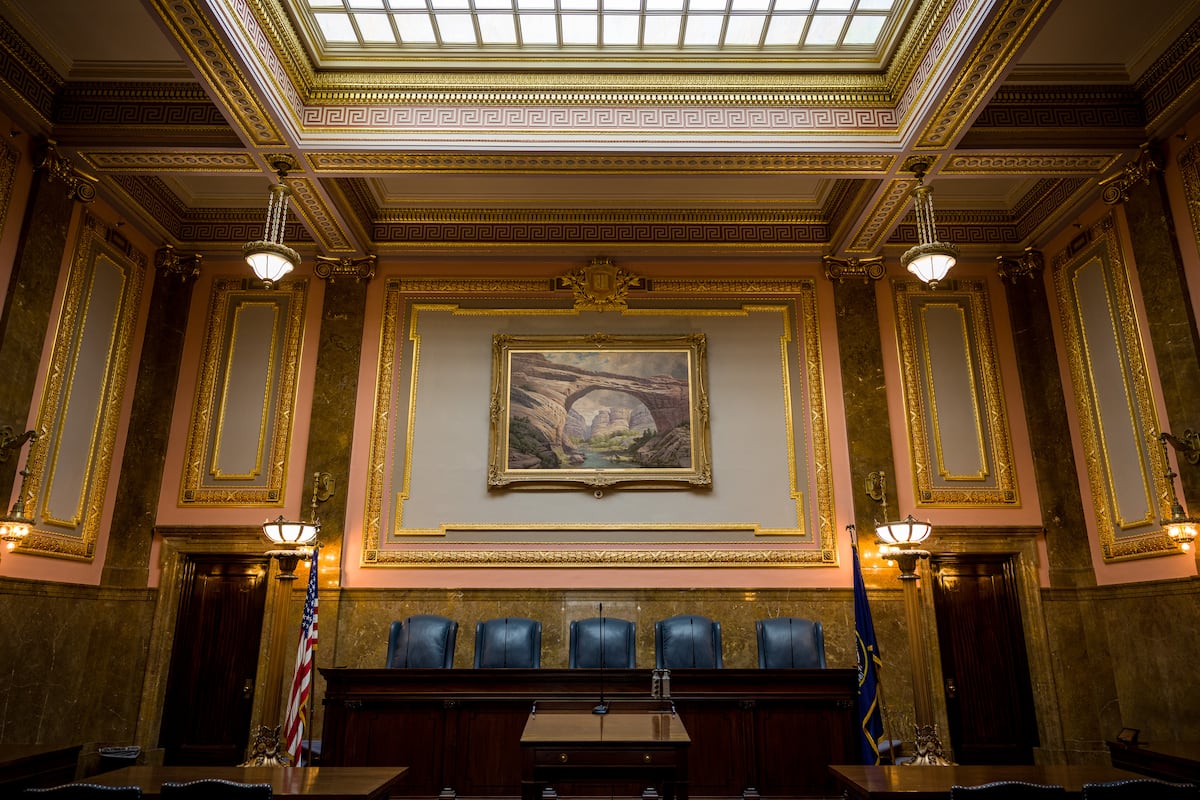
Fewer than 25 people attended the hearing, including the petitioners and church representatives. The justices sat in tall leather chairs in front of the 19-foot-tall mural “Capitol Reef.”

Mansfield and Jordan separately made their arguments at a pulpit between the attorneys’ tables.

Mansfield said allowing construction to continue jeopardized the water table. He said the site is a flood plain and that the church would redirect 1 million gallons of water a day during construction. Construction would permanently redirect 750,000 gallons a day once the temple is complete.

Jordan said Wasatch County considered the environmental impact and approved the plan. Mabey found in her July ruling that the county council’s decision was legal.

President Russell M. Nelson and his wife, Sister Wendy W. Nelson; and Elder Kevin R. Duncan and his wife, Nancy, are joined by residents in turning over the soil at the groundbreaking of the Heber Valley Utah Temple ceremony on Saturday, Oct. 8, 2022.
President Russell M. Nelson and his wife, Sister Wendy W. Nelson, and Elder Kevin R. Duncan and his wife, Nancy, are joined by residents in turning over the soil at the groundbreaking of the Heber Valley Utah Temple ceremony on Saturday, Oct. 8, 2022. | Scott G Winterton, Deseret News

President Russell M. Nelson announced plans to build the temple during the October 2021 general conference. The First Presidency announced the temple’s location in September 2022.

Protesters picketed across the street when President Nelson dedicated the site at a groundbreaking ceremony in October 2022.

“We pray that the construction of this temple may be completed to accommodate thy divine purposes,” he said.

The county council determined the church’s proposal for the temple met its land-use rules and enacted an ordinance for construction in November 2023.

The four men sued Wasatch County, alleging that the county council broke Utah and federal law when it allowed the temple’s construction.

The church said it voluntarily postponed construction at that stage to allow a judge to review the lawsuit.

Save Wasatch Back Dark Skies attempted to reverse the Wasatch County Council’s unanimous approval of the temple by adding a referendum to the 2024 general election ballot. The effort required 3,235 signatures but fell 25% short of that number.

In a hearing on June 2 this year, Wasatch County argued the men didn’t have standing to sue, but Mabey ruled the following month that they did.

It was the only argument the men won. Mabey ruled for the county on every other issue, clearing the way for construction, pending appeals.

The temple project combines two lots for a total of 18.17 acres. Plans call for a footprint of 26,089 square feet. The proposed temple would have three floors, for a total of 87,626 square feet.

Source: Utah News

Trump-aligned group paying out-of-state signature gatherers in bid to undo Utah’s new House map

The Utah GOP is using out-of-state signature gatherers paid with funds from a D.C.-based “dark money” group in their effort to repeal Utah’s new congressional map.

As Republican-dominated states like Texas and Virginia, pressed by President Donald Trump, redraw their congressional boundaries to shore up a GOP majority in the U.S. House of Representatives, a Trump-affiliated dark money group is paying to deploy out-of-state signature gatherers to Utah in hopes of rescinding a court-imposed map that could yield a seat for Democrats.

Utah Republican Party Chair Rob Axson said recently that the party is taking an “all-of-the-above strategy” when it comes to gathering the nearly 141,000 valid signatures it needs — to include using hundreds of volunteers, as well as paid signature gatherers, both from Utah, as well as many brought into the state.

If the effort is successful, voters will decide next year whether to repeal Proposition 4, also known as the Better Boundaries initiative, clearing the way for the Legislature to repeal new court-ordered congressional boundaries that create a Democratic-leaning Salt Lake County district.

Legislative leaders, meanwhile, have said they will also continue their court fight to try to block the judge’s chosen map from being used in the 2026 election.

The paid signature-gatherers, inside Utah and outside of the state, are being recruited by Patriot Grassroots, a political consulting firm registered in Wyoming and headquartered in Washington, D.C.

Patriot Grassroots was paid more than $27 million in 2024 by Turnout for America PAC, an organization affiliated with the Trump campaign that spearheaded a door-knocking blitz bankrolled by Elon Musk ahead of the presidential election.

Axson said that about half of the permanent staff at Patriot Grassroots are returned missionaries for The Church of Jesus Christ of Latter-day Saints or went to school in Utah. For example, Elijah Day, who is the company’s president, according to Day’s LinkedIn profile, attended Southern Utah University.

“You knock doors for Jesus,” Axson said, “it becomes a lot easier to knock doors for pest control or gathering signatures.”

(Bethany Baker | The Salt Lake Tribune) Utah Republican state party chair incumbent candidate Rob Axson speaks with an attendee during the State Organizing Convention for the Utah Republican Party at Utah Valley University in Orem on Saturday, May 17, 2025.

About half of the signature gatherers being paid are from outside the state, Axson said, which he acknowledges costs more than hiring in Utah, because importing workers means having to pay for lodging and per diem.

“From an efficiency perspective, hiring local is the more efficient thing to do,” he said.

The Utah GOP’s efforts are being run through a Utah-based political issues committee, Utahns for Representative Government, which thus far has been bankrolled exclusively by Securing American Greatness, Inc.

“That’s obviously one of the Trump-aligned [nonprofits] that exist,” Axson said. “It’s one of the vehicles that Elon Musk worked with on a lot of the voter turnout in the 2024 election cycle, definitely an entity out there that cares about issues on the political right and securing American systems of government.”

It is a “dark money” group, so-called because it is not legally required to disclose its donors. In 2024, it was run by Taylor Budowich, who went on to become deputy chief of staff overseeing communications and personnel in the Trump administration until his September departure. The entity also spent millions advocating for passage of Trump’s budget bill earlier this year.

Securing American Greatness has channeled more than $4.3 million to the Utahns for Representative Government committee, which does not have to disclose how it has spent the money — including how much was paid to signature gatherers — until Jan. 12, 2026.

Elsewhere around the country, Republicans are trying to increase their advantages ahead of next year’s midterm congressional elections. This week, the U.S. Supreme Court allowed Texas, at least for now, to use a redrawn U.S. House map aimed at adding five new GOP seats. Other states are also attempting to do the same. Democrats in states like California are attempting to retaliate by redrawing their maps, as well.

But the efforts by Utah Republicans to bring paid signature gatherers into the state is rubbing some in the party the wrong way.

Former GOP state Rep. Phil Lyman — who ran an unsuccessful Republican, then independent, campaign for governor last year —posted on social media that one of his followers was asked to sign the repeal initiative outside a Salt Lake City grocery store by a woman who said she is from Michigan and was working with a team of 22 out-of-state signature gatherers.

“Is this really the state of the Utah Republican Party?” Lyman posted.

Republican legislative leaders, like Senate President J. Stuart Adams, R-Layton, have railed against what they said were out-of-state interests fueling ballot initiatives in Utah.

“We cannot let unelected special interest groups outside of Utah run initiatives and override our republic, destroy our businesses, demean, impugn and cast aside those who are duly elected to represent their neighbors and friends in Utah,” Adams said earlier this year. “We will not let initiatives driven by out-of-state money turn Utah into California.”

Axson said he agrees with the sentiment. “I don’t like the idea of things going to the highest bidder … and especially folks outside of Utah dictating to Utah how things are done,” he said.

But when “those outside forces” on the other side are still able to pour money into the state, it doesn’t make sense for the party to tie its hands when it comes to fighting back. And since the GOP’s initiative seeks to undo Proposition 4, “this is really just an effort to get back to where Utahns decide to be.”

Defenders of Proposition 4 have begun raising money to oppose Republicans’ efforts. Former Democratic Salt Lake County Council member Jim Bradley has formed a political issues committee Defend Utah’s Ballot, which has brought in about $100,000 so far. All of that money is also from political nonprofits outside the state — Western Leadership and Western Futures Fund.

When the Better Boundaries initiative passed in 2018, about half of the $2.8 million raised came from entities outside of Utah.

(Chris Samuels | The Salt Lake Tribune) Elizabeth Rasmussen speaks as plaintiffs from a redistricting lawsuit hold a news conference outside Third District Court in Salt Lake City, Tuesday, Nov. 11, 2025. A judge selected a map proposed by the plaintiffs to be the 2026 congressional boundaries.

Elizabeth Rasmussen, executive director of Better Boundaries, said Axson is right that meeting with voters and gathering signatures is expensive, and her group raised the money needed to communicate its message.

Salt Lake City Council member Alejandro Puy, whose firm Landslide Political was hired to gather signatures for Better Boundaries in 2018 and has worked on dozens of other initiatives across the country, said there are professional signature gatherers who make a living traveling around the country working on initiatives, but hiring them “often is done either in desperate moments or when you need a boost.”

“It’s more expensive that way,” he said. “It’s also not a preferred way of doing it, because you have people from outside of the community talking about issues that are going to impact the community.”

When Puy’s firm worked on the Better Boundaries initiative, all of the canvassers were hired locally, he said.

Earlier this year, the labor-backed Protect Utah Workers committee hired Landslide to handle signature-gathering logistics for union groups collecting signatures to repeal a law banning public employee unions from negotiating contracts with their government employers.

That effort relied mainly on volunteers — some of whom were union members who traveled to the state at their own expense, staying in the homes of fellow union workers.

Axson said the party has “strong support” for its efforts to repeal Proposition 4 and, while pushing a new initiative has been a “Herculean effort,” he is confident it will have the resources it needs to succeed.

Gatherers are expected to begin submitting signatures for verification by the county clerks within the next few weeks.

Emily Andersen contributed to this reporting.

Note to readers • This story is available to Salt Lake Tribune subscribers only. Thank you for supporting local journalism.

Source: Utah News