Siakam’s late surge leads Indiana to 112-111 comeback win over Utah

Utah News! Image is of two women hikers overlooking Bryce Canyon.

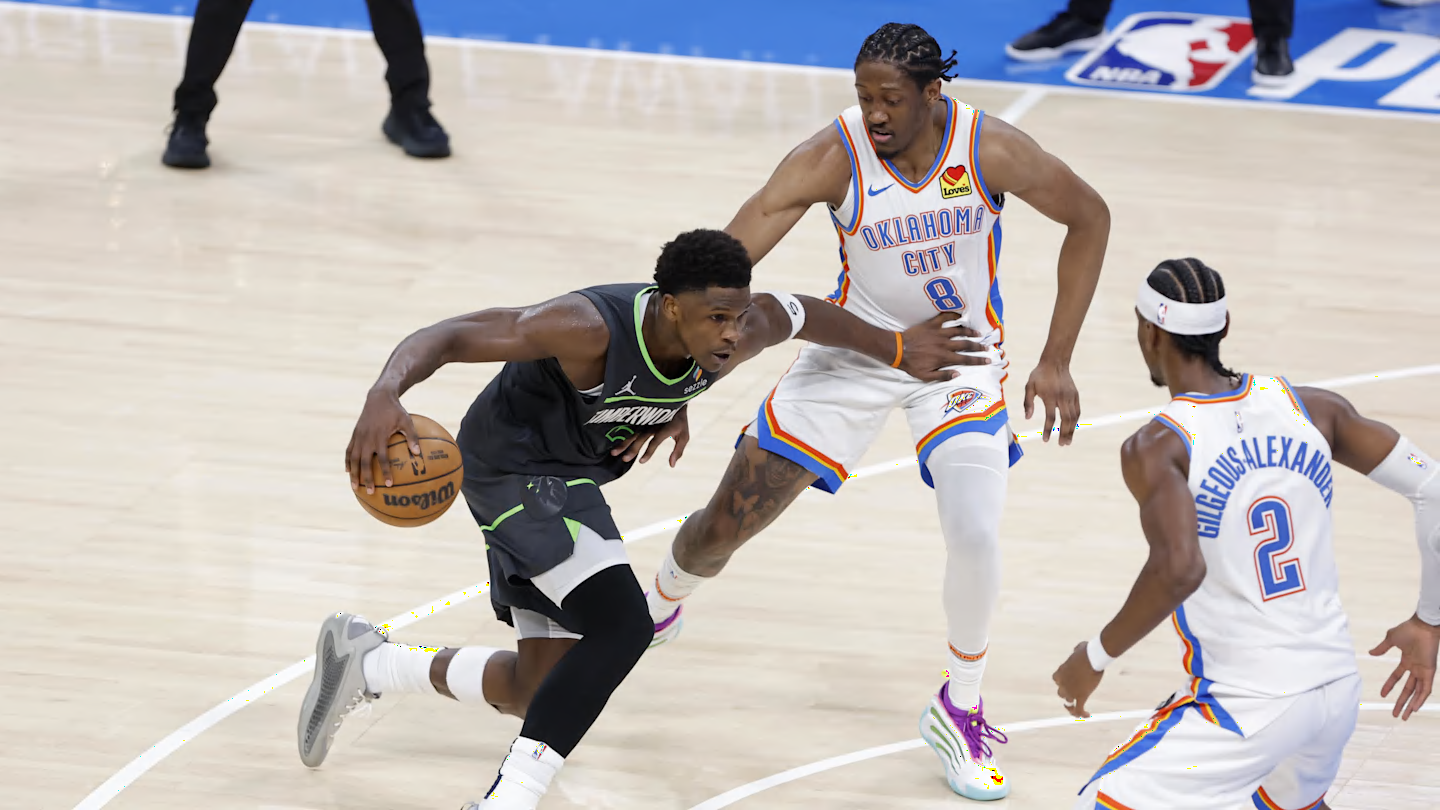
Pascal Siakam scored 10 of his 22 points in the fourth quarter to help the Indiana Pacers beat the Utah Jazz 112-111 for their fourth straight win.

SALT LAKE CITY (AP) — Pascal Siakam scored 10 of his 22 points in the fourth quarter to help the Indiana Pacers beat the Utah Jazz 112-111 on Monday night for their fourth straight win.

Tyrese Haliburton scored 18 for the Pacers, who played without Myles Turner after the center was a late scratch due to an ankle injury. Obi Toppin and Aaron Nesmith each had 13 points.

John Collins and Jordan Clarkson both scored 21 for the Jazz (11-37), who have dropped nine of 10.

Utah guard Collin Sexton sprained his left ankle in the opening minutes and did not return. Isaiah Collier and Keyonte George combined for 27 points and 21 assists but made errors down the stretch that showed their inexperience.

The Jazz led 101-89 on Collier’s 3-pointer with 6:52 to play, but were outscored 23-10 down the stretch as the Pacers turned up the pressure.

Takeaways

Pacers: Indiana had scored at least 130 points three games in a row but the Pacers’ long-range shooting deserted them (23.8% from 3). So they made their comeback by going inside and getting out in transition.

Jazz: Late-game mistakes cost Utah again. After Collins gave Utah its last lead at 106-105, the Jazz had two turnovers and missed two tough shots. Lauri Markkanen misfired on two free throws with 17 seconds remaining.

Key moment

With Utah down two and pressing, Andrew Nembhard found Siakam for a wide-open dunk with 5.1 seconds left to lift the Pacers to a 112-108 lead.

Key stat

The Jazz outrebounded the Pacers 60-37, but the Pacers forced 19 turnovers and scored 26 fast-break points to Utah’s 11.

Up next

The Pacers are at Portland on Tuesday night. The Jazz finish their four-game homestand against Golden State on Wednesday.

___

AP NBA: https://apnews.com/hub/nba

Source: Utah News

Indiana Pacers vs Utah Jazz live score updates: Cold-shooting Pacers stay close

Utah News! Image is of two women hikers overlooking Bryce Canyon.

The Indiana Pacers have four games against Western Conference teams this week, and they start the trip against the Utah Jazz. The Pacers (27-20) have moved into fourth place in the Eastern …

The Indiana Pacers have four games against Western Conference teams this week, and they start the trip against the Utah Jazz. The Pacers (27-20) have moved into fourth place in the Eastern …

Source: Utah News

‘Everyone’s really said just about all that could be said’ — Frustration rises as Utah HC’s losing streak reaches 5 games

Utah News! Image is of two women hikers overlooking Bryce Canyon.

The frustration in the Utah Hockey Club locker room is rising. Utah is now on a five-game losing streak after Sunday night’s 2-1 setback to the St. Louis Blues, with the last three losses coming at …

The frustration in the Utah Hockey Club locker room is rising.

Utah is now on a five-game losing streak after Sunday night’s 2-1 setback to the St. Louis Blues, with the last three losses coming at home.

Nothing Utah HC doing seems to be working, and the players are starting to recognize it.

“We’ve had a lot of meetings about this,” said veteran defenseman Ian Cole after the game. “I think that everyone’s really said just about all that could be said. At some point, it needs to get put in practice on the ice.”

Head coach André Tourigny agreed.

“You want to win,” he said after the game. “You want to find a way to cross the finish line and stuff like that. I don’t think we played that well today.”

The team is left looking for answers to more questions than just what it should be called next season. They have one game left in their current home stand, and its importance is not lost on Tourigny.

“It’s an extremely huge game for us (Tuesday) against Philly,” he said. “We need the two points; We need to finish the home stand at least at .500, hit the road and have a hell of a road trip before the break. There’s no doubt about it.”

Here’s a rundown of Sunday’s game.

How this works

This is a three-part article geared toward three different audiences.

  • First, we’ll have “Utah hockey for dummies” for all you new hockey fans. Welcome, by the way — we’re glad you’ve taken an interest in the greatest sport in the world.
  • Next, we’ll have a section titled “Utah hockey for casual fans,” aimed at those who have a basic understanding of the sport.
  • Finally, we’ll have “Utah hockey for nerds.” That will be for those of you who, like me, think about nothing but hockey all day, every day.

Feedback is welcome, so let me know what you think in the comments of this article or the comments section on “X.”

Utah Hockey for dummies

As mentioned in the pregame article, a number of Utah players have had great success in against the Blues in their respective careers.

Defenseman Michael Kesselring continued his offensive streak against St. Louis with Utah’s only goal of the game. He now has goals in all three games against the Blues this season and he has points in all four games he’s ever played against them.

“(I’m) a little lucky, I guess,” Kesselring said of his scoring tendency against the Blues. “It was nice to get one there.”

On the other hand, two point streaks came to an end. Nick Schmaltz had scored points in each of his previous 11 games against the Blues, while St. Louis-area native Clayton Keller had done so in each of his previous eight contests versus his hometown team.

It was not for a lack of effort. Keller and Schmaltz, who play on the same line, seemed to be feeding off each other all night. They were responsible for more than their fair share of Utah’s scoring chances, but they just couldn’t get anything past Blues goaltender Jordan Binnington.

It culminated in Keller’s third-period bomb on the power play. Upon receiving a perfect pass from Mikhail Sergachev, Keller let it fly and drilled the crossbar.

The puck went so high that the fans on the left side of the net thought it might fly above the netting and into their section of the stands.

Utah Hockey for casual fans

Since Connor Ingram’s return to the lineup, he has given his team a chance to win every time he’s tended the net. Utah has struggled to score though, which means he’s gotten credit for a few more losses than he’s deserved.

In his six games since returning, he has a .910 save percentage and a 2.50 goals-against average. He’s not the most technically sound goaltender, but he’s finds ways to make saves — and that’s what ultimately matters.

For example, nearing the halfway mark of the first period Sunday with Utah killing a penalty, Ingram made an excellent save in tight on Oskar Sundqvist.

Ingram was down and out, but he managed to get his stick in position to block Sundqvist’s next bid and keep the game knotted at zero. Ingram has given his team all the support in the world. The team needs to start returning the favor by scoring enough goals to win.

Utah Hockey for nerds

To the Blues’ credit, Utah HC’s biggest problem was something the Blues did well rather than something UHC did poorly: congest the offensive zone.

In the first two periods especially, Utah couldn’t get anything to the inner slot without five white sweaters blocking every lane. That forced them to either shoot from the outside or cough the puck up.

“We made some tactical adjustments after the second to build more speed through the neutral zone,” Tourigny said after the game. “We’re happy about the result and it’s something we’ll try to duplicate.”

According to Natural Stat Trick’s data, Utah controlled just 23.08% of the high-danger scoring chances in the first period and 33.33% of those chances in the second.

Statistically speaking, Tourigny’s adjustments worked in the third period: Utah HC had 83.33% of the high-danger chances in the third period.

What’s next?

Utah closes out its home stand on Tuesday as it hosts the Philadelphia Flyers.

The Flyers are in second-to-last place in the Eastern Conference standings, but there’s so much parity in the east that they’re only seven points out of the playoffs.

They made a big trade last week to acquire Jakob Pelletier and Andrei Kuzmenko, the latter of whom is due for a bounce-back season. He scored 39 goals and 74 points as a member of the Vancouver Canucks in 2022-23, but he hasn’t come close to that since.

Neither player has suited up for the Flyers yet. It’s unclear why Pelletier hasn’t played, but Kuzmenko is experiencing visa issues, according to NBC Sports Philadelphia’s Jordan Hall.

Being the last game of the home stand, it’s the last day to vote on the team name and branding.

Source: Utah News

What Utah showed in the first half of Big 12 play, and what lies ahead for the Runnin’ Utes

While Utah has shown through the first half of league play it is well behind the upper echelon of the Big 12 programs, there’s still that optimism that the Utes could — in theory — earn a first-round …

Perhaps fittingly, in the last game of the first half of Big 12 Conference play, Utah coach Craig Smith faced off against another head coach getting his first taste of Big 12 action this season.

Steve Lutz and the Oklahoma State Cowboys got the better of Smith and the Runnin’ Utes on Saturday afternoon, beating Utah 81-72 at Gallagher-Iba Arena in Stillwater, Oklahoma.

This gave the two schools a split of a pair of games during the first half of the conference schedule. Going into the midway point, the Utes are 12-9 overall and 4-6 in Big 12 action, while the Cowboys, under first-year coach Lutz, are 11-10 and 3-7, respectively.

The Utes, admittedly, missed a solid chance to pull even in league play after an 0-3 start. They were a slight favorite on the road, a rarity in the conference, especially for teams like Utah, who was picked to finish last in the Big 12 this season.

That leaves disappointment in Utah’s program following Saturday’s outcome, though Smith, in his own way, was able to reflect on a loss while focusing on how a determined, focused approach could pay dividends.

“We were picked 16th out of 16. Now, being a part of it halfway through, we have a better feel for what you need to have to really climb to where you want to go,” Smith told reporters after Saturday’s game.

“I’m sure Steve has seen the same thing, and I’ve certainly seen it. We have some really good things, but there’s some things that we have to add if we’re going to do what we need to do as we move forward.”

Going into the second half of conference play, which begins with a game against last-place Colorado on Wednesday (7 p.m. MST, ESPN+), the Utes find themselves tied with three other schools (UCF, TCU and Kansas State) at 4-6 in the conference standings.

They all sit one game behind eighth-place West Virginia.

In the Big 12 basketball tournament in Kansas City, which runs March 11-15, the league’s bottom eight schools will be forced to play in the first round.

Teams seeded five through eight earn a bye to the second round, while teams one through four have a bye until the quarterfinals.

While Utah has shown through the first half of league play it is well behind the upper echelon of the Big 12 programs, there’s still that optimism that the Utes could — in theory — earn a first-round bye if they can grab that eighth spot in the league standings.

It’s a slim margin of hope at this point for a team two games under .500, but it also reflects the uncertainty that surrounds the Big 12 for every team that finds itself outside the upper crust of schools like Houston, Iowa State, Arizona and Texas Tech.

“I love it. I think it’s an awesome league,” said Smith, who led the Utes through their final three years in the Pac-12 Conference. “The brand of basketball, I love the physicality of it. I love the athleticism of it, the skill level of it.

“Lots of well-coached teams, that’s just the whole thing. Great venues, being on the road, venues that are really hard, and you feel the presence at certain places. It’s awesome.”

The reality is, Utah — a once-proud program that hasn’t played in the NCAA tournament since 2016 — is living through the hard times of learning how “to show up every day” in the Big 12, often considered one of the best two or three leagues in the college game.

That’s been reflected in the number of blowouts Utah sustained during the first half of league play. In that disastrous start, the Utes lost three straight by an average of 25.3 points per game.

Then came a three-game winning streak, which began with the aforementioned victory over Oklahoma State when it visited Salt Lake City.

The Utes followed that with a victory at TCU — thus far their only true road win of the season — and a home victory over rival BYU in overtime.

“I’m a big believer you can talk the talk all you want, but you got to go walk the walk, and actions speak louder than words,” Smith said.

When exactly progress may or may not pay off for Utah is difficult to tell, especially in the now 16-team Big 12, which plays a 20-game schedule in 10 weeks.

There are few times to catch a breather during the conference stretch, and the Utes are also headed into the tougher half of their conference schedule, according to national metrics.

Torvik rates Utah as having faced the 11th-toughest schedule in Big 12 play so far, and over the next half, the Utes will face the ninth-toughest.

That may not seem like a significant change, but KenPom helps paint the picture of what lies ahead for Utah. Of the Utes’ final 10 games, KenPom has Utah as the favorite in four of them.

Their most favorable odds for a win are a 78% probability of beating Colorado at home on Wednesday. After that, in two of the other three games Utah is favored, the Utes are a narrow favorite over Arizona State (53%) and West Virginia (52%).

In its five remaining road matchups, the highest probability for Utah to win is 27% at UCF, according to KenPom. By those numbers, it’s fair to assess that things could get tougher in the back half of the schedule — ergo, victories could be even more difficult to come by.

For Smith, he’s embracing the challenge of rolling up his sleeves and getting to work, a mentality he’s lived in his coaching career that’s included head-coaching stops at Maysville State, South Dakota and Utah State before landing at the U.

“It’s not for the meek. You better have a strong backbone, and you better have a strong spirit, and you gotta have the fine line of learning right through disappointment and learning through victory,” Smith said of the Big 12 grind.

Part of that learning process, Smith said, is figuring out how to handle both prosperity and failures.

“You’ve gotta be able to handle prosperity. I think that’s the thing that people don’t talk about enough. I saw this quote a long time ago — for every 100 men that can handle failure, only one can handle success, and I really believe that,” Smith said.

A couple weeks ago, things were looking good, as Utah was on a three-game winning streak and had established a presence as a team willing to be physical in the post and run its offense through the paint.

“When things are going good, it’s easy to forget why it’s going good, and (be like), ‘Oh, we got this, so you gotta be able to handle prosperity, but then you gotta also be able to handle failure. Sometimes when you get down, it’s either easy to feel the loser’s limp, it’s easy to feel sorry for yourself, and you gotta respond,” Smith said.

Since that three-game winning streak, Utah has lost three of its last four, with the setback to Oklahoma State the only conference game thus far that the Utes have lost by single digits.

That loss is arguably also the most discouraging — after all, the majority of Utah’s losses thus far have come against tough teams in No. 6 Houston, No. 3 Iowa State, Texas Tech (which just beat Houston in overtime) and two against perennial conference power Baylor.

The key, Smith reiterated, is that Utah can’t let losses and disappointments of the past impact potential future growth.

“With 20 games in 10 weeks, you learn and it’s on to the next and if you’re still worried about a tough loss or you’re still celebrating a big win, it’s probably not going to be very good for you the next game so you’ve got to be able to learn, but you’ve got to have amnesia,” he said.

That’s the reality of Big 12 play — one that Utah is halfway through in its inaugural season, and one in which Smith is unabashed in desiring to be better while also understanding the adversity his team will face in the next five weeks, plus the conference tournament.

“It’s a heck of a league. So pumped to be a part of it,” Smith said. “With the league, just like we’re learning, right?”

Superlatives from Utah’s first half of Big 12 play

Best win73-72 vs. BYU, Jan. 18. The Utes rallied from an eight-point second half deficit and used a physical presence inside to take the fight to the Cougars.

Ezra Ausar had 21 points, while guys like Hunter Erickson and Keanu Dawes made clutch plays at critical moments as Utah beat BYU for the second straight time.

This victory looks even better, considering BYU has won four straight since.

Worst loss — 70-36 at Houston, Jan. 22. While the Cougars are a headache for everyone they face and create issues across the board, it’s the way the situation unfolded that was discouraging.

Just four days after Utah had beaten BYU, the Utes went to Houston and were manhandled by a suffocating Cougars defense and rarely showed much fight. It resulted in the lowest-scoring game for Utah in more than a decade.

Best development — Ezra Ausar coming into his own. Ausar, the East Carolina transfer, had shown flashes of his potential to take over the paint during nonconference play.

In league action, he’s started to be even more assertive overall, though there’s still consistency needed from the closest thing the Utes have to a go-to player.

Ausar has averaged 15 points over the last five games, and that even accounts for a 1-point game against Houston.

Biggest issue – Turnovers. While Utah has defensive troubles keeping up in the Big 12, turnovers have been especially problematic.

The Utes are worst in the league in turnover margin at minus-6.2, well behind the second-worst team (Colorado) at minus-4.4. Utah is giving up 14.6 turnovers a game, and teams have consistently turned those takeaways into points.

What lies ahead — The Utes will play five home games and five road games over the next five weeks. That slate includes a road game at Arizona, two contests against previously ranked West Virginia, and the highlight — a home game against No. 11 Kansas on Feb. 15, as well as a road game at BYU to finish the regular season.

Source: Utah News

Oklahoma State Bounces Back Against Utah for Third Big 12 Win

The Cowboys got back into the win column for the first time in two weeks. On Saturday, Oklahoma State beat Utah 81-72 in Gallagher-Iba Arena in Stillwater. The …

The Cowboys got back into the win column for the first time in two weeks.

On Saturday, Oklahoma State beat Utah 81-72 in Gallagher-Iba Arena in Stillwater. The win snapped a three-game losing streak for the Cowboys and was their third conference win.

Riding a losing streak and coming off of the biggest loss of the season only three days earlier, the Cowboys got a much-needed performance from their longest-tenured player. Bryce Thompson led the Cowboys in scoring on Saturday, dropping 20 points on 6-of-10 shooting, including a 4-of-4 mark from beyond the arc. Beyond Thompson, Marchelus Avery also chipped in for OSU, scoring 17 points as the only other Cowboy to score in double figures. 

While the game was relatively close throughout, and OSU never led by more than 15, Utah never had a lead. OSU held Utah to 40% from the floor and 25% from beyond the arc.

Although the Cowboys played solid defense, they struggled with keeping Utah off the line. The Utes shot 30 free throws, making up a large portion of their offense. Still, OSU managed to get a solid whistle on the other side, taking 36 free throws in the win.

While it wasn’t a perfect performance from the Cowboys, it was a showing that should leave some optimism for fans. The Cowboys have three conference wins, albeit against some of the worst teams in the Big 12, and all coming at home.

However, getting wins in conference play, considering the state of the program, is an important step to building something special. OSU fired its coach after seven seasons, waited weeks to hire a new one in the middle of transfer portal chaos, and had to fill out a roster of almost entirely players coming from another school. 

Despite all of that, OSU secured its third win in the Big 12 on Saturday and has remained .500 or better for the entire season. The Cowboys will look to continue that trend for the rest of the season in the tough Big 12. They will take the court again on Tuesday when they face Houston on the road.

Want to join the discussion? Like Oklahoma State Cowboys on SI on Facebook and follow us on Twitter to stay up to date on all the latest Cowboys news. You can also meet the team behind the coverage.

Source: Utah News

Opinion: Newborn blood retention policy raises constitutional concerns in Utah

Rather than destroy the paper cards used to collect bloodspots for newborn testing, Utah keeps the samples without telling parents, creating a secretive database with potentially millions of entries …

New parents are careful who they invite into the hospital room after a delivery. Doctors and nurses have permission to enter. Friends and family, too. But what about police officers, for-profit research companies and the Pentagon?

Under state law, all of these third parties have backdoor access to the blood of every Utah child. The intrusion starts within 48 hours after birth, when maternity ward workers prick an infant’s heel to collect blood for laboratory testing.

The mandatory screening allows for early detection of rare conditions like cystic fibrosis and sickle cell disease. This testing is uncontroversial. All states do it — and the results no doubt save lives.

But afterward, rather than destroy the paper cards used to collect bloodspots, Utah keeps the samples without telling parents, creating a secretive database with potentially millions of entries.

Parents cannot opt out. Once the Utah Department of Health receives the paper cards, state law says the blood becomes the property of the state. If parents refuse to participate, they can face charges of medical neglect.

Utah currently keeps the blood for seven years. But information from the paper cards remains on file for 22 years. The state does not say precisely what happens during this period, but the potential for abuse is high.

Plaintiffs caught Texas officials turning over DNA data to the Pentagon for a national registry. Michigan was selling newborn blood for research. So was Minnesota. Court rulings forced all three of these states to stop.

More recently, New Jersey was caught turning over infant blood samples to police agencies without a warrant, leading to criminal charges for at least one father. Our public interest law firm, the Institute for Justice, represents New Jersey parents in a class-action lawsuit to stop the abuse.

Erica Jedynak and another New Jersey mom are leading the fight. Jedynak says she was blindsided when she learned the state was keeping her son’s blood for unknown purposes.

“There is something morally not right that the government would be tracking him or almost assuming the guilt of babies,” she says. “I have to protect him from what appears to be a very creepy database.”

The Constitution provides ammunition in her fight. The Fourth Amendment guarantees the right to be secure against unreasonable searches and seizures. If states want to keep blood in a government database, it can. But first, the state needs a warrant or parental consent.

The first option is a nonstarter. No judge would sign off when no crime has occurred. This just leaves consent. To satisfy the Constitution, this consent must be voluntary, informed and obtained before a state retains blood.

Some jurisdictions respect parental rights in this way. Indiana, for example, asks parents whether it can retain their children’s bloodspots for specific medical research purposes. If parents decline, their child’s bloodspot is destroyed.

Delaware and South Dakota enforce similar policies. But holdouts, including Utah and New Jersey, remain. In both states, the government has taken the choice about retention away from parents, claiming the government should automatically keep the blood of every child in a state-run facility.

Technically, New Jersey parents can opt out by asking the state to destroy the bloodspot. Utah previously allowed this, but the state no longer accepts requests for destruction because it says the policy is “undergoing legal review.”

Courts in other states have rejected the “opt-out” model. As a Michigan judge explains: “The silence of (parents) might well have been the product of the opacity of the system, the infants’ nascent existence in the world, or the result of the overwhelmed state of their new parents.”

In other words, parents cannot opt out of something they do not know exists.

Utah must fix its unconstitutional retention program. Blood belongs to the individual, not the state.

Source: Utah News

Utah State humbled in a big way in showdown against New Mexico

Utah News! Image is of two women hikers overlooking Bryce Canyon.

And nothing went right for the Aggies after Allen’s score, as the Lobos went on an 11-0 run and scored 21 of the next 26 points on their way to humbling Utah State, 82-63, in front of a sellout crowd …

And nothing went right for the Aggies after Allen’s score, as the Lobos went on an 11-0 run and scored 21 of the next 26 points on their way to humbling Utah State, 82-63, in front of a sellout crowd …

Source: Utah News

Clippers trade P.J. Tucker and Mo Bamba to Utah for Patty Mills and Drew Eubanks

The Clippers also ship out a future second-round pick and cash in a deal that puts them below the luxury tax with an eye potentially toward the trade deadline …

The Clippers also ship out a future second-round draft pick and cash in a deal that puts them below the luxury tax with an eye potentially toward the trade deadline.

Subscribe to continue reading this article.

Already subscribed? To login in, click here.

Originally Published:

Source: Utah News